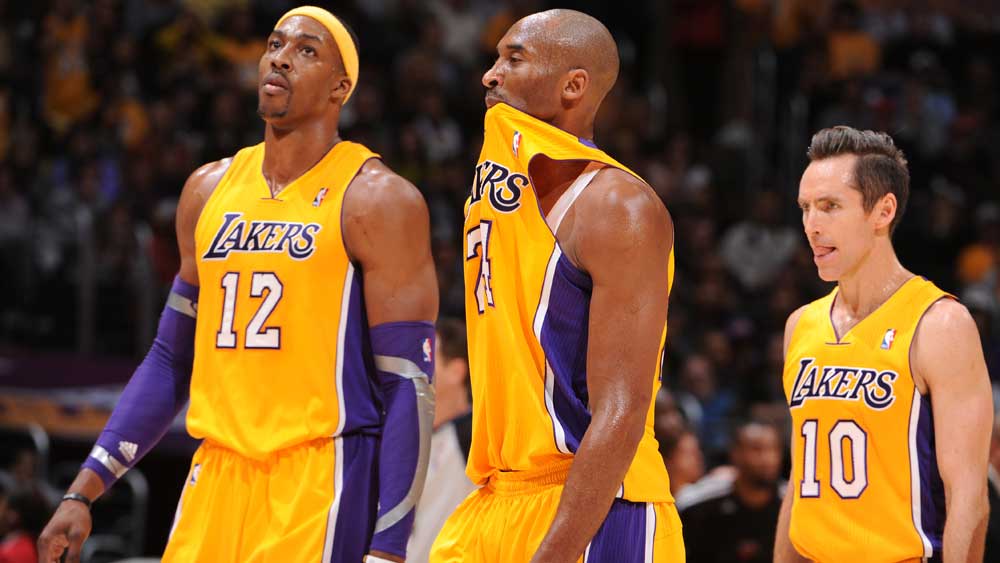

Everyone has an opinion on the fumbling, stumbling Los Angeles Lakers. Even the guy who details their cars while they’re at practice. That’s been Rudy Mendoza’s gig for 13 years now.
The native of South Central got his job in the most L.A. of ways: He got to know someone (he did security work for actress Vanessa Williams) who knew someone (her ex-husband, former Laker Rick Fox) who introduced him to someone (Shaquille O’Neal) and a decade later he spends most of his days at the team’s practice facility in El Segundo putting a shine on rides like third-string point guard Chris Duhon’s bright yellow Lamborghini Gallardo at $35 a pop, working out of a beaten-up white trade van that has its own water tank, a mountain of rags and every car-cleaning supply known to man. Like seemingly everyone in Los Angeles, Mendoza, 43, has been a Lakers fan since birth.
“My favourite player was Jim Chones, I don’t know why,” he says, referring to the journeyman power forward on the 1980 Lakers championship team that introduced the world to the Magic Johnson Showtime era. And like almost everyone, he thought the current edition of Southern California’s favourite team would roll to its NBA-leading 17th championship behind its Fantastic Four: incumbents Kobe Bryant and Pau Gasol—the backbone of the Lakers’ 2009 and 2010 title-winning teams—bolstered by the off-season additions of Dwight Howard and Steve Nash. Easy peasy.
But as the NBA season comes out of the All-Star break and heads for the home stretch, Mendoza finds himself in a most unlikely position: Detailing cars for the Lakers, yes, but detailing the cars of a Lakers team that sucks. The cars remain pristine, but L.A. is on course to spend $128 million on player salaries and luxury taxes—nearly double the league average—and not make the playoffs.
Like everyone, Mendoza has a theory for why a roster that features a combined 37 All-Star Game appearances, eight championship rings, four Defensive Player of the Year awards and three Most Valuable Player nods headed into the break 10th in the Western Conference and a distant second-best at the Staples Center, behind the Los Angeles Clippers: “Dwight and Kobe,” he says while taking a pause from waxing a Bentley Continental GT. “Man, they need to find a way to coexist.”
To which I can only add, after spending a week in Laker-land, good luck with that.
It would be wrong to say that no one saw this coming, though the pre-season caveats were generally lost in a torrent of optimistic gush. “Now this is going to be fun” was the headline splashed across Sports Illustrated’s NBA preview, featuring Howard and Nash on the cover. A survey of NBA executives picked the Lakers as the third most likely contender to take home the Larry O’Brien Trophy in June, behind only the defending champion Miami Heat and finalist Oklahoma City Thunder. The contributors at Lakers fan blog Silver Screen and Roll captured the mood of Lakers nation as seven of their eight contributors picked L.A. for the title; the eighth picked them to go to the finals.
But some were more cautious in their optimism. Take Nash for example. His surprise acquisition from erstwhile rival the Phoenix Suns preceded the trade for Howard by a month. Either deal would have been considered a home run for Lakers GM Mitch Kupchak as he tried to leverage the best of the remaining peaks of Bryant and Gasol—combined, they made Kupchak front-runner for executive of the year. But Nash never completely bought the idea the regular season was a warm-up to a deep playoff run, as he peppered his predictions with “on paper” and “theoretically.” After 16 years in the league, he knows that while talent is essential to winning, it’s not a guarantee (Toronto Blue Jays fans take note). Not that he’s in any position—having just signed a three-year, $27-million contract at age 39—to chortle about his foresight.
“I’m not going to sit here and say I knew we weren’t going to be good. I thought we were going to be very good, but I always thought we had a lot to work through,” Nash says after practice, fresh off a drama-filled 12-day road trip while the Staples Center was hosting the Grammys. “I was very optimistic, but I thought it was going to take us time and we didn’t know how guys were going to fit together concerning their personalities and mentalities. I wasn’t saying 73-9 or whatever.”
And that was before all the befores:
* Before the Lakers went 0-8 in the pre-season and started the regular season 1-4, which led to the dismissal of Mike Brown, the hiring of Mike D’Antoni and, perhaps just as significantly, the decision not to hire Phil Jackson.
* Before Nash missed 24 games with a broken leg and associated nerve damage, delaying the integration of the pick-and-roll-based attack he was so successful running for D’Antoni in their glory years in Phoenix.
* Before Gasol chafed at coming off the bench and struggled with tendonitis in his knees and eventually tore a tendon in his foot, putting him out for the season, most likely.
* Before Howard looked so sluggish coming off back surgery in the off-season and before he tore the labrum in his shooting shoulder.
* Before Bryant told a reporter in early February that when it comes to said shoulder—an injury that won’t heal without rest but can’t be made worse by playing—Howard should man up and get on with the business of winning basketball games. (It’s a view echoed by Nash, normally the most gracious of teammates, and by D’Antoni, who made a point of saying that Howard was medically cleared to play even as he sat out a stretch of three road games.)
* And before Howard, already upset that he wasn’t the primary focus of the offence—he famously walked around the Lakers dressing room at one point this year, pointing at a stat sheet, complaining, Shaq-like, that the big dog needed to be fed—shot back with: “Kobe’s not a doctor.”
* And before Howard’s father told his hometown newspaper that the latest mess was D’Antoni’s fault for not having control of his team.
* And before the Lakers longtime owner, Jerry Buss, succumbed to cancer, casting a pall over the team as it returned from the All-Star break.
Complicating matters as the Lakers struggle on and off the floor is the fact that the organization, even going back to the Magic Johnson era, has never really gone for the “keep it in the room” adage that most professional sports teams try to adhere to, unless the room is a talk-show set with a crushing media contingent as the live studio audience.
“It’s complete basketball anarchy,” says Los Angeles Times beat writer Mike Bresnahan. “I don’t think there’ve been two quiet days, back to back, since the season started. It’s exhausting but also kind of—I guess exhilarating is the right word. You just never know what’s going to happen.”
Consider the scene facing D’Antoni on his first day back from their long, eventful road trip. Troubles aside, the club was beginning to show signs of clawing its way out of the hole they’d dug to start the season, but instead of on-court progress, the L.A. media wanted to talk off-court distractions. If there was something going on between Kobe and Dwight, would D’Antoni step in and correct it?
“I don’t know,” D’Antoni said in his Appalachian drawl, which he typically uses to “aw shucks” his way out of awkward situations. “Do I get an elephant gun and shoot ’em?” (He was joking. No Lakers coach could get away with shooting Bryant.)
“[Look], we’re not going to play out what we do in the locker room or how we coach or how we should play in the media. That’s been our problem,” he said. “And I’m really surprised, here in L.A. that seems to be the norm, that you don’t talk to each other—you talk to the media. And that’s not good. In New York [where D’Antoni last coached with the Knicks] the media would try to pry in and stuff, but not like this. This is different.”
This is L.A.
There are all kinds of reasons why the Lakers should be an elite club, but most of them centre around Bryant and Howard. In Bryant the team has one of the game’s ultimate shot creators and closers, whose hunger for a sixth championship, which would pull him ahead of Magic and tie him with Jordan, gnaws at him even in his 17th NBA season. In Howard, the club has the kind of interior presence that has anchored each of the Lakers’ championship teams, a nearly unbroken line running from George Mikan to Wilt Chamberlain to Kareem Abdul-Jabbar to Shaquille O’Neal to – more recently – Gasol. With Howard 27 and theoretically just entering his prime, it looked like a perfect marriage: Bryant would teach him the Lakers way and step aside after a couple of years and a couple of championships so his protegé could shoulder the franchise alone. The highly-skilled Gasol would complement Howard on the offensive end and Nash would provide the ball-handling fairy dust to bring it all together.
It’s not happening. In the Lakers locker room, Bryant and Nash, who came into the league together in 1996 when Howard was in fifth grade, hold down the far left corner of the room. Gasol, injured, is nowhere to be seen. Howard holds court on the far right—worlds apart, in other words, from Bryant, and it’s not just a handy metaphor.
The Lakers’ struggles can be laid at the feet of all kinds of legitimate basketball factors, from a dearth of elite perimeter shooting—L.A. ranks a mediocre 15th in three-point percentage—to injury woes to defensive indifference to a lack of depth. On a technical level, they’ve become a team that plays upside down on most nights. Howard wants his touches in the post while Bryant is accustomed to getting the ball in isolation and dictating the play from there. Nash’s gift is controlling the ball in such a manner that he can create enough holes in the defence and reward his teammates with easy baskets. Partner him with an alert, quick-moving big man to set screens and he’s been unstoppable in the past. Now? It’s gotten to the point where Bryant often dominates the ball, but in order to be a playmaker—he even hogs assists.
In one game before the break, Bryant – who has taken more shots than any other NBA player over the course of his career – didn’t take a shot until the third quarter. He finished with eight assists, but also rang up eight turnovers while his teammates looked at him like they’d suddenly discovered Dad wearing Mom’s lingerie. Meanwhile, Howard has yet to mesh with Nash as a screener, meaning the two-time MVP often has little choice but to accept his role as an undersized three-point shooting specialist who occasionally runs the point.
“I still feel like I can do pretty much everything I’ve ever done. I show it on a night-to-night basis, just on a very small window,” he says. “But at the same time, to sit here and complain about opportunities would further hinder our growth and finding our identity. For me it’s important for my well-being to just shut up and play.”
Well, that makes one.
But their status as a team that is decidedly less than the sum of its superstar parts is best explained by the philosophical divide between the two cornerstones—a gap Howard can never expect to bridge without “conforming to the brand” as former Laker James Worthy describes it. Bryant holds sway over the Lakers kingdom like a child prince who has grown into the throne, which pretty much captures his career arc from presumptuous 17-year-old prodigy to 34-year-old veteran who’s earned a massive share of the franchise’s psychic equity. The kid is now an old soul who enjoys making basketball seem like work and taking pride in his pre-dawn workout regimen. He’s the only Laker who doesn’t participate in the rehearsed pre-game handshake/dance routines that are part of the NBA fabric. Even Nash did a little stutter-step shuffle before dapping it up with shooting guard Jodie Meeks during introductions before a recent game. Bryant strides from his seat, stone-faced, as if there’s coal to be scraped out of some deep, dark mine.
I asked Bryant, would I like playing with him?
“Probably not, but you’d like the results,” he said. “But it depends on your personality. If you’re a guy that’s demanding of yourself and likes the pressure and the hard work every day, yeah, it’s fun. You might get your feelings hurt, but it’s a matter of: Do you have the competitiveness and the drive to meet the expectations that I put on you to be successful and do what we need you to do to be successful? If you can’t stand that, if you can’t measure up to that, you’re going to have a hard time.”
Howard is having a hard time. Pinpointing just why is tricky. His numbers, while fractionally off from his best years in Orlando, are still the stuff of an elite NBA centre: He leads the league in rebounding, is fourth in field goal percentage and fifth in blocks, and is second on the Lakers in scoring. From all appearances he’s been diligent about regaining his athleticism after back surgery. In the week I spent in L.A., Howard was always the last Laker off the practice floor after doing punishing additional conditioning drills, punctuated by gym-rattling grunts.
“The guy’s amazing. There are not enough weights in the building for him,” says Lakers strength and conditioning coach Tim DiFrancesco.
Still, there’s something missing. He rarely makes a second effort on offensive rebounds. If he doesn’t get the ball when rolling the lane, his hands fall in disappointment. He got in a heated on-court shouting match with Nash during the Lakers’ recent loss to Miami after Nash scolded him for not moving to an open spot for the ball when he was trapped.
“Not a big deal,” says Nash. “Everyone on our team has gotten pissed at someone at one time or another and that’s the way the game is.”
But it’s not the way Howard’s game is. Few athletes fit the “man-child” description better. During Lakers games, the team runs a feature on the video screen called “My Lakers Profile” where players talk about their favourite movies, food and hobbies. Boring stuff. But Howard’s is like performance art. His favourite movie, he says, is Finding Nemo, before breaking into impersonations from the 2003 animated hit. He panders to his new SoCal fan base by claiming to like surfing and skateboarding, wrapping up the bit with a Jeff Spicoli–quality “Hey duuuude, hang 10.” It’s harmless fun if a guy is performing at a peak level – it’s not like Shaq was above cutting up – but Howard’s easy smile on the video board is in sharp contrast to what’s unfolding on the floor below. This could be a problem for the Lakers given their goal of signing Howard, a free agent this summer, to a five-year, $120-million contract in the hopes that he’ll earn his place alongside the team’s championship-winning basketball Mount Rushmore. Howard has given little indication that he wants the throne, or is capable of handling the responsibility. The Lakers and their fans will tolerate all kinds of personal quirks—Magic partied and smiled and worked behind the scenes to get his first coach fired—as long as winning a title remains front and centre.
“People take that smile the wrong way,” Howard says while standing at his locker after a Lakers win over the Suns, a massive ice pack on his injured right shoulder. “When I was in Orlando, I had a smile on my face, I had fun and I put that whole team on my back and took them to the finals, and I did that without growling at folks or cussing everyone out. I was just me, every night. That’s all that matters. There’s no way I should be a certain way because a certain guy is this way. Every guy has a different personality. You should never want to take the fun out of someone’s life or game.”
Which is why there is a growing belief that for all the upheaval the Lakers have suffered through so far this season, the worst is yet to come. Privately, those close to the team share the views that Rick Fox – part of the chorus of former Lakers who regularly weigh in on the team through the media – made public prior to the All-Star break: “He’s playing like a guy who doesn’t want to be here.”
That’s hard to imagine. It’s part of the natural NBA order: Big men migrate to L.A. like birds fly south in the winter, but Howard might be the one looking to get out. The fans can sense it and he’s taking his share of heat.
“Because I haven’t signed a deal, I’m assuming that’s why,” Howard said when he acknowledged that Lakers fans have been slow to warm to him. “Is it sort of like dating but not getting married? That’s close.” A potential breakup could set up a level of drama and franchise-altering intrigue that would make this season seem quaint.
Could it happen? Back in the Lakers parking lot, Rudy Mendoza shudders at the thought. He believes that things will fall into place soon enough.
“We might be in too deep a hole this season, but next year will be OK,” he says. But the owner of the The Detail Company might be missing the biggest clue of all. The only car he doesn’t primp and polish in the Lakers’ stable of extravagant automobiles is the blue and tan Maybach 62S belonging to Howard.
“He gets that done somewhere else, I guess,” says Mendoza.
Howard loves his ride. It’s long and fast and quiet, a perfect haven where he can stretch out his back and tune out the noise that seems to be forever swirling around the team. He spends his time in traffic sleeping or reading on his iPad Mini—“stuff on spirituality, how to be a better man,” he says—on the 45-minute commute between work and his residence in Bel Air.
“It’s nice there,” he says. “But I’m renting for now.”
And the car? It’s the only one in the Lakers parking lot that comes with its own driver, and the driver—idling laws be damned—he keeps that car running. Better for a quick getaway, I guess.
This story originally appeared in Sportsnet magazine. Subscribe here.