
This story originally appeared in Sportsnet magazine. Subscribe here.
Dario Franchitti, the fastest man on any American roadway this evening, tempers the urge to redline his grey Toyota Corolla rental and treat this Alabama interstate like his own personal racetrack. Instead, he watches his speed and increases the distance between Dario Franchitti, the humble man chauffeuring himself to dinner, and Dario Franchitti, the three-time Indy 500 winner with the James Bond mystique.
It’s six o’clock. Franchitti is hungry, tired and in considerable pain. He can’t turn his head to check his blind spots and it’s less than two weeks to the 2013 IndyCar season’s inaugural race, in which he’ll crash out and finish last. Outside it’s cool, rainy and altogether miserable as he pulls into the parking lot of the Mizu Japanese Steakhouse, an unremarkable sushi joint in a suburban strip mall outside Birmingham.
He has come here because he wants to eat the same meal in the same restaurant as he did last night. And if he has his way, he will come again tomorrow and order yet another 26 pieces of sushi. It’s not the menu that keeps him returning but the familiarity that comes with the repetition, which comforts the soul of a man who spends his nights dreaming about circling an oval over and over and over again.
For the next two days, the four-time IndyCar champ will test both himself and his Honda-powered Chip Ganassi race car against the 24 other cars and drivers competing for this year’s championship. He will drive fast, try new tires and suspension coils, and re-acclimatize himself to the 1,550-lb., 650-hp machine that has nearly killed him on multiple occasions. Last year, Franchitti arrived for testing and found his car was significantly slower than those of his Chevy-powered rivals. Seven months later, he lost the championship for the first time since 2009, finishing 105 points behind Ryan Hunter-Reay.
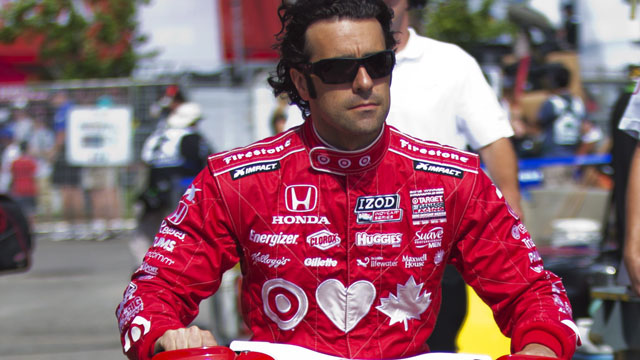
But today, Franchitti hasn’t even looked at the car he hopes will carry him back to the top. He has spent eight hours being herded through the pouring rain to a myriad of five-minute interviews with journalists who have all asked him variations of the same lunchbox questions. He has exuded the poise they have come to expect from the man formerly known as Ashley Judd’s husband. But at some point, he doesn’t know when, he turned his head to look at a camera and aggravated his neck. He is in pain but doesn’t show it. He smiles, jokes on camera and cusses off, but always with a lyrical Scottish accent that make his vulgarities endearing.He appears charming, especially when wearing the names of his team’s sponsors. Today he has been Dario Franchitti: former king of the IndyCar circuit; the chiselled-chin Scot with the Italian name, dark eyes and even darker curls. The guarded man with the public persona, currently avoiding queries about his divorce from his Hollywood wife. The face of his sport, his team and its sponsors—Target, Energizer batteries, Maxwell House and Huggies included. Such is the reality for a man who gets paid millions to be covered in corporate logos and race fast cars around some of the world’s most treacherous tracks. But now night is falling and Franchitti is done playing the roll of a walking billboard. And if he didn’t have to dine with another journalist, he might actually enjoy his sushi in peace.
The rules for dinner—and the longest one-on-one interview he’ll do all year—with the biggest name in the IndyCar paddock have been laid out by his handler: “Dario will have dinner with you. But don’t ask him about Ashley or he won’t want to talk to you.” Understandable, considering Franchitti is currently sorting through the particulars of who gets which part of the couple’s estimated $72-million estate. Franchitti parks the Toyota and enters the restaurant in jeans, suede shoes, a grey cashmere sweater and a tan scarf. He sports no logos, other than the one on his wrist: A Dario Franchitti special-edition TW Steel watch, the type you too can buy for $950.
The questions start easy:
“What have you done to your neck?”
“I don’t really know,” he says, rolling the “r.” “It’s all connected to an old injury.”
That was back on Feb. 9, 2000—long before he ever won the Indy 500 or any of his four championships—when the rear right wheel flew off his car as he turned into a bend at the Homestead-Miami Speedway. He hit a wall head-on, smashed his hip, broke his pelvis, suffered contusions on his brain and some sort of chronic injury to his neck. “I can’t even turn my head right now,” he says. Some might think this a threat to the career (and life) of a man who is routinely subjected to four times the Earth’s gravitational pull and who rounds corners at upwards of 300 km/h. But Franchitti plays it down. “As soon as the chiropractor goes crack with his hands, I’ll be good to go.”
His words linger over the table as he breaks from the questions and orders enough sushi to feed a seal.
After just a few moments in his presence, it is clear that Franchitti is the type of person most men wish they’d grown up to be. He is rich, famous and ruggedly handsome. He has a fleet of exotic and classic cars, helicopters and motorcycles, and he lives part-time in a Scottish manor. On some level, he is the man James Dean, Paul Newman and Steve McQueen all pretended to be.
But as soon as the waiter leaves, Franchitti confirms that he does not live a fully charmed life. He says he contemplated quitting after he broke his pelvis and damaged his brain. The 1999 crash that killed his best friend, Canadian Greg Moore, was still fresh, but he recalls having decided then that he would keep racing until the day he woke up and realized he didn’t want to do this anymore. He assumed that day would have come by now. Two months shy of his 40th birthday, Franchitti is the second-oldest driver in IndyCar. But he insists, “So long as I can win, or at least perform at a high level, I’ll keep on going.” And so, with little left to prove, he does, advancing ever higher up the list of the all-time greats.
The son of a local ice cream maker/go-kart enthusiast, he was three the first time he got on a motorbike outside his house in the outskirts of Edinburgh and 10 in the summer of 1983 when he blew up his first go-kart. “They thought I was just going to toy around on the track,” he says. “But by lap three, I’d kind of blown the thing apart because I’d been going flat out.” It’s a distant memory but one he seems to cherish. A funny anecdote to counter the weightier truth that his parents once mortgaged their house to invest in their son’s racing career. There’s a story that has been repeated in the press about how his father once got so enraged by his son’s poor lap times at the kart track that he just drove off and left him to find his own way home. Thinking about that, Franchitti closes his eyes and shakes his head, albeit gently, so as not to hurt himself.
“Is it not true?”
More gentle head shaking. He suddenly seems irritated.
“Do people write a lot of lies about you?”
“Oh God, yeah,” he says. “There was a whole book written that was a load of garbage.”
That book is just one of the reasons he doesn’t talk publicly about his personal life. Years back, there were also rumours published that his mother-in-law, Naomi Judd, had disapproved of his marriage to Ashley for fear that Franchitti might kill himself on the track and leave her a widow. He has lived far too long to think himself immortal and says he’s somewhat scared every time he gets in a race car, and that any competitive driver who says they don’t think about death is lying. On four different occasions, he says, he truly feared for his life. “I broke my back once riding a motorcycle,” he says, casually dropping a piece of sushi in his mouth before continuing the tale. “I had this MV Agusta Senna racing bike that was just lying in my front hall. It had been in the dealership, they had done something to repair it, supposedly, and I took it out and suddenly it broke on me. It had been leaking oil onto the back tire and I got to a corner and I went to turn and it didn’t turn. So I went through a hedge. Landed on the back of my head. Fractured my spine.”
Ten weeks of pain was followed by surgery and three months in a body brace. There have been other accidents, too. Big ones, including one in which Dan Wheldon collided with Franchitti’s rear tire, propelling his car into the air at what he estimates to have been 320 km/h. “It was terrifying, being up in the air and not knowing where you’re going to land. Six days later, I hit a guy at the finish line and I flipped over again. I was OK getting back into the car after the first one, but after the second one, I was a little freaked out. But then I got back in and won the next race on that style of track—so I guess I managed to do my job.”
Further emphasizing the less-than-glamourous side of his life, Franchitti talks about waking up many days in a trackside motorhome and lying in bed at night struggling to scribble down ideas to make his car go faster. He insists he doesn’t think he’s any better than the other drivers. Perhaps more experienced and maybe a little calmer, but not better. “You’ll know when I’m mad because I’ll explode on the radio and that Scottish accent will become really thick. But it’s very rare. You’re never a better driver when you’re enraged.”
When asked about a perfect day away from the track, he says it would begin with walking his dogs. He pulls out his iPhone and shows a picture of him cuddling with a cockapoo. “That’s me and Shug. It’s Scottish for Hugh. And then here’s the boy, Buttermilk.” They are the same two cockapoos that have been publicly photographed with him during celebrations along the start-finish line of the Indianapolis Motor Speedway. “That was him yesterday,” he says, stopping at a photo of Buttermilk, his fur blowing in the wind. “Ashley sent me that. They stay in Nashville with Ashley. They have a great life there. That’s their home. I’ll go visit.”
He’s getting somewhat emotional about the dogs, but a question about his car collection transforms him back into the embodiment of cool. He says he has a special relationship with the three pace cars he has been awarded for each of his Indy 500 wins. He likens them to trophies and hopes to add another to his garage this year. If he does, he will tie the record (currently shared by A.J. Foyt, Al Unser and Rick Mears) for most Indy 500 victories in history.
He talks of his plans for tomorrow and the next day. Says he’ll wake up, go to the track, have a cup of green tea and a bowl of yogourt before zipping on his race gear and strolling down the pit lane. He doesn’t say it but he knows that, once there, he’ll be a walking billboard again, the face of his sport, surrounded by photographers. They will snap him as he ties his shoes, applies his nasal breathing strips and stares off over the track. And they will capture every moment as he squeezes his body into the tight cockpit.
Tomorrow, he will spend far less time driving the car than he will just sitting in it while mechanics conduct experiments on all aspects of its set-up. His only excitement: the few occasions when his engineer will clear him to take the car out. Then he’ll shoot around the track once, maybe twice before coming back in and waiting for the next experiment to begin. When the day is done, he will have described to his engineers every problem he felt with the $1.4-million machine they have built for him.
Then he’ll do it all again the next day, when he’ll find himself chasing down Hunter-Reay’s Chevy-powered car. He’ll try to keep up with the man who last year took his title away. But again, he’ll find himself slower. Then he’ll run wide on a corner, put his tires into the dirt, and launch a rock straight through his radiator. Back in the pit, he’ll climb out of his cockpit and inform his race engineer that he can’t turn his head. The pain persists. But that doesn’t matter, because the man Franchitti needs to beat is no longer behind him.
Brett Popplewell is a senior writer at Sportsnet magazine