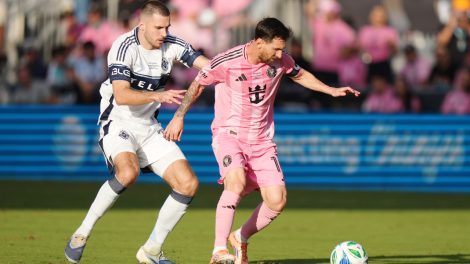

Montreal striker Marco Di Vaio is leading the charge for a new breed in MLS: veteran Europeans who actually deliver
Aron Winter used to be Marco Di Vaio’s chauffeur. A future Toronto FC coach driving a future Montreal Impact star around. Honest.
When Winter transferred from Dutch side Ajax to Lazio in 1992, Di Vaio, then a member of the Serie A club’s youth academy, was living in Winter’s Rome neighbourhood. The teenager had trouble getting to Lazio’s suburban training facility each morning, so Winter, then a Dutch international of some repute, offered the young apprentice a ride.
At first, the star midfielder would stop by Di Vaio’s house and pick him up in the morning. But soon the kid started showing up at Winter’s place, gym bag in hand as the Dutchman stepped outside his door, ready to pepper Winter with questions as they drove in. “He was so serious, so eager,” Winter recalled during his tenure as Toronto FC manager. “Even then I knew he’d be a great professional one day.” He was right, of course. And then some. Di Vaio eventually graduated from Lazio’s youth ranks and played alongside Winter on the first team, and then went on to enjoy stints at Juventus, Genoa and Bologna, becoming one of the top scorers in Serie A history and making 14 appearances for his country.
Soccer Central podcast: Sportsnet is proud to announce the launch of the Soccer Central podcast, hosted by James Sharman, Brendan Dunlop and Thomas Dobby. To listen and subscribe to the podcast, CLICK HERE.
Those early morning drives through the streets of Rome were back in 1992—when most of Di Vaio’s current Montreal teammates were either babes-in-arms or, in a few cases, mere glimmers in their parents’ eyes. Di Vaio’s eagerness to get to training and pick Winter’s brain along the way speaks volumes about the desire and dedication that has carried the Italian striker through the years. At 37, he is still performing, and is one of the best players in Major League Soccer. More importantly, Di Vaio’s success is representative of a new breed of player in the league: the big-name overseas star who hasn’t disappointed, who came to MLS not in search of an easy last paycheque, but of serious competition.
By traditional soccer math, Di Vaio shouldn’t be wowing MLS like this. He really shouldn’t be playing at all. While goalkeepers often push on into their late 30s, forwards have a much shorter shelf life. Their speed deteriorates, their power wanes and the goals don’t come as easily or as frequently as they once did. Di Vaio is an exception to the rule. If anything, he became more prolific in his early-to mid-30s, bagging 65 goals over the course of his final four seasons in Italy, the most productive period of his career. During the 2008–09 campaign, when he was 32, he scored 24 times, finishing second in Serie A to no less of a superstar than Zlatan Ibrahimovic, who had 25 goals and was in his prime.
Still, when Di Vaio left his beloved Bologna in the summer of 2012 to sign with the Impact, most thought he was just another in a long line of aging veterans looking to cash in on his name and take a high-priced vacation playing out his final days in North America. But Di Vaio has silenced the sceptics with an impressive 20 goals in 2013—third best in MLS and enough to keep him in the running for the Golden Boot right up to the end of the season—and helping Montreal qualify for their first playoffs in only their second MLS campaign. “The clinical finisher he is, it’s so hard to find,” says analyst and former Jamaican international Lloyd Barker. “That’s what Di Vaio has over most everyone else in the league. He’s the most clinical finisher in MLS, bar none.”
Little wonder, then, that the Italian maestro is being touted as a potential league MVP candidate after one of the most impressive individual seasons in MLS history. Vancouver’s Camilo (top scorer, with 22 goals), L.A.’s Robbie Keane (16 goals, 11 assists) and Chicago’s Mike Magee (21 goals) are also in contention, but none of those players have meant more to their respective teams than Di Vaio. His 20 goals accounted for a staggering 40 per cent of the Impact’s offensive output this season. The next best scorer on the team, Brazilian Felipe Martins, had five goals. With sophomore Andrew Wenger misfiring for most of this season, the pressure fell on Di Vaio to produce for a porous Montreal team that relied heavily on scoring punch for wins. And he rose to the challenge, his steady supply of goals allowing the Impact to sneak into the playoffs on the final day of the season. They fell to Houston at the first post-season hurdle, but reached the playoffs nonetheless. And that’s down, in large part, to one man: No Di Vaio, no playoffs.
It’s not just his goals that have had a positive effect in Montreal. The keen sense of professionalism that Di Vaio displayed as a teenager at Lazio continues to serve him—and his team—well. “He’s always the first to arrive and the last to leave,” says Montreal assistant coach Mauro Biello. “He’s a great example for everyone. He’s someone that wants to win at all costs, not just in the games; he’ll show that desire even in a small 3-on-3 drill in training.”
This is the kind of return MLS teams hope for—and so rarely get—when they invest in an aging star. Di Vaio is one of few European veterans who arrived to great fanfare and actually lived up to the hype. Like New York’s Thierry Henry and L.A.’s Keane, whose goal-scoring prowess has transferred seamlessly to MLS, Di Vaio is bucking an old trend. Time was players like Denilson, Marcelo Gallardo, Mista and Rafa Marquez promised much, delivered little and cost bucket loads—and damaged the league’s reputation in the process.
And so, with his contract set to expire at season’s end, the Impact moved heaven and Earth to sign Di Vaio to an extension. His signature was anything but a given—his wife and two daughters had returned to Italy in the summer after his mother-in-law fell ill. Di Vaio considered retiring, but after getting his wife’s blessing, he put pen to paper. “She knows how much I wanted to keep playing and she’s happy that I can,” Di Vaio says. “So I have a lot to thank her for. I really wanted to stay here, especially after the season that I had with the team. I wasn’t ready to stop playing.”
The Soccer Show with Nigel Reed: Tune in to Sportsnet 590 The FAN’s every Thursday at 8pm ET to listen to The Soccer Show, Canada’s foremost soccer weekly co-hosted by Nigel Reed and ex-NASL champion Bob Iarusci. For more details and to listen to past shows, CLICK HERE
Di Vaio’s commitment is a huge boon to his team, pushing back the difficult task of finding a replacement to match his production. Only 13 players have scored 20 goals in an MLS season in the league’s 18-year history, so finding a top goal-scorer is like discovering a pot of gold. Part of the difficulty lies in the toll MLS takes on skill players, both through its heavily physical style and the long road trips—two things veterans of the European game don’t often deal with back home. But Di Vaio has made sure he can endure thanks to a tireless work ethic, on and off the field. “It’s why he still has a turn of pace at the age of 37, and still gets past defenders in their 20s,” says Barker.
There were moments of doubt, though. Di Vaio initially struggled in MLS, scoring just five goals in 17 appearances last season and becoming the object of ridicule for his propensity to stray offside continually. But he showed his true self this year. He still gets flagged offside a great deal—a by-product of his aggressive style, playing just off the shoulder of the last defender—though his movement off the ball has been sublime; seamlessly interchanging positions with teammates to give his markers the slip. More impressive has been Di Vaio’s uncanny ability to quickly turn and burn opponents who try to close him down inside the penalty area. No matter if defenders are right on top of him or playing just off him to better anticipate his next move, more often than not they are shown a clean pair of cleats as the aging Italian blows by them and beelines toward the opposing goal.
Di Vaio credits much of that ability to the Impact’s medical team, which has worked tirelessly to treat any niggling problems that threaten this fitness. Paolo Pacione, who took over as the Impact’s fitness coach after last season, is quietly regarded as a team saviour, all but eliminating last season’s complaints of misdiagnosed ailments and players running out of steam at the 70-minute mark. “I started working with [Pacione] in the beginning of January, which was really important,” Di Vaio says. “If physically we’re doing well… for sure it’s to Paolo’s credit.” It’s this tireless dedication to take care of his body at an age when extra effort is required to stay fit that separates Di Vaio from failed league imports of the past.
Unlike their star striker, the Impact as a team were plagued by inconsistency this season—their strong start to the campaign betrayed by a horrendous finish that required other results going their way on the final day of the season in order to sneak into the playoffs.
Even with the Impact’s early post-season exit, it won’t undermine the incredible success story of Marco Di Vaio and what he’s become for Montreal and MLS: the ultimate workmanlike star, the hero living up to his hype, the import who’s making a serious impact.