
An Olympic medal is at Dylan Armstrong’s fingertips. No, really. Metaphorically, it’s obvious enough, but in actuality, years of honing his technique to harness his freaky genetic power will likely come down to a faint brush of his middle finger against steel. Four years ago the best shot putter to ever compete under the Maple Leaf came up one centimetre short of the bronze medal–winner, the closest a Canadian has come to the podium in this event.
He stepped into the throwing circle in Beijing’s National Stadium holding his 16-lb. shot, stared down the funnel-shaped landing area before sidling over
to the container of chalk and spreading it liberally across his neck, hands and collarbone, the better to avoid the possibility of one sweaty slip on the humid night. He then crouched his six-foot-four, 345-lb. frame—think of a nimble refrigerator—with his back to the target before spinning to his left, staying low, then exploding in just the right sequence.
It was, Armstrong says while digging into a Cobb salad near his training grounds in Scottsdale, Ariz., the favourite throw of his career to this point. It landed 21.04 metres away. It was his personal best and a Canadian record, yet only good enough for fourth place. Despite the initial letdown of missing out, Armstrong looks back fondly on that particular throw. “I just remember an effortless feeling,” he says. “It came off my fingers perfect. I just brushed it.”
The gregarious giant has put everything into these Games. He trains six days a week, lifting and throwing twice a day, routinely huffing a suitcase filled with three shots wrapped in towels from airport to airport, with little else in the way of priorities. The 31-year-old doesn’t even have a girlfriend. “What woman would put up with what I do, travelling all over the world?”
He’s optimistic there will be a payoff in London in the form of a medal, gold ideally. “There’s gotta be, man,” he says. “I’ve put in the work. It’s not easy, but you have to put everything on the line.”
His journey to find that extra fingernail began the morning after his final in Beijing when his coach, Ukrainian expat Anatoliy Bondarchuk, knocked on the door of his room in the athlete’s village and told him it was time to start training again. The disappointment faded quickly, replaced by a new goal and the buzz of effort. Three years later, Armstrong set a personal best of 22.21 at the Canadian championships in Calgary, the best throw in the world in 2011.
That he and Bondarchuk came together is a sign of just how capricious the route to being the best in the world really is. In 2004, Armstrong was a frustrated hammer thrower, thinking of packing in track and field, stymied by a lack of support and progress. A year later, Bondarchuk, perhaps the best throwing coach on the planet, was looking to spend his semi-retirement closer to his daughter in Calgary after moving from Kuwait. He sent out resumés, looking for part-time work, and one came to the attention of the track club in Armstrong’s hometown of Kelowna. An inquiry was made, a position accepted and soon Armstrong found himself being coached by a global sports science authority in his own backyard.
“I wouldn’t be who I am if I didn’t have my coach, you know what I mean,” says Armstrong. “I could be on all sorts of programs, but would I be at 22 metres? No way. His methods of training are probably 30 years in advance.”
One of the problems in throwing events is that the spectre of performance-enhancing drugs looms large. Armstrong has improved his personal best by 1.16 metres in three years, so…
He cuts you off between bites of salad.
“No. I don’t want it that much. Not that I don’t love it, but it doesn’t make any sense. There have been too many people in my life supporting me,” he says. “Do I want to end up like Ben Johnson? They’re still talking about him 25 years later. It’s not worth it.”
But that’s what he’s up against, if not among his current competitors—“I don’t want to point fingers,” he says—then certainly when matched up against the sport’s recent past. Armstrong is set on a gold medal, but has never really allowed himself to think about a world record. That mark—23.12, set by American Randy Barnes in 1990—was tainted after Barnes tested positive for steroids later the same year. No one has thrown 23 metres in 22 years. “I think maybe I could get 23 metres, but I’d have to train all year—not compete, only train for the world record, that’s it,” says Armstrong. “In the meantime you’re not making any money, you’re not doing anything else. And you’d have to have a lucky, lucky throw. It would have to be that one perfect throw—without drugs.”
With drugs?
“I could probably do it in three weeks.”
In less time than that he’ll be in London, stepping into the circle, repeating his pre-throw mantra—“rhythm and patience, rhythm and patience”—before chalking it up and letting it fly. He’ll have arrived there thanks to a remarkable combination of factors: his own genetics—Armstrong says he could bench-press 135 lb. as an eight-year-old and high-jump 1.90 metres as a 245-lb. teenager—the luck of connecting with the right coach at the right time and his own efforts. He has a thick callous the size of a toonie on his neck where the shot rubs as proof of time served. He’ll let you touch it. It’s big and rubbery and hard-earned.
All of that luck and effort will need to come together in one fantastic throw. He’ll know he’s nailed it when it rolls off his fingertips just so, that last flick of the wrist worth a half-metre alone. If it happens, that will be his new favourite throw, his career best, and Canada’s first-ever gold medal in the event. At that point there will be no metaphors required. —
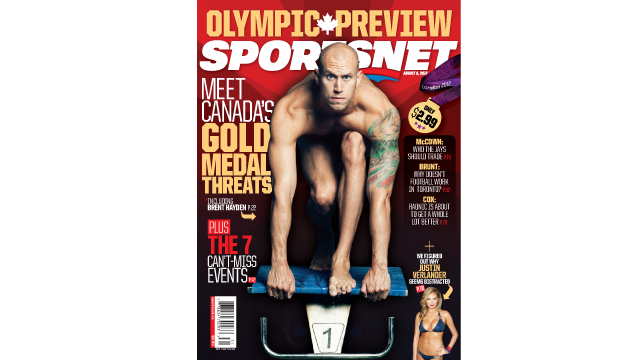
This article originally appeared in Sportsnet magazine.