By Adam Elliott Segal, Sportsnet Staff
It’s January in Los Angeles, and Ronda Rousey is standing toe-to-toe with Miesha Tate, fists raised, posing for the cameras. For the past several months, the two rivals, blonde and brunette, challenger and champion, have been verbally jabbing each other. At a radio interview they both attended in Columbus, Ohio, earlier this year, Tate ignored Rousey.
"It would have been professional of you to say hi," Rousey complained.
"No, that would have been polite," Tate replied. "I don’t like you so I don’t have anything to say to you."
Today, despite spending the entire afternoon together, the two women haven’t said a word to each other. Tate, Strikeforce’s bantamweight champion, notices Rousey’s shaking hands, heavy breathing and nervousness every time they lock eyes. To Rousey, Tate comes across as pompous.
It is a genuine dislike that’s been festering ever since it was announced that Rousey would receive a title shot. For a fledgling women’s sport that’s desperately in need of a star, it just may have found two.
For several years, Gina Carano was the closest thing women’s mixed martial arts had to a queen. But the former bantamweight champ’s beauty appeared to trump her accomplishments in the ring. She posed for the covers of magazines and became the face of female MMA. And yet today, most know her only as the high-flying heroine in Steven Soderbergh’s recent Hollywood blockbuster Haywire.
That’s the conundrum: for the sport to succeed, women need to be recognized as fighters first, females second. But most fights have lacked the explosive power that’s commonplace on the men’s side — knockouts are fewer, as are the number of competitors.
Meanwhile, for society at large, the act of fighting — the sight of women bloodied and bruised — is regarded as unseemly. Although female fighters have been battling in the cage since the mid-’90s, the sport has yet to achieve critical mass.
"The sport doesn’t get any respect," says MMA journalist Ariel Helwani. "These girls are 10 years behind the men."
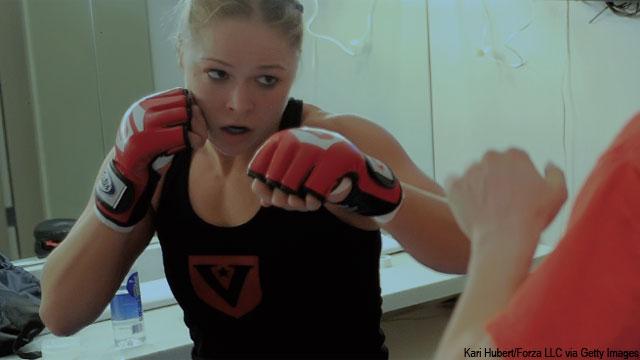
Enter Ronda Rousey. An attractive former Olympian from Riverside, Calif. — she captured bronze in judo at the 2008 Beijing Games — the 25-year-old arrived like a firestorm just over a year ago.
After making her 2010 debut (as an amateur) in the 145-pound division, Rousey won all seven of her fights, all by armbar submission, all in under one minute. But despite the fact that her resumé is much shorter than contenders-in-waiting Sarah Kaufman (14-1) and Alexis Davis (11-4), she’s been given a title shot.
Some say it’s based on a wide-ranging bag of tricks: long blonde hair, red-carpet charisma and a big mouth. Not bad for a former tomboy who didn’t wear makeup until she was 21.
Last fall, she began clamouring for a high-profile bout with Tate.
"If we push the ‘hot chicks’ to fight each other for a title, we’re going to get a lot of attention," Rousey said at the time. "That’s why I’d rather fight Miesha for a title instead of Sarah Kaufman. Because she’s good-looking and marketable."
The brass at Strikeforce, the world’s premier promotion for women’s fighting, agreed. And on March 3 in Columbus, the two will go head-to-head in the first main event on the women’s side in nearly three years.
But while Tate stands to benefit from Rousey’s antics, she’s not amused. She believes fighters native to her own weight class (Rousey is dropping from 145 pounds to 135 pounds to fight Tate) are more deserving of a title shot.
Also 25, Tate was born in Tacoma, Wash., and has been kicking around the MMA circuit since 2006, flashing a 12-2 professional record — in the world of women’s MMA, that’s a lifetime of experience.
"I’m one of the pioneers. If it wasn’t for me and Gina paving the way, little miss Ronda Rousey wouldn’t have the stepping stones that she’s used to climb to the top," Tate says.
Helwani was surprised by Tate’s attitude.
"It was shocking to me that Tate was pushing this aside and saying, ‘I want to give this shot to Sarah Kaufman,’" Helwani says. "Tate-Kaufman? There’s no way that would have been a main event."
On Helwani’s radio show last November, Tate was quick to point out how Rousey’s approach is undermining women fighters.
"If you weren’t pretty, it wouldn’t matter what you said or didn’t say," Tate says.
Rousey’s overt marketing of her looks — and of her opponent’s — irks Tate, who has struggled to present herself in a more understated fashion, especially after posing provocatively in 2009 for FIGHT! Magazine, something she now regrets.
But Rousey’s guerrilla tactics — talking her way into the spotlight, vocally sparring with other more experienced fighters — are typical in the world of professional fighting and reminiscent of former heavyweight titleholder Brock Lesnar, who transitioned from the WWE to the Octagon, earning himself a title shot with few fights to his name.
Other fighters were miffed, but Lesnar, immensely popular with fans, was an easy sell for the UFC. (Lesnar’s pay-per-view fight in December was beamed into about 750,000 homes).
"Rousey took the fast track and marketed herself well," says Helwani. "Strikeforce feels she can make the most money."
Rousey also appears attuned to the fact that a good cat fight still resonates.
"I think women take things more personally than men," she says. "They can’t stand being shown up by other women."
At the very least, it’s adding intrigue.
"When I’m watching a fight with my wife, when the women come on, I can tell she’s more into the fight," Helwani says.
And who can resist an underdog story?
"Women’s fights are more aggressive because everyone is doubting them," says Rousey.
Both Rousey and Tate have long felt the need to prove themselves. Rousey was unable to speak until age six. Her father committed suicide after suffering paralysis following a sledding accident. But both he and Rousey’s mother, a former Olympian judoka, instilled in their daughter an indomitable winning spirit.
Meanwhile, Tate wrestled on the boys’ team in high school. After returning from her first amateur MMA bout in Wenatchee, Wash., with a bloodied, broken nose, Tate received tepid support from her family.
But that night in the ring, held back by her corner out of concern for her safety, a killer instinct awoke in her. All she wanted to do was prove herself again.
"I learned I’m a fighter at heart," Tate says.
She was back sparring with men shortly thereafter. Her father still cannot stomach watching his daughter fight without having a few beers.
Digesting women’s MMA is going to take time. The UFC still does not employ female fighters (although its parent company, Zuffa, purchased Strikeforce in March 2011), and president Dana White has stated the lack of depth as the primary reason.
White suggested the 145-pound weight class be all but eliminated following Cris (Cyborg) Santos’s recent positive test for a banned substance. Some think this is for the best.
"It would force all those girls (at 145 pounds) to funnel into the (bantamweight) division and that creates depth," says Rousey.
White seems to be coming around, name-checking Rousey and women’s MMA at a press conference.
Tate and Rousey haven’t agreed on much, but they do have at least one goal in common. They’re hoping to alter the perception that women cannot be fighters, that somehow the two are mutually exclusive. Sex appeal has always been an integral component in promoting female stars, but with MMA evolving to include a growing mainstream audience, the fighters’ femininity needs to be reconciled in the minds of fans with the inherent violence of the sport.
The fight goes off in the 18,000-plus capacity Nationwide Arena in Columbus and will air on Showtime in the U.S. (Super Channel in Canada). Tate knows the pressure has never been greater, that this will be how many judge all of women’s MMA.
"If we go out there and the fight is a total flop," she says, "it’s a detriment to the future of women’s MMA."
And so, despite her objections, Tate has been pulled into the mud with Rousey, and like it or not, it’s working. They’ve engaged in Twitter wars, attacked each other’s (good) looks and continued barking back and forth. Tate’s seething-mad, respect-your-elders routine is the perfect foil to Rousey, the young, trash-talking upstart.
Both women, heading into this career-defining bout, are playing the game: angling for respect from the powers that be and hoping for acceptance from the fans. It’s a delicate dance, and once those eyeballs are fixed, they’ll need to deliver.
No more pouting, no more posing. Just punching.