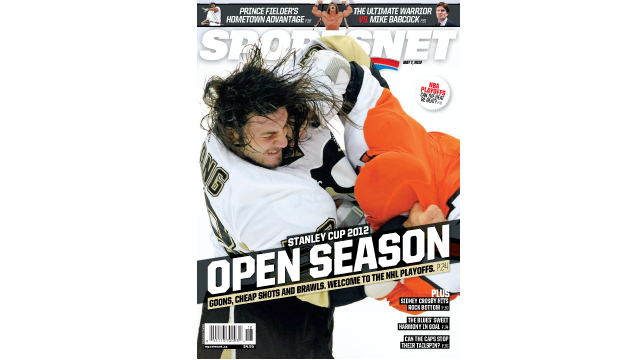

Sidney Crosby was standing at the left side of Ilya Bryzgalov’s net, in the filthiest part of the dirty ice. Bodies were banging and clanging off each other, the action dialed up to levels of intensity reached only in the post-season. Crosby was just a couple of shifts into his first playoff game in two years, a return to hockey’s prime time many feared would never come. The fans were still settling into their seats at the Consol Energy Center, and Crosby was still settling into his usual game. The game had been played in Philly’s end from the drop of the puck. Pascal Dupuis threw a pass over to Crosby from the far wing, and he had it on the tape of his stick.
Nicklas Grossmann, an imposing defenceman acquired in trade for just such occasions, lined up Crosby. Grossmann was too late to make a play, but he gave it a shot anyway. By the time the puck was past Bryzgalov, Grossmann had leveled a head shot that didn’t quite catch Crosby flush. With Crosby down and the red light on, Grossmann delivered a downward crosscheck, more out of frustration rather than with intent to injure.
For an awful second, you had to fear for Crosby, given his struggles with concussions and a suspected neck fracture this season. Dupuis seemed to when he leaned down over his centre, looking for the green light from the Penguins’ captain. Still on all fours, Crosby gave him a fist bump.
At that moment, you had to pity Sidney Crosby. Given his wealth and fame, it might have been counterintuitive, even when Grossmann was banging lumber off his helmet. And pity is definitely unwanted by the Penguins captain. Crosby’s private life is almost Salingeresque, so there’s no knowing if he ever lapses into self-pity away from the arena. Still, ever since his run of bad luck began in early January of 2011, when he suffered a concussion that snuffed out his season, he never asked for anybody’s compassion. Not once did he say, “Please give me a break,” or, “Cut me some slack.” Crosby asked for some understanding and patience, mostly from management and teammates who know his value. Supposedly there were rumbles from Penguins who thought he had stayed on the sidelines too long, but nobody ever put names to it, and those whispers could well be groundless fiction. Those in his dressing room know his competitive zeal better than anyone.
Even though Crosby was scoring almost two points a game since he came back from his second long hiatus this season, he said his game wasn’t where he wanted it to be. He was toughing it out, standing in when others would be skating scared, and he wasn’t going to get credit for it. His toughness has always been under-appreciated. And a select group of media flame-throwers, those seemingly paid by the decibel, mock him and claim he’s anything but tough. Not that they’ve ever had first-person experience with the physical price Sidney Crosby has paid, and the unrelenting psychic toll of being not just the best but wholesome too, safe as milk.
By the end of game one, Crosby’s goal was going to be hardly remembered at all. The Flyers stormed back from a 3–0 first-period deficit to take the first contest of the opening round’s most anticipated series 4–3 in overtime. Crosby couldn’t have had any idea that he was entering the worst week of his career. Hard to imagine that it could be worse than the hours and days of sitting in a dark room waiting for concussion-induced blurs and echoes to clear. But it was. Just a couple of games later, Crosby’s reputation was in tatters. The Flyers did some of the damage, but Crosby brought the worst of it on himself.
Going into the playoffs, Crosby had something to prove. That sounds like hype. What more could a player who has captained a Stanley Cup winner and scored a goal to win Olympic gold have to do? The easy answer: He had to prove he could do it all again, that he wasn’t damaged goods, that he could be the Sidney Crosby we had grown accustomed to before David Steckel caught him from behind at the Winter Classic back on Jan. 1, 2011 and sent his career into an awful holding pattern.
The answer there was easy because it was only tied to performance. He just had to rack up goals and assists, leading Pittsburgh to a Cup again.
The hard answer: He had to dispel a knock against him that was gaining traction, namely that the NHL’s golden boy was not the boy scout the storyline would have him appear to be. That a sneer fit him as well as the saccharine smile we’ve grown used to. That the wooden performances in commercials are a by-product of insincerity. That Sidney Crosby as we know him is a fiction of his own making.
That was a far harder challenge. It wasn’t going to be enough to play well. He was being held to higher standards than anyone else. Others could compete for wins and goals and saves. Crosby had to compete for hearts and minds and respect.
This spring there had been a groundswell of criticism aimed at Crosby. A small faction voiced their absolute disdain for him. They just happened to be the loudest voices in the game. When the subject of Crosby was raised, a few television commentators cranked up the volume and damaged the eardrums of the techies wearing headphones in the control booth. Crosby had to know he was powerless to win their respect.
There’s no chance in hell he’d ever win over media meatball Mike Milbury, a.k.a. “Mad Mike,” who won enduring fame and infamy for going up in the stands during a game and using a fan’s loafer to hit him. Milbury went after Crosby with the same spirit late in the regular season after an incident in a Pittsburgh-Philadelphia game. Any game between those teams is a small war, but they were even edgier in the weeks leading up to the playoffs, when both teams knew they were bound to collide in the first round. It started with Crosby slashing Brayden Schenn, a bit of stickwork that had serious intentions but came in the flow of play, and was not obvious enough to draw a whistle. Schenn struck the second blow: a cross-check across Crosby’s lower back away from the puck when he was skating to the bench on a line change. Those are routine circumstances for discreet digs at an opponent. This, however, crossed the line, and Crosby dropped to his knees. It wasn’t close to a dive, but Crosby did look for a ref. This was not stoic enough for Milbury.
The former GM aired it out on Philadelphia sports-talk radio, which is sort of a no-think tank. “Little goody two-shoes [Crosby] goes into the corner and gives a shot to Schenn,” Milbury said. “Schenn was late to the party, he should have turned around and drilled him right away, but I guess better late than never. So you know, Crosby gets cross-checked, big whoop. He said after he came back from his 35th concussion, ‘I’m not going to do this anymore, I’m not going to get into these scrums, I’m going to stay away from that stuff.’ He couldn’t help himself because there’s a little punk in Crosby.”
Only in the NHL would you have league-approved commentators on networks in Canada and the U.S. running down the character of its most marketable star.
Milbury issued a league-pressured, job-saving apology, but like all damage control, it came too late and was too half-hearted to matter. And he wasn’t a single gunman shooting off his mouth. New York Rangers coach John Tortorella joined in with his patented profanity-splattered name-calling, labelling Crosby and his teammate—two-time Art Ross Trophy winner Evgeni Malkin—“f—– whining stars.”
It’s always been like this for Crosby. It started with Don Cherry on Hockey Night In Canada carving up Crosby when he was in Rimouski for hot-dogging on a lacrosse-style wrap-around goal. No matter that the teenager had no real opportunity to reply. That’s the same for all those Cherry browbeats. Still, even for him, it was egregious. He turned Coach’s Corner into an attack ad, putting a high school kid in his crosshairs.
Crosby isn’t the first less-than-universally-beloved superstar. They knocked Eric Lindros as a rich kid with a sense of entitlement, and he never got past it. Mario Lemieux, Penguins owner, Crosby’s mentor and his former landlord, was slagged as a talented loser for years and won respect only after coming back from crippling back injuries and lymphoma.
Crosby tried to take the high road about the knocks in the media. “I’m not surprised,” he told reporters before game one of the Philadelphia series. “I’m not ready to get into a battle about it. I don’t feel like it’s necessary to get in these battles in the media. The game is played on the ice.”
In this post-season Crosby has done damage to his reputation on and off the ice, much of it irreparable, certainly none of it forgettable now.
Crosby didn’t distinguish himself in game two of the series. No matter what magic he and Malkin could have conjured up it wasn’t going to be enough to make up for the goaltending of Marc-André Fleury and a defence corps that seemed to lose its compass and confidence in face of Philadelphia’s forecheck. The 8–5 final score flattered the Penguins.
Still, Crosby and his teammates could have put the losses behind them with a couple of road wins, a couple of performances like those that made Pittsburgh the hottest team in the league going into the playoffs. Even respectable losses would have allowed the Penguins to exit gracefully, or at least inconspicuously. Instead, Crosby was the lead player in a series of messy incidents, and those images will last a long time, maybe as long as he plays in the NHL.
Milbury, Cherry and other knockers notwithstanding, many in the game gave Crosby deserved credit for his competitiveness, but that quality lapsed into petulance in game three of the Philadelphia series. Previously always composed, Crosby emotionally melted down this time. He had displayed class, even in previous defeats, but only a sad lack of it on the road against the Flyers. The Penguins fell behind by a couple of goals early on, with Fleury’s struggles continuing, and Crosby acted out like a spoiled ninth grader.
The first sign of bad things to come might have escaped the notice of someone casually watching the game (which might be the category the referees would fall into). A Pittsburgh teammate was locked in a tussle with Flyers tough guy Zac Rinaldo, and Crosby pushed his glove in his face. It didn’t rise to the seriousness of a cheap shot, but it was cheap, without real cause and without worry of Rinaldo returning fire.
Crosby later ended up in a couple of sessions with Flyers star Claude Giroux. In the first exchange, what looked like a little bumping behind the net that would blow over after a couple of profanities, Crosby put his glove in Giroux’s face and shoved him helmet-first into the glass. Giroux, like Crosby, had missed time with a concussion this season, but no matter. Crosby clearly prescribed to a variation on the Golden Rule: Do unto others as they have done unto you.
Crosby and Giroux, a willing participant this time, would end up trading punches and rolling around on the ice as Crosby’s and his teammates’ frustration boiled over and fights spilled out into something close to a line brawl. It was ugly, unnecessary and ultimately ineffective.
It was also inexplicable—at least Crosby couldn’t explain it or didn’t feel like bothering after the game. “I don’t like them,” Crosby said. “I don’t like any of them.”
Yet Crosby came off looking even worse due to something so innocuous that it might have passed unnoticed if it had not been in view of a wide-angle shot. During a stoppage of play, just when it looked like hostilities had been quelled, Flyers winger Jakub Voráček bent down to pick up his glove, and Crosby, again like a grade-school brat, pushed it out of his reach, just enough to raise tensions once more.
Why? “There’s no reason to explain, why I have to sit here and say why I pushed a glove away,” Crosby told reporters. “They’re doing a lot of things out there, too. You know what? We don’t like each other. Was I going to sit there and pick up his glove for him, or what was I supposed to do? Skate away? Well, I didn’t that time.”
Words on paper can’t convey the snark. Crosby’s tone was strictly “So Sue Me.”
This wasn’t the Sidney Crosby who skates with kids on frozen ponds in commercials. This wasn’t Sidney Crosby, Olympic hero and role model. This was a 24-year-old lost in emotions he had always successfully suppressed. Most had been willing to give him the benefit of the doubt in the face of the critics’ battering. Three losses later, all his most ardent defenders could say was that Crosby’s actions were out of character. Fact is, his actions weren’t out of character. They revealed it. None of the modern greats he had aspired to match—Gretzky, Yzerman, Messier and, yes, Lemieux—ever looked as bad in public as Crosby did in Philadelphia. He reached a breaking point many thought didn’t exist. And no one will look at Sidney Crosby the same way after his playoffs have wound down. Except for Mike Milbury, Don Cherry and all those who flung mud that stuck on the NHL’s most important player. Yup, he’s less than perfect.
This article originally appeared in Sportsnet Magazine.