
In November 2011, pilot Chris Spring and his four-man bobsleigh crew—then known as “Canada Two”—suffered a devastating crash during a practice run for a world cup in Germany. Today, Spring is preparing to compete in Sochi, his four-man sled currently ranked third in the world standings. Below is Sportsnet’s story, originally published in May 2012, of that harrowing accident that took place two years ago.
—
Thick, wet flakes of snow fall heavy from the sky, slowly dotting Chris Spring’s body as he lies on the ice in a pool of his own blood. The source of the leak is a massive cut on his right buttock, starting at his hip and stretching down almost to his upper leg. A shard of wood—20-cm long and five-cm thick—has sliced his right glute in half and left a thick flap of flesh hanging off of him like a portion of rare roast beef when carved halfway. The snow makes white freckles on his blood-drenched face as he squirms on the ice, looking for his teammates. One is gone entirely, run off in search of help. The other two are just 10 feet away, crumpled on top of each other in another red pool, motionless, letting out low, terrible moans that will fill Spring’s head for weeks. At least the sounds mean they’re still alive.
To Spring’s right is what’s left of his bobsled. It is 250 kg of destruction, a mangled, white mess of shredded fibreglass and twisted steel, resting on its side. Its front axle—the strongest point of the sled, responsible for holding in place the two long steel front runners it glides on—is lodged upwards into the sled’s body and jammed into the back axle. That’s not right, Spring thinks to himself, seeing the metre-long gash the axle tore into the sled’s underbelly like a can opener. That’s not supposed to look like that.
Nobody has reached him yet. Minutes feel like hours as he lies here at turn 16, slowly bleeding out, waiting for someone to come carry him away. He’s overcome with shock but feels no pain. His senses are strong, vivid; his thoughts as clear and true as ever. He takes it all in and thinks a lot about how he got here. How he came to Canada for a few months on a work visa six years ago and never left. How in late 2007 a newspaper story inspired him to try bobsleigh on a whim. How he made it to the Olympics just three years later as a world-class pilot. All of it led him here to the hard ice of this feared track in Altenberg, a tiny German border town where he just might die. But more than anything, Spring’s thoughts keep coming back to what he’s going to do next. “Because there’s no chance I’m f—in’ bobsledding again, that’s for sure.”
Canada Who?
That’s the self-coined nickname of Spring’s team, Canada Two: the country’s second entrant into the Fédération Internationale de Bobsleigh et de Tobogganing World Cup this past winter. Essentially, they are the second-stringers to Lyndon Rush’s Canada One that won bronze in the four-man bobsleigh at the 2010 Vancouver Olympics. Spring competed at those Games, too—for Australia. He was born there 28 years ago in Darwin, one of the northernmost points of the warm island. A lack of funding and coaching drove Spring to switch allegiances to Canada, where he was living as a permanent resident in Calgary. It took just a year and a half for the perpetually unshaven Spring to become Canada’s second-best pilot and qualify his team—all close friends—for its first World Cup.
In Spring’s four-man sled, 25-year-old Tim Randall sits second. A thick fullback on the football team at the University of Guelph, he was watching the Vancouver Olympics bobsleigh one afternoon and told his roommates he was going to do that. They laughed and told him he was an idiot. It took just one tryout for Bobsleigh Canada to invite him to the national development camp in Calgary, where Spring offered to put him up at his house. The two quickly bonded and now, less than two years later, Randall is one of the best pushers in Canada.
Sitting third is Derek Plug, a former Jr. B hockey player who first tried bobsleigh in 2008 when he was just 18. Today, he’s one of the fastest-rising pushers in Canadian bobsleigh and the horse of the crew. He’s the athletic freak from your high school who could beat the sprinters in a 100-metre dash and bench-press more than anyone on the football team. He drinks three Red Bulls before every race and aggressively slaps his thighs and arms when he’s standing at the top of the hill, yelling at the top of his lungs. His teammates call it getting “Plugged up”—doctors might call it a caffeine imbalance. Either way, you can practically see his tail wagging whenever he’s near a sled.
The fourth seat belongs to Graeme Rinholm, a blindingly fast converted sprinter—he once ran the 60-metre dash in 6.78 seconds—whose role is both mindlessly easy and crucial to the team’s success. He pulls the brakes. Rinholm lives in two worlds. The 26-year-old already has a biochemistry degree and hopes to someday add another diploma to his resumé. But for now, he spends most of his time in a sport that, by his own admission, “provides very little mental stimulus.” He simply can’t bring himself to give up on his lifelong dream—to compete in the Olympics.
The final member of the team, Bill Thomas, is an alternate. A former linebacker at McMaster University, he gets into a training run here and there, giving Plug or Randall a rest. He decided to try bobsleigh in 2009 after watching the Disney classic Cool Runnings. There had to be at least one, right? All five spend the majority of their time away from the track together. On Sunday nights they meet at one of their homes to cook up a bounty of food, play video games and watch movies well into the night.
Together, they set out this past November for Europe and their first World Cup. No one was expecting much. Going into the season, these five had just 11 years of sledding between them. Bobsleigh Canada wanted the crew to gain experience; results were secondary. But they shocked the tour, finishing in the top 10 at the first three World Cup stops against bigger, faster, more experienced competition. They were even sending a message to Rush and Canada One, beating them in each of the first three four-man races.
The team, growing moustaches and mullets during their European trip, were the talk of the tour, on the track and off. Word quickly spread about the fun-loving Canadian crew that could be found in little European pubs on any given night entertaining the masses with a cappella renditions of “Wonderwall” by Oasis. “We were loving life,” Spring says. “Other teams started to notice. That’s a lot of where the name came from. People were like, ‘Canada who?’”

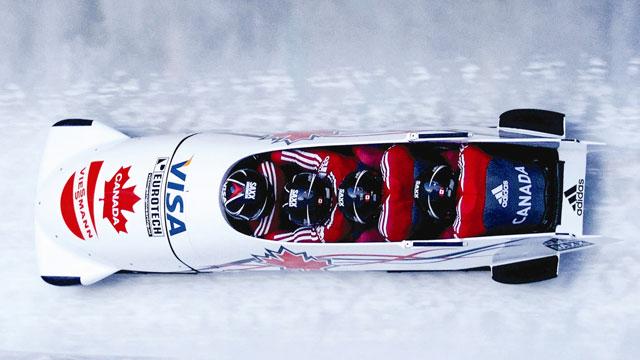
The crew of Canada Two were known for their fun-loving approach to life away from the track.
Nothing comes easy at Altenberg—the fourth stop on the World Cup circuit. The German track drops you 122 metres toward the centre of the Earth in less than a kilometre and a half, the third-biggest plunge in the shortest distance on the World Cup circuit, shy of Whistler and Königssee. In some areas, the track slopes downward at a 15 percent grade, a descent steep enough to flip a freight train’s cargo over onto itself. It’s a slick, fast track, too—by corner four, the sled is already travelling more than 100 km/h. The toughest stretch comes after turn 10’s Kreisel, a long 360-degree loop installed to slow sleds down. The next four corners—hard left, soft right, hard left, hard right—come up on you in about eight seconds. By the time the sled reaches corner 15, it’s travelling 130 km/h through an almost cruel series of three hard left turns. It’s a challenging 55 seconds.
Spring found that out quickly. Canada Two crashed on its very first run when Spring came into the 13th corner late, meaning he didn’t ride the curved wall at the onset of the turn, a risk/reward manoeuvre that can either save time or make a mess of things. The pressure from coming into the hard left so flat picked the sled up and rolled it into the corner, flipping the team upside down and leaving them there as they slid on their heads 300 metres down the track. It was Spring’s first crash in nearly two years and the first ever of Randall and Rinholm’s young careers. Aside from a few bumps and bruises, though, no one was hurt, and all were ready for the team’s second qualifying run about 45 minutes later, which went off without a hitch. But, due to the crash, Spring and Co. would have to complete one more clean training run the next afternoon to qualify for the real races that weekend. No one had any worries. Spring figured it would be good to get another run on a new track under his belt anyway.
Over breakfast on a cold Thursday morning ahead of the run, Spring tells Plug to take a day off. He wants him fresh for the two-man races the next day. Plug is hesitant at first but eventually accepts. Thomas happily fills his spot, sitting third in the sled, and Canada Two takes off well, sliding through the first three quarters of the run with little trouble. The only hiccup is the straightaway between turns nine and 10 that allows clumps of thick snow to collect on Spring’s visor, cutting his visibility in half. But in spite of that, he’s still cruising, driving confidently and mostly by feel. He comes out of the Kreisel with ease, goes early into 13 and hits 14 almost perfectly. “I’m laughing,” Spring says. “No problems, man, no problems. But then I came into 15.”
Corner 15 at Altenberg is far from the track’s most treacherous, but it’s a honey trap for young, risky drivers like Spring. You have to steer it. You have to get your runners going. But Spring isn’t that kind of driver; he hates over-steering. It’s a fast approach but some days it gets him in trouble, and by the time he comes out of 15 his sled is flying at 130 km/h on just its two left runners. This is a bit of an issue, considering the 15th corner at Altenberg almost bleeds into the 16th, which is more of a wall than a corner. Not good.
Spring immediately goes into crash mode, tucking his head as far under the front of the sled as he can, patiently waiting for the top of his helmet to smack the ice. The pressure and lack of steering immediately send the sled to the roof, where it ricochets off the long slats of wood that cover the corner before diving back down, on its runners, into the short concrete wall on the inside of the curve. Like a pinball, the sled crashes off the wall and is sent diagonally back up to the roof, where this time, it slices gruesomely into the wood like a cleaver through bone. As Canada Two tears a long, gaping hole in the roof, one after the other, Spring, Thomas and Rinholm’s heads smash violently into a thick steel girder. Spring’s nose shatters. Thomas and Rinholm are knocked unconscious instantly. As the sled continues to carve through the roof, shards of wood separate and spray into the four men, Spring taking the brunt of the lumber shower. One particularly nasty shaving—about the size of a chef’s knife—shreds directly into Spring’s right buttock, lodging itself deep in the flesh between his spine and his hip. Immediately beneath him, the force of the crash jars loose the sled’s front axle, which is quickly dragged back through the sled, cutting a long, gaping hole in its underbelly as it thuds into each man’s hip. The sled goes from 130 km/h to nearly zero in about three seconds before crashing down to the ice on its left side, with four heads in a row stopping just shy of the short wall.

The sled destroyed elements of the course due to its speed through Corner 15.
For a moment, no one says a word. No one moves. They just sit in ruins, the January wind whistling past their helmets, snow collecting around them. Spring speaks first. “Mate, I think we need to get out of the sled.” Randall, sitting directly behind him, hears Spring but doesn’t say anything. It felt like a normal crash; what’s the rush? Suddenly, everything comes into focus. Spring’s face covered in blood. The two men behind him making sounds you never want to hear. It all hits him at once. Randall reaches out and grabs on to the side of the sled, backing his head and spine into the short wall and worming his way out. He stands beside the wreckage, looking forward and back, not seeing a thing. No medics, no help, no one. So he does the only thing that seems rational at the time and starts running up the track screaming for help.
Meanwhile, Spring uses his arms to drag himself free and along the wall to the front of the sled, where he puts his right foot in front of him to take a step and immediately collapses. Let’s not do that again, Spring thinks, as he lies there, blood pooling around him. He figures his legs have gone numb from the crash but isn’t quite sure what the ache in his butt is so he reaches back with his right hand to feel around. His hand passes over his hip to an area on his rear end where both layers of his suit have been ripped open and fused together from the intense burn of the crash. He hits a ridge and feels a sudden sting as the four fingers of his hand slide easily into his body. He jerks and pulls his fingers out; they’re blood-red from tip to knuckle. He decides it’s best not to do that again, either. Spring scans down to the twisted, mangled bobsled and sees Thomas and Rinholm, who still haven’t moved and are piled on top of each other. He feels helpless, lying here watching his friends die.
The medics, team doctors, coaches and a terrified Plug all seem to arrive at once. Plug had been taping the race at the 13th corner—the site of the previous day’s crash—and watched the sled whiz by cleanly through the lens of his camera. All he heard a few seconds later was a loud bang. Damn, not again. Plug was in no hurry to get to them until he saw a truck speeding toward the crash site and several people running alongside it. That’s when he started sprinting. He arrives to an unholy mess of wood, blood and bodies. Then, as if out of nowhere, Randall, the only crewman who can walk, comes running down the track. “Can you f—in’ believe this?”
Plug starts helping the medics where he can, carrying IVs and stretchers, pushing the sled out of the way, telling his friends they’re going to be all right, even though he has his doubts. He helps haul Thomas and Rinholm’s torpid bodies from the sled and, with the medics, tries to carefully untangle the limp mess of legs and arms. As they slowly drag Thomas away, Rinholm briefly stirs to consciousness and starts kicking violently—with quarter-inch spikes on the bottom of his shoe—as his teammate’s weight presses down on his broken leg. Thomas, still unconscious, is quickly pulled clear and hooked up to an IV. He has a severe concussion and a cerebral hemorrhage slowly seeping blood into his brain tissue. Plug and the medics stretcher him into an ambulance and send him off while Rinholm lies on the ice, drifting in and out of consciousness. He too is severely concussed, with broken ribs and a fractured fibula. The last thing he remembers from the crash is lurching forward. His next memory is waking up in the back of a moving ambulance with a German medic who kein sprechen Englisch holding his arm. He reaches to feel his hip and comes back with a hand soaked in blood. That’s when he looks square in the medic’s eyes and the pair come to a quiet, unspoken agreement: We’re going to look each other in the eyes and you’re going to hold my hand and we’re just going to keep doing this, OK? Because this is what I need right now.
Spring is the last to be loaded into an ambulance and the last of anyone conscious—medics, doctors, coaches, athletes—to realize the gravity of the situation. During most of the aftermath, he remains completely convinced he is fine. “Man, don’t worry about me. Can you hear what’s happening with the other guys? These people are going to die,” Spring tells the medics tending to his injuries. “I’ve got a busted nose. No big deal.” Little does Spring know, a medic looking into the wound on his backside can see the top of his pelvis and the bottom two vertebrae of his spine fully exposed. The medic doesn’t have enough gauze to handle a cut of that magnitude so he shoves a balled-up T-shirt into Spring, trying to stop the bleeding.
One of the few faces Spring recognizes is a massage therapist with the Monaco team, Thomas Lohfing, who is sitting beside him, holding his hand, staring at his rear end in disbelief. “Mate, I know I’ve got two holes in my ass now but that doesn’t mean you can check me out,” Spring says to him, still not grasping the severity of the situation. Lohfing is one of the more jovial characters on tour, always keen for a joke, especially with the fun-loving Spring. But this time, he just grimly looks Spring in the eye. “Don’t worry about it, Chris. You’re going to be OK,” Lohfing says. “Just keep breathing.” Spring looks back, perplexed. This is not the Thomas he knows. And so begins the turning point for Spring, when the intensity of it all begins to set in. He decides to shut up and curls up in the fetal position, waiting to be taken away.
That night, a small crew of track workers arrive to clean up the blood and the wood. Then they climb ladders and replace plank after plank of ceiling, long two-by-fours lined neatly in a row, bandaging the gash Canada Two tore in the roof. They use the exact same construction that failed earlier in the day, and once Canadian coach Tom De La Hunty sees the patchwork repairs, he pulls the rest of his team out of the event. It is the first time a Canadian team has ever withdrawn from a World Cup race over track concerns. Meanwhile, Randall and Plug return to their hotel for a very quiet, very sombre evening. They sleep in the same room and late at night both men lie wide awake in the dark thinking their bobsleigh careers are over. Randall thinks hard, replaying the accident over and over in his head, trying to figure out how he walked away. Plug fights to muzzle his thoughts—he was supposed to be in that sled.

The aftermath of the accident shows just how serious it was for the crew.
As Spring, Rinholm and Thomas lay alone in three separate hospitals—no one ever told them why they couldn’t all go to the same one—Plug and Randall settled into a daily routine of waking up early and making the rounds to each infirmary, delivering food and movies to keep their teammates entertained. Thomas was in the hospital for just four days but was also the most antsy to leave, due mainly to the fact that he kept forgetting why he was there. De La Hunty was the first to visit him the day after the crash and caught Thomas just as he was waking up. Thomas rubbed his eyes and realized where he was. He looked under his sheets, saw himself lying there completely naked and immediately looked at his coach, unable to muffle the sheepish look on his face. “Man, what did we do last night?” Thomas questioned, not entirely wanting to know the answer. “Did we have a big night out on the town, or what?” It would be like that for days after the crash, and then eventually weeks, as Thomas slipped further into the fog of concussion, struggling to comprehend what was happening in his world. Randall and Plug visited him each of the four days he was in the hospital and had to remind him each time that they had visited the day before. They showed him pictures of the crash each visit and every time, without fail, Thomas thought they were playing a prank. It wasn’t until about a month after the accident that he started being able to remember what he had done the previous day. Rinholm stayed in the hospital for six days. The first night, he was put under as doctors operated on his hip and his leg. He woke up the next day and thought he was in a dream. It took weeks for him to clear the cobwebs and feel like himself again.
Spring had the longest hospital stay, confined to a bed for eight days as two small tubes hung out of his rear end, draining blood, puss and debris from his body into glass jars. They drained about a litre every 36 hours. Every night a doctor came into his room and said “Schmerzen? Schmerzen?” Spring would nod as the doctor hooked the morphine up to his IV. But by the fourth night, Spring started refusing the painkillers. The doctors still force-fed him ibuprofen, which took a bit of the edge off but did little to numb his excruciating pain. Spring watched kids’ movies at night to keep his spirits up—The Lion King was a favourite—but it was still a few days before he could take a visitor without crying. No one else in the sled blames Spring for what happened and, with time, he’s come to terms with the accident being just that: an accident. Spring’s cheerful nature simply won’t let him stay down. But pilots take crashes harder than anyone. When Spring pauses to think back on Altenberg, the haunting nights in that German hospital are still fresh in his mind. “I felt like I inflicted all this pain and damage onto people, onto my friends,” Spring says. “Lying wide awake in that bed by myself every night—I went to some dark places.”
Canada Two is recovering, some quicker than others. Randall and Plug have already been back in sleds, while Rinholm and Thomas are still battling their injuries. It’s been baby steps for everyone—a series of firsts. The first day without pain, the first workouts, the first push-offs going at full speed. Someday, they will each have to face the ultimate test: going back to Altenberg, standing at the top of the track that nearly ended four lives and throwing themselves down it.
Spring doesn’t know how it will make him feel. Nervous, he presumes. What he does know is there’s no way to keep him out of a bobsled. No matter how he felt lying on that cold Altenberg ice, he’s a born pilot. And it took just one run to prove it.
Pierre Lueders, Canada’s most decorated male bobsledder who won a gold medal at the 1998 Nagano Olympics and a silver at Turin in ’06, insisted on being in the sled for Spring’s first run back after the accident. Lueders drove bobsleds for 20 years and crashed countless times; he knew what Spring would be going through. “I was really afraid I’d get back in the driver’s seat and not know what to do,” Spring says. “Or I would get halfway down the track and start freaking out.” But if Lueders would put his life in Spring’s hands, then Spring had to have that same faith in himself.
They chose Valentine’s Day—exactly 40 days after the crash. Spring pulled up to the track in his truck about an hour early and started his usual preparations. He checked the sled up and down, meticulously polishing the runners over and over until the steel was as smooth and perfect as fresh ice. Then he went up the hill to meet Lueders and take it all in.
As Spring stood at the top of the course, his mind raced with memories, just as it had while lying on the track that snowy, bloody day in Altenberg. He thought about the letters and emails he received in the hospital as he recovered. He thought about the German fan who sent a care package with a handwritten note in broken English saying he couldn’t wait to see Canada Two back at the World Cup next year. He thought about the nights spent lying on his side in a hospital bed because it hurt too much to be on his back, unable to sleep, struggling to stay positive as he lived through his sport’s worst realities. He thought about it all as he calmly put on his white helmet, fastened the strap tightly under his chin, took a deep breath and snapped his visor shut. They had one last moment, these two men, the old and new of their sport in Canada. They simply slapped hands. Lueders stood at the back of the sled, watching over as Spring climbed gingerly into the pilot’s seat, putting one foot after the other deep into its gut and gripping the steering handles. It felt so familiar. It felt so right.
And then they pushed off.