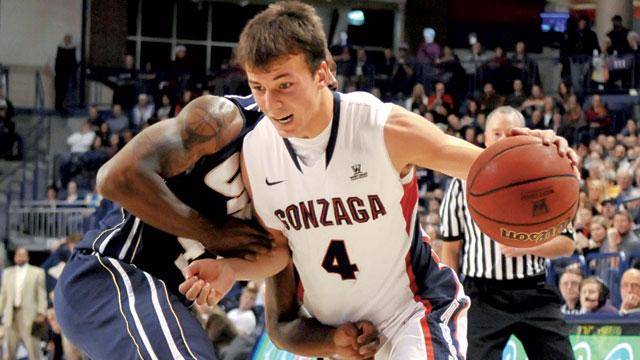

SPOKANE, Wash. — Kevin Pangos’s expression is as blank as any you’d find at the final table of the World Series of Poker. Pangos, Gonzaga University’s point guard, has the ball out on the perimeter and his eyes are darting, tracking the nine bodies in front of him. Robert Sacre has his right hand out, giving Pangos a target for an entry pass, and his left hand is discreetly behind him, trying to fend off the defender leaning over his back. There’s no pass there, no way to get the ball to the seven-footer in the paint. Pangos has to wait for something to open up. Biding his time, reloading, he moves the ball around the perimeter and Sacre is left double-teamed and waiting.
The good citizens of Spokane, Wash., are devoted to the hometown Bulldogs, but those in attendance at the McCarthy Center are restless. Gonzaga is facing unusually stiff resistance from the Broncos of Santa Clara University. A box-and-one defence has the Bulldogs flummoxed in the early going. Pangos can’t crack it, can’t find Sacre, can’t get off a three-pointer. The Broncos have done their homework. They run out to a 10-point lead in the first half.
Going into this game, Gonzaga was sitting at No. 21 in the country. Seven days before, the Zags registered their best win of the season, beating the previously eighth-ranked Xavier Musketeers. Santa Clara shouldn’t even be close. It’s hard to believe that the seven-foot centre waving helplessly down on the blocks has been mentioned as an NBA first-round pick. It’s hard to believe that the guard who’s stymied 25 feet from the basket was, for one night in November, the talk of college basketball. National hoops officials are counting on these two as key pieces for Canadian teams in world and Olympic play for the next decade. Early on against Santa Clara, however, they look nothing like that.
The NCAA men’s basketball tournament is appointment viewing for fans, especially in the opening two rounds. Fans check in at noon on a Thursday and get off the couch 48 games later, after which 60 Minutes will be seen in its entirety. March Madness has had its share of Cinderella teams, upsets putting underdogs like Austin Peay and George Mason (those are schools, not players) in the spotlight, however briefly. Gonzaga looked like another one-hit wonder back when it landed a 10th seeding in ’99. A private Roman Catholic school with an enrolment of 7,500, Gonzaga had one claim to basketball fame: it’s the alma mater of John Stockton, a hometown gym rat who, despite looking like a lunchtime rec league player, recorded the most assists in NBA history, all with the Utah Jazz. Gonzaga made a memorable run in ’99, narrowly losing to eventual champion UConn in the Elite Eight.
In the normal run of things, Gonzaga would have returned from whence they came the next season. But a funny thing happened on the program’s plunge to earth: it never happened. The one-off became a perennial-13 straight WCC regular-season titles, 13 straight NCAA tournament appearances and five Sweet 16 appearances. An even funnier thing: the Bulldogs managed to stay likeable. A priest still stands at centre court, blesses the gym and leads the crowd in prayer before the teams’ warmup. Unlike many major programs, the Bulldogs have remained untainted by scandal-no NCAA investigations, no stints on probation. Their coach since 1999, Mark Few, could have written his ticket to a big school, landing a seven-figure salary. Few decided to stay put and has recruited players who are academically legitimate, not one-and-done NBA-bound hotshots. “Players know our reputation,” Few says. “A certain type of player comes here, a player who’ll buy in.”
They’re not all John Stockton, though the past two years the team has featured his son David in its backcourt, a doppelgänger except that he’s less physically imposing and athletic than his father. But Gonzaga players are often a piece with the original Stockton: gamers, owners of high basketball IQ, overachievers.
Gonzaga has recruited a bunch of Canadian kids since ’99-a coincidence, Few insists. “We’ll recruit anywhere we find players.” Gonzaga’s roster features kids from San Diego to Germany and France. Still, the Zags have built up a network of Canadian contacts. It seemed natural for a North Vancouver kid to land in Spokane, but neither was it a great leap for a prodigy from Toronto to end up in what locals call “the Inland Empire.”
“If you’re seven feet tall, they’ll find you, doesn’t matter where you are,” Robert Sacre says. In the early going against Santa Clara, it’s hard for Kevin Pangos to find Sacre, but five years ago he was on the radar of dozens of U.S. schools. It wasn’t uncommon to see 10 NCAA coaches taking in his high-school games in Vancouver. Sacre couldn’t have hidden if he had wanted to and, even if he had, recruiters would have heard him. “Robert was born talking,” Few says, “and he hasn’t stopped.”
Though Sacre’s a Canadian citizen, he was born in Louisiana. His mother, Leslie, a native of Vancouver, went to Louisiana State University on a basketball scholarship and settled near Baton Rouge with her partner, a former LSU football player. When Robert was seven, Leslie decided to move back home and raise her son as a single mother. Despite Robert’s prodigious size (six-feet-eight in Grade 8), she didn’t push him onto the court, only insisting that he learn to swim. “I made up my own mind to play basketball,” he says. “My mother said she wasn’t going to coach me, because she had to be my mother.”
When he was 16, Sacre made an unofficial visit to Gonzaga. Few and his staff weren’t there to roll out the red carpet for him but that wasn’t what he was looking for. “He told me, ‘That’s it,'” Leslie says. “I really wanted Gonzaga because Coach Few said he’d hunt down Robert if he left school without a degree, but I wasn’t going to tell Robert what to do.”
Sacre’s now in his fifth year in Spokane-he spent one season on the sidelines with a broken foot. He ranks as one of the most popular players in the Zags’ history. He figures there’s only two degrees of separation between him and any name in the Spokane white pages. He calls his apartment “the vortex,” and it’s something like a 24-hour drop-in centre. All who enter are almost powerless to leave, whether it’s Sacre’s torrent of words that hold them spellbound or his pitbulls pulling at their pant legs. He’ll subject them to his eclectic mix-hip hop followed by his favourite Louisianan, Jerry Lee Lewis. “He keeps everyone loose here,” Few says. “He has emerged as a team leader, but I’m proudest of Robert’s development not just as player but as a person. He has a learning disability but he has already earned a degree [in sports management] and he’s working on his master’s.”
Few says the most impressive thing he’s ever seen Sacre do came not in a game but on a visit the team paid to a palliative care unit for children with cancer. “I was having trouble holding it together with these terminally ill kids but when I looked over at Robert he was talking with one kid, getting him to laugh, completely engaged and at ease.” Leslie isn’t surprised. “I work with people with disabilities,” she says. “Robert grew up around them. He’s a people person. I don’t know what he’ll do-I think he understands if he plays in the NBA he’ll be a supporting player, coming off the bench. But no matter what, he’ll be happy and he’ll make people happy.”
Kevin Pangos is an emotional counterpoint to Sacre. He brings to the game a quiet intensity, whereas Sacre does nothing particularly quietly. Like Sacre, Pangos grew up in a hoops-savvy household: his father, Bill, is the coach of the women’s team at York University in Toronto. “Kevin’s a typical coach’s son,” Few says. “There’s something about a coach’s son as a player in terms of feel for the game. They see the whole floor.”
In his last season of high-school ball at Dr. John M. Denison Secondary in Newmarket, Pangos took his game to a level that neither he nor the Gonzaga staff anticipated. In a tight loss to Vaughan, Ontario’s top-ranked team, Pangos scored 48 points. At the FIBA World Under-17 Championship he captained Canada to a bronze medal and was named the tournament’s top point guard. “You gain a lot of experience in a short time in international play,”his father says. “I’ve coached in events like that. You have a game a day for weeks at a time and every game is do or die.”
Whereas Sacre was a project on his arrival in Spokane, Pangos was regarded as a ready-for-prime-time player, or at least as much as a freshman point guard can be. “It’s the most difficult position for a first-year player to step into,” Few says. That was the challenge facing Pangos when he arrived last fall as the most hyped Canadian point guard since Steve Nash. In fact, at the same age, Nash was far less well-known than Pangos was to insiders. “I arrived a day late after being with the national team,” Pangos says. “I went all out. I was doing stuff that I couldn’t even do a single rep with. I was either trying to be tough or just being stupid. But I really wanted to impress. I couldn’t move for a week.”
The training staff worked overtime getting Pangos unknotted. Good thing they did—Gonzaga was going to need him. The starting point guard from the two previous seasons—Demetri Goodson—was leaving school after his junior year to play football. David Stockton was the fans’ choice to fill the void, but Few slotted in Pangos and another prized recruit, Gary Bell Jr., for an all-frosh backcourt-the makings of a rebuilding year. (No other team with a realistic shot at the top 25 started two freshman guards.)
That thinking was turned inside out in 40 minutes in November, the Zags’ second game of the season, which also happened to be Pangos’s first start: a nationally televised game against Washington State from the Pac 10, a game that instantly entered the lore of a storied program. Gonzaga scored a seven-point victory over WSU and Pangos rang up 33 points and dropped nine three-pointers. “It was a surreal experience,” Pangos says. “I was trending on Twitter. People were trying to call me for interviews, but I couldn’t pick up. I hadn’t paid my phone bill.” Web pages were subsequently created to track him—like the “Kevin ‘The Kev Show’ Pangos” page on Facebook. Pangos, though, seems unfazed. “It’s just one game,” he says.
Coach Few suggests it is in fact more than that. “It changes things for him the rest of the year. There’s no sneaking up on other teams. They’ll have seen the video. They’ll have adjusted their defences for Kevin. It advances his development, I think; being defended tougher means having to compete harder.”
He has started every game since the Washington State wonder and he’s been a positive player. Into February he has led the team in minutes per game at 31, averaged 13.3 points per game-second highest on the team—and just under four assists, with about a two-to-one assists-to-turnover ratio.
“I’m still getting used to the college game and school,” Pangos says. “It’s a big change, stepping up to play at another level, living away from home. It’s also a bunch of little changes. My roommate and I didn’t really have a place to sit until the other day and then we picked up a beanbag chair.”
A beanbag chair: the “Kevin ‘The Kev Show’ Pangos” Facebook page keeps fans posted on his exploits in games, but his home furnishings haven’t made it. Yet.
Despite Gonzaga’s slow start against Santa Clara, the game is a model of what Gonzaga can hope to see out of Sacre and Pangos in March. Sacre struggles offensively, picking up just seven points but pulling down eight rebounds and blocking four shots in 21 minutes. When the Broncos double-team Sacre, there are open looks for his teammates. Pangos has a more direct impact, although it’s not quite like the light show against Washington State: 10 points including two threes, five assists with just one turnover in a team-leading 33 minutes. In stretches, the Zags go small, with three guards on the floor: Pangos, Stockton and Bell Jr., who leads Gonzaga with 15 points in an 82-60 victory.
“My shot wasn’t dropping early in the game so I didn’t try to force it,” Pangos says. “It’s not about stats. You measure point guards by wins and losses.”
His coach is of exactly the same mind. “A good point guard makes everyone better,” Few says. As Pangos goes, so goes the team, no matter what his statistics look like at the buzzer.
A TV reporter corners Pangos after the game. Just as the light shines in the freshman’s face, Sacre, still in his underwear, starts a lewd dance behind the cameraman. Imagine a seven-foot male stripper with a map of Louisiana tattooed on his shoulder. But Sacre can’t crack Pangos’s card-shark countenance. He keeps the deadest of deadpans. When you’ve trended on Twitter at 18, when opponents’ defensive plans are focused on shutting you down, when you’re starting ahead of the son of a Hall of Famer, you don’t rattle.
This article first appeared in Sportsnet magazine.