When the Toronto Blue Jays acquired starting pitcher Taijuan Walker from the Seattle Mariners on Thursday, it may have signalled the beginning of their trade deadline activity rather than the end.
Following the move, general manager Ross Atkins said that the calls he’s fielding at the moment are “non-stop” and expressed an interest in continuing to build on the club’s run-prevention capabilities. In all likelihood, that means the team is looking at bringing aboard another starting pitcher. With Matt Shoemaker, Nate Pearson, and Trent Thornton on the IL, the Blue Jays still only have four starters in hand – although the option to convert one of their more stretched-out relievers remains.
The bullpen has been solid more often than not, but the load it has been asked to carry is unreasonable, which is keeping the group bloated. That has shrunk the bench and hurt the team’s offence as well. Another reliable starter would do this team a world of good.
Although Walker is a pure rental, the Blue Jays are probably most interested in a rotation addition that comes with control beyond 2020. Going in on a pending free agent is especially risky right now considering that COVID-19 is still an existential threat to the season, and the unorthodox run-up to the campaign has made pitchers more susceptible to injury. They’ve already taken that plunge with Walker, it’s hard to see them doubling down. Instead, it seems reasonable to assume they’ll want someone who can help them take another step forward in 2021 – and possibly beyond.
With that in mind, which pitchers make logical targets for the club? Here are a few names that make the most sense:
The big fish: Lance Lynn, Texas Rangers
How it works: There isn’t a box that Lynn doesn’t tick from a Blue Jays perspective.
Last season, the big right-hander put together a massive 6.8 WAR season, and he’s picked up where he left off in 2020. Right now, he’s sitting on a 1.59 ERA in 45.1 innings. His FIP is a more reasonable 3.13, but he’s missed bats (9.93 K/9) while keeping his walks under control (2.78 BB/9) and his contact management metrics are impressive.
The 33-year-old also has an exceedingly team-friendly contract that has him making just $8 million next season. He would be an outstanding fit alongside Hyun-Jin Ryu atop the Blue Jays rotation. Even from a stylistic standpoint, his fastball-heavy approach from the right side would neatly contrast Ryu’s finesse-focused arsenal from the left. He’s also capable of hauling a heavy workload. Last season his 208.1 innings ranked seventh in the majors, and this year he’s second to only Shane Bieber in that category.
It’s hard to find a downside here, and the Rangers are exploring the idea of moving Lynn. The sticking point is what Texas wants in exchange for its top starter. The combination of Lynn’s production and his salary makes him a hell of a trade chip, and this is a seller’s market with so many teams in the hunt – particularly in the National League.
If the Blue Jays were to go this route, it would take the kind of significant package of young players the team hasn’t yet relinquished in the Atkins-Shapiro era. That doesn’t mean it’s a pipe dream. On Thursday, Atkins explicitly stated that the Blue Jays’ strong farm system puts them in position to be in the running for “every player.”
[snippet id=3305549]
The obvious fit: Trevor Williams, Pittsburgh Pirates
How it works: Because the Pirates front office, led by former Toronto executive Ben Cherington, has an intimate knowledge of the Blue Jays’ minor-league system, these two teams make for obvious trade partners. The Pirates are clear sellers, they have some arms the Blue Jays are reportedly eyeing, and they know what they’re getting with any of the Blue Jays’ prospects, which is particularly valuable in a season where evaluating young talent is a difficult task.
Those factors are no guarantee that a deal between the two clubs gets done, but they lay the foundation for something to happen here. The most obvious deal for these teams to broker would be a trade centred around Williams.
Although the 28-year-old is not a top-of-the-rotation type, he’s been a steady presence in the Pirates’ rotation for years. From 2017 to 2019, he gave the Pirates 466.2 innings of 4.13 ERA ball – good for a WAR of 6.2.
Williams got knocked around on Wednesday (eight earned runs in six innings), which bloated his ERA to an ugly 5.34, but there’s a lot to like about his season. For one, he’s seen his strikeout rate jump from a well-below-average 6.87 in that 2017-2019 span to a healthier 7.71. It’s hard to know if that’s for real as his fastball velocity isn’t up and none of his movement numbers have changed in a way that suggests his stuff is different. Whether his improvement in missing bats sustains itself or not, the right-hander continues to impress with his ability to force weak contact.
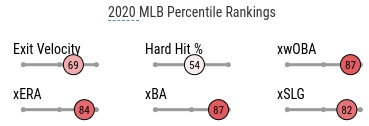
The right-hander’s average exit velocity against of 86.2 mph ranks 22nd among 139 pitchers with 50+ batted ball events — a better ranking than any Blue Jay. He’s allowed just three Barrels in 30.1 innings of work, resulting in a Barrel Rate of 2.2 percent — good for ninth-best in that aforementioned sample of 139 pitchers. For reference, the man he’d be filling in for, Shoemaker, conceded eight this year in only 25.1 innings. This is a longstanding skill, too, as the righty’s exit velocity has been 68th percentile or better in each of the previous three seasons.
From a contractual standpoint, Williams is under team control through 2022 with two more arbitration-eligible years. He’s making $2.825 million this year and figures to earn substantial raises, but remain a bargain.
Williams would not be a flashy add, but he’s the type of player who would bring the Blue Jays some needed stability in their starting five. He’s also quite the character, and Twitter follow, giving him the chance to earn fan-favourite status in a hurry.
[snippet id=4722869]
The outside-the-box move: Yusei Kikuchi, Seattle Mariners
How it works: When you’re in the thick of a playoff race, trading for a pitcher with a 6.30 ERA isn’t exactly intuitive. Neither is making a third consecutive deal with one team. That said, there’s more to Kikuchi’s appeal than meets the eye.
The 29-year-old struggled mightily in his rookie season in 2019, producing just 0.2 WAR in 161.2 innings. He looked like a poor investment on the Mariners’ part into 2020, but he’s become a totally new pitcher this season.
Kikuchi’s fastball has ticked up from a 92.5 mph average to 94.9 mph. He’s added a cutter, which he throws 43.1 percent of the time. Hitters have whiffed on it at a 29.9% clip and slugged just .289. He’s also dropped his ineffective curveball (.623 slugging against in 2019) entirely. That’s a total arsenal revamp.
The ugly ERA that’s come as a result doesn’t reflect how he’s pitched, either. His FIP is just 2.56, the jump in his strikeout rate is incredible (6.46 K/9 to 9.45), and he’s yet to allow a home run. He also has yet to concede a Barrel and has a Hard Hit rate against in the 69th percentile, suggesting you can’t chalk the ERA up to hard contact. Instead, it’s explained by the fluky .400/.526/.467 he’s allowed with runners in scoring position that’s caused him to strand just 50 per cent of batters. It feels safe to assume that won’t continue.
Now is precisely the time to buy in on the new Kikuchi because he’s pre-breakout and the price tag could be more reasonable. The complicating factor here is his contract, which is both unorthodox and rather significant. Kikuchi will be paid $15 million in 2021, then there’s a team option to pick up a four-year $66 million dollar option. If that’s declined, the Japanese southpaw can pick up a $13 player option for the 2022. There are a lot of variables there, and not an insignificant amount of risk for a team to assume, especially since at this point you’re betting on Kikuchi’s stuff more than his prior production.
Despite those hurdles, Kikuchi’s arrow is pointing up, he’s a current and future upgrade, and now might be the best time to try and bring him into the fold – and potentially lock him into a reasonable deal if he performs. He’s also a player the Blue Jays have looked at closely in the past.
[snippet id=4931337]
Other names to consider:
Dylan Bundy, Los Angeles Angels: Bundy has gone from a hotshot prospect, to a boring innings-eater, to a breakout star. That’s quite the rollercoaster, but if you buy his step forward in 2020, he’s got age (27) and arbitration-eligible status in 2021 going for him.
Marco Gonzales, Seattle Mariners: Gonzales has recorded 7.1 WAR in the last two seasons, and his wildly-reasonable four-year $30-million contract kicks in next year. Because of that contract, bringing him aboard would be costly.
Andrew Heaney, Los Angeles Angels: Heaney’s health has been a question for years, but he misses bats with his high-spin fastball and he was a great middle-of-the-rotation guy as recently as 2018. He’s arb-eligible in 2021 coming off a modest $4.3 million salary.
Matthew Boyd, Detroit Tigers: Boyd is struggling this season (8.48 ERA with a 5.85 FIP), but he’s coming off three seasons where he’s topped 2 WAR, and his stuff looks essentially the same. The former Blue Jay could represent a buy-low opportunity and he’s under team control through 2022.
Chad Kuhl, Pittsburgh Pirates: The other Pirates starter that could be a fit for the Blue Jays throws harder than Williams, and misses more bats, but he can’t match the righty’s consistency or durability. He’s also arb-eligible through 2022.
[relatedlinks]


 1:03
1:03