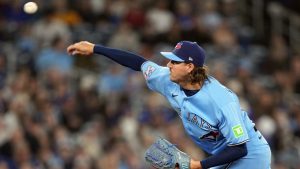
DUNEDIN, Fla. – Some 19 months removed from the reconstructive elbow surgery that paused his push to the majors, Ricky Tiedemann is on a spring training backfield facing big-league hitters and trying to get the jitters out.
Months of recovery and tedious rehab work put him back on track, the Toronto Blue Jays added him to their 40-man roster in November and now he’s trying to show he’s ready, finally, to factor in some way this season.
“You're so excited to be out there again and finally face some batters after such a long time, you can get overhyped and you can't even feel your legs a little bit, you know?” the electric-armed lefty, still just 23, said Thursday after two simulated innings versus George Springer, Kazuma Okamoto, Andres Gimenez and Davis Schneider. “Just getting that feel back and getting settled down faster is the goal. You're going to be amped up, regardless if it's a practice game or if you're in a stadium with a lot of fans, if you're a competitor.
“That's how it feels, at least for me.”
Tiedemann missed those feelings over the past three years, when a litany of arm ailments limited him to a combined 79.1 innings after a breakout season in 2022, when he logged 78.2 innings with 117 strikeouts in 18 starts at three different levels, had put him on a fast track to the big-leagues.
But he was managing around various ulnar collateral ligament tears in his left elbow and that started catching up with him in the spring of 2023, when shoulder soreness shut him down. Later that season, a biceps injury sidelined him, too, and while he recovered to finish the year with one start at triple-A Buffalo and throw in the Arizona Fall League, the next spring, he missed time with hamstring and calf tightness, before a bout of elbow inflammation and, finally, the surgery he’d tried so hard to avoid.
“Ultimately,” he said, “that was what was necessary to get better.”
Complicating Tiedemann’s various diagnoses was that his ligament never fully tore. Eventually, however, it weakened to the point that “I had too much joint space when my elbow was in a stress position,” which caused other injuries as his body compensated.
“Once the UCL isn't doing its job and your joint is too far spread out, your flexor is doing all the work in keeping your elbow supported,” he explained. “That's when your flexor gets tightened up and won't recover and it's like rock solid in your forerarm. It kind of feels like something might tear and that's when you get a lot of this stinging feeling while pitching.
“You've got to pitch through that – most guys are pitching through a little something,” he continued. “But it gets a certain point where you're like I can't even throw right now without thinking about this, rather than thinking, let’s get this guy out.”
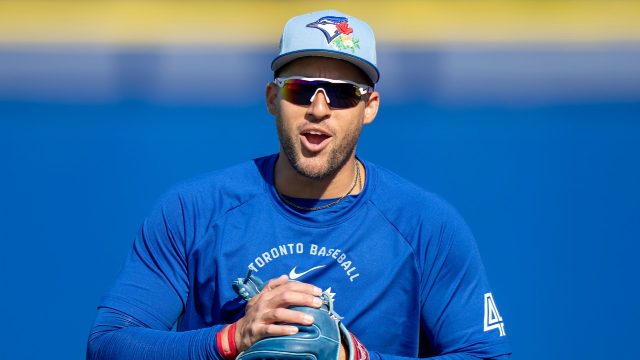
Blue Jays open spring training vs. Phillies on Sportsnet
The Toronto Blue Jays open spring training on Saturday against the Philadelphia Phillies. Watch the game on Sportsnet and Sportsnet+ at 1:10 p.m. ET/ 10:10 a.m. PT.
Broadcast schedule
As his body sought ways “to ease that pain,” his arm slot varied, in turn making his command more erratic. The sport’s most durable pitchers “are masters at compensating to get by while staying healthy,” said Tiedemann and “that's the name of the game. If you're good enough to stay out there and healthy enough to stay out there, then you'll play for a while.”
To that end, Tiedemann is working through a number of adjustments aimed at keeping his arm healthier, including different grips to all three of his pitches, most notably on the slider which is believed to have been at the root of his arm issues.
“I was overextending on my slider, releasing the ball and hyperextending my elbow causing some joint trauma,” he said. “So we figured out, let's stay behind the ball more rather than spinning around it, basically trying to keep the ball in front of your fingers so it's less stressful. It's helped thus far and staying there is what's important. The slider is definitely the biggest change.”
He’s now using more of a cutter grip, changing the offering’s shape from sweeper-like to more of a power slider break. On his changeup, he’s adopted the kick grip, spiking the ball with his middle finger to shift its axis upon release and his movement profile “has been really consistent, so I'm happy with it.”
Finally, he’s tucking his thumb in on his fastball to eliminate a touch point he feels caused pitches to either miss slightly right or slightly left.
“So all three pitches I'm working on, constantly trying to trying to find new ways to be more efficient,” said Tiedemann. “It's coming along.”
His progress is significant for the Blue Jays, as in an ideal world, the calibre of his repertoire gives him a chance to come up at some point and offer the team a lift the way Trey Yesavage did last season.
While the comp is convenient, it's worth remembering that the organization carefully mapped out the right-hander’s progression to save enough innings for the end of the year, and that Yesavage was building off a better workload base.
As difficult as that needle was to thread, then, the eye is even narrower with Tiedemann, which is why the Blue Jays are looking at him as a bulk arm, rather than a traditional starter, for now and adapting as needed.
“In spring most clubs, I know we're doing it, are trying to build up as much length in guys as we can, especially guys that are on the (40-man) roster,” said manager John Schneider. “That's what we're going to continue to do and then if it happens to get a little bit shorter, it gets a little bit shorter. … We're going to let him dictate that with the thought of, right now, because of the injury and because of the layoff, capping it at a certain point.”
Navigating his return that way opens up a potential path to starting once again in 2027 and while Tiedemann isn’t ready to give up on the possibility, he also recognizes the realities of his current situation.
“Right now, you're working up to be a starter, as always, but whatever the team needs, you're obviously going to want to be ready for that, as well, whether that's a relief role, closing role, whatever that may be,” he said. “It's whatever's asked of you as a player. Try to adapt and be professional with it.”
Having spent most of the past three years on the sidelines watching, he’s ready and eager to do just that.


 1:03
1:03