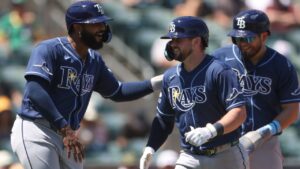
In many ways, the Tampa Bay Rays and Cleveland Guardians have come to occupy a similar place in the hierarchy of the American League.
Both franchises often operate with bottom-10 payrolls, yet have emerged as consistent regular-season forces and fixtures in October. Over the past 10 seasons, they have combined for 13 post-season appearances and a .554 win percentage — racking up the fifth- and seventh-most victories in the majors.
And the similarities don’t stop there. In an era when the home-run ball and a reliance on a three-true-outcome approach have become ever more prevalent across baseball, the Rays and Guardians have remained resolute in their ability to put the ball in play, run the bases well and prevent runs with solid defence and pitching.
Catch all the 2026 MLB post-season action on Sportsnet and Sportsnet+.
But the 2026 editions of these clubs have differed in how they got here. Tampa Bay powered through the regular season on its way to the top seed before dismantling the New York Yankees in a three-game ALDS sweep. Cleveland, on the other hand, needed a 24-11 run to close the regular season just to punch its ticket back to October. And even after earning a wild-card bye, the Guardians fell behind the Chicago White Sox 2-0, then became just the fourth team in major-league history to win a Division Series after dropping the first two games at home.
Despite their sustained success over the past decade, neither club has claimed baseball’s ultimate prize. Now, to earn a shot at the Commissioner’s Trophy, they’ll see whose version of that winning formula holds up better in this best-of-seven.
No. 1 Tampa Bay Rays (98-64) vs. No. 2 Cleveland Guardians (85-77)
What’s working for the Rays: After taking their place as the toast of the American League with a 98-win regular season, the Rays rolled through the Yankees in the ALDS behind some dominant pitching. Tampa Bay’s arms surrendered just 12 hits and five runs over 27 innings against New York, striking out batters at a 31.3 per cent clip — nearly a 10 per cent increase from their regular-season mark.
Drew Rasmussen led the way in Game 1 as he flirted with a no-hitter and punched out 10 Yankees himself, continuing to build his case as one of the most underrated pitchers in baseball. Another under-the-radar contribution came from Ian Seymour’s 4.1 frames of one-run ball. The multi-inning southpaw covered key bridge innings for the Rays and figures to play an integral role against the Guardians, who finished 27th in OPS against lefties.
What’s working for the Guardians: In completing its ALDS comeback against Chicago, the biggest difference for Cleveland came from its offensive production. In their Game 1 and 2 losses, the Guardians scored three runs on seven hits and no homers. Then in Games 3 through 5, they exploded for 20 runs, 27 hits and three big flies while working 19 walks.
At the forefront of the turnaround was José Ramírez, who delivered the most impressive stretch of his post-season career, going 5-for-12 with four extra-base hits, including two homers — one of them the go-ahead blast in Game 5 — in Cleveland’s three wins. Of all the swings Ramírez has taken in his 50 career playoff games, two of the most impactful, by championship win probability added, were his four-baggers against the White Sox. If the Guardians hope to play spoiler against the Rays, they’ll need their star third baseman to continue producing in the biggest moments.
Where the Rays are vulnerable: For as convincing as its victory over the Yankees felt, Tampa Bay’s offence was relatively held in check across the three contests. Jonathan Aranda (.968 OPS) and Junior Caminero (.817 OPS) provided some needed production at the top of the lineup, but the rest of the Rays’ order went 14-for-74 (.189 AVG) with three walks.
Over a best-of-seven, the Rays’ supporting bats will need to contribute more consistently. Beyond Aranda and Caminero, Ryan Vilade and Victor Mesa Jr. hit a pair of clutch Game 3 homers in the Bronx — contributions the AL East champs will hope to see more of in the ALCS. It will be fascinating to see how Tampa Bay’s high-contact approach fares against a Cleveland pitching staff that just set the MLB record for strikeouts in a nine-inning game and punched out 75 White Sox batters in five games.
Where the Guardians are vulnerable: Cleveland emptied the tank to come back and beat Chicago, which could leave it at a disadvantage early in this series. The Guardians needed ace Gavin Williams to close out Game 4 and start Game 5, all-star closer Cade Smith and Hunter Gaddis pitched in all five games, and although he only covered 2.1 innings in Game 4, Parker Messick seems unlikely to bounce back in time for the series opener against Tampa Bay.
Thanks to their sweep, the Rays can set their rotation as they please for the ALCS, while the Guardians will have to piece together their pitching plans for the opening games. Foster Griffin was excellent for Cleveland against the White Sox, but the rest of the Guardians’ starting options — Joey Cantillo, Daniel Espino and Tanner Bibee — struggled in the ALDS. If Cleveland falls behind early against Tampa Bay, it might be too tall a task to dig out of another hole against the Rays’ rested crop of arms.
It’ll all come down to: Cleveland’s pitching against Tampa Bay’s offence. The Guardians quite simply can’t afford to let the Rays get going offensively. We saw Cleveland heat up against a White Sox pitching staff that was out of gas, but it will now have to solve a group of pitchers with significantly more depth and upside. Runs will likely be at a premium in this series, and Tampa Bay’s lineup was much more productive than Cleveland’s during the regular season, meaning the Guardians’ staff will need to level the playing field if they want a chance to move on.

 1:25
1:25