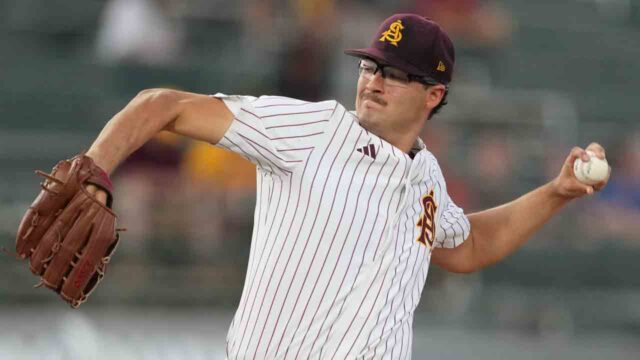
PHILADELPHIA – Shortly after the Toronto Blue Jays selected imposing Arizona State lefty Cole Carlon with their first pick, No. 39 overall, a text message from a friend popped up on Marc Tramuta’s phone.
“I was laughing the way he put it,” relayed the amateur scouting director, “he goes ‘He’s got two October pitches.’”
Those would be a fastball that sits in the mid-90s and a slider that was missed more than half the time batters swung at it, prime reasons the Blue Jays “were very excited” when the 21-year-old from Tempe, Ariz., slid to them as the draft opened Saturday. Combined with a six-foot-five, 230-pound frame and an untapped changeup development staff feel can be the needed third piece in his arsenal, “this guy fits very well into a good rotation because of the power stuff that he has.”
“I had them rated as a solid first-rounder that I did not think was going to get out of the top 20-25 players,” continued Tramuta. “Sometimes those things happen.”
Time will determine whether the Blue Jays were actually fortunate or not.
But working with the draft’s second-smallest signing bonus pool, the second-last pick each round and the loss of two selections due to their World Series run and payroll spending, they need some things to break their way to help sustain their farm system reliably.
Once Carlon was on the books, the Blue Jays didn’t pick again until 103rd, when they took Oregon infielder Ryan Cooney, whom Tramuta described as “like an Ernie Clement clone.” Their final pick of the opening day was high-school catcher Will Brick, a big swing for a touted Mississippi State recruit Tramuta said he expects to sign.
How they approach the second day will be intriguing, but with only $5,543,100 to work with — less than everyone but the Los Angeles Dodgers at $3,951,900 — Tramuta is limited in how much money he can move around to take more shots at high-end talent. The No. 39 pick’s assigned value is $2,571,700, while it’s $762,900 for No. 103 and $581,100 for 131, which is 71 per cent of their pool total.
“Limited bullets,” said Tramuta. “I won't get into (details), obviously, signing bonus-wise, but everybody knows our pool and we have limited bullets.”
Unless the next Collective Bargaining Agreement rewrites the draft rules in the current deal that’s set to expire in December, the Blue Jays will need to get used to drafting with such restrictions if they continue reaching the post-season.
Not only did losing in the World Series situate them second-last in the draft order, but their first selection dropped them from No. 29 to 39 because their 2025 payroll exceeded the second Competitive Balance Tax threshold. The Blue Jays also lost two picks for the signing of free agent Dylan Cease, who had received a qualifying offer from the San Diego Padres.
Given that they’re currently projected to spend beyond the second CBT line again this season and likely to be in the market for qualified free agents again this off-season, the 2027 draft, again barring major changes to the CBA, could be just as limiting.
Under those circumstances, a late-bloomer with “now stuff” like Carlon – he was a reliever in his first two years with Arizona State before starting this season and logging 83.2 innings, when his velocity also spiked – falling into their laps becomes even more important.
Area scout Adam Arnold followed him for years while national scout John Hendricks “was really keen on this kid” heading into the spring season, Tramuta said.
Carlon’s inexperience starting may raise some reliever risk, but the Blue Jays still “had him up in the mid-90s” in their final looks and “the ability to post and hold your stuff over a long period of time, that answers the question can he do it,” he added.
The Blue Jays see him as a starter and if he can lock down a changeup, which they feel he has “but it was just a pitch usage thing with him that he did not use it much,” he’ll not only stick in a rotation, but have a chance to move quickly, too.
Complementing his selection is Cooney, who fits the Blue Jays mould of drafting high-contact hitters they can try to help develop some more pop. The 21-year-old from Portland played shortstop in the past and may get some opportunity there in the system, but he’s “a really polished hitter that is a contact bat,” said Tramuta. “If the power comes, obviously that will be a bonus.”
Meanwhile Brick, a prep star in Memphis who just turned 18, is the type of high-upside play typical in the high school class. He caught many of this draft’s top arms with the U18 USA Baseball program and is considered an elite defender, but he also impressed the Blue Jays with the bat during a private workout at the Player Development Complex.
“I haven't seen too many kids in recent history, even when he came down to the complex, that can drive the ball to centre field and right-centre field with the amount of power that he currently has,” said Tramuta. “We're very excited with that pick.”
There were no major surprises atop the draft, as the Chicago White Sox selected UCLA’s Roch Cholowsky first overall, leaving the Tampa Bay Rays, with their highest pick since having No. 1 in 2008, to take fellow shortstop Grady Emerson after. Georgia Tech catcher Vahn Lackey went third to the Minnesota Twins, UC Santa Barbara righty Jackson Floras was the San Francisco Giants’ pick at four and the Pittsburgh Pirates took LSU outfielder Derek Curiel to round out the top five.
None were in attendance at the second floor of the Pennsylvania Convention Center, where the proceedings went from feckless Journey singalong to commissioner Rob Manfred announcing a draft pick to a DJ spinning Snoop Dogg to a stilted Hollywood Walk of Fame fan trivia contest.
The mascot plushy toss was a real low point, and the afternoon’s content Frankenstein was a perfect metaphor for MLB’s jumbled attempts to build the event into a must-see show, a worthy endeavour still trying to find the right mix.
Indiana State outfielder Carter Beck of Candruff, Sask., was the first Canadian picked in the draft, going to the Atlanta Braves at No. 26. Prep infielder Taj Marchand, whose father Hugo is a native Montrealer who was a seventh-round pick of the Toronto Maple Leafs in 1997, went to the Rays at No. 33.
The San Diego Padres picked infielder Elliot Lascalles of Toronto at No. 60 while the New York Yankees grabbed lefty Sean Duncan of Port Coquitlam, B.C., at No. 63. The Blue Jays had interest in both Canadian high-schoolers, but both were priced beyond the club’s reach.

 2:55
2:55

 2:06
2:06