ATLANTA — The Toronto Blue Jays started following JoJo Parker a couple years ago and by last summer, he’d become a target for them in the 2025 draft. Their interest only intensified as the 18-year-old Purvis High School shortstop continued to hit his way up the rankings and by early March, after Marc Tramuta saw him in person, the new amateur scouting director decided that “this is somebody I want to circle the wagons on.”
Circle the wagons he did, sending in 14 different members of the scouting department to get looks in and draw their own conclusions. Once their turn in the 2025 draft came up Sunday, they were in full consensus on using the eighth overall pick on Parker, believing they’d landed “the best hit-power combo with plate discipline that we felt was in the draft.”
“His swing we think is advanced. We think his plate discipline is advanced. The contact has shown up. Our analysts have obviously done their jobs and he was very strong in those departments as far as contact, consistency with his barrel and we think he's going to grow into more power. He has it now but we think he'll grow into some more,” Tramuta said during a Zoom call with media. “We couldn't be more excited to get this type of what we think is a well-rounded offensive player and one that is a shortstop, that also, if needed, can play second base or third base. But we were really drawn to the potential offensive impact that he can have.”
On a night of surprises in the draft, Parker’s selection wasn’t among them as the Blue Jays were linked to high school shortstops throughout the spring. Tramuta said last week that, generally speaking, his “lean would be up the middle players, athletic players and players that provide versatility” — and they ended up having their choice of Parker and Billy Carlson, a gifted defender out of Corona, Calif., who went to the Chicago White Sox at 10.
In its scouting report, Baseball America described Parker as having a “picturesque left-handed swing” and “a nose for the barrel,” as well as “a case as one of the best pure hitters in the class, with real power to go with his polished hit tool.” Additionally, “he has an eye for the zone, will take pitches when he needs to and is a proven hitter against both velocity and spin.”
A description similar to that of the Blue Jays.
Parker comes from a family “that is all about baseball,” said Tramuta and his twin brother Jacob, an outfielder, is also eligible for the draft. Whether the Blue Jays will try to pair them up is an interesting question but with their second selection Sunday, at No. 81 overall, they took intriguing Southern Mississippi outfielder Jake Cook, a speedster who converted from pitching to centre field this season and may give the club flexibility later in the draft.
The assigned value for the No. 8 pick is $6,813,600, the vast majority of the Blue Jays’ $10,314,600 signing bonus pool, which was the 20th largest pool overall. They didn’t have a second-round pick, the penalty for signing Anthony Santander in free agency over the winter.
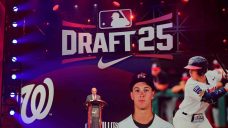
Commissioner Rob Manfred unveiled the selections at the Coca Cola Roxy, where the vibe was aspirational-nerd-tries-to-throw-a-party-worthy-of-the-cool-kids, with commensurately awkward results. The lights, presentation and venue were slick, and the draft is certainly worth building up, but with only a small handful of mascots roaming the crowd, no draftees in attendance and lots of airtime to fill, there was way too much filler and precious little killer.
Still, for the hardcore, the draft itself provided the intrigue, with the Washington Nationals blowing up the leading mocks immediately by selecting high school shortstop Eli Willits first overall. The Angels further demolished expectations by taking University of California, Santa Barbara right-hander Tyler Bremner, a San Diego native born to Canadian parents, second.
At No. 3, the Seattle Mariners took LSU lefty Kade Anderson, projected to go first overall, before the Rockies selected shortstop Ethan Holliday, the son of the one-time Colorado outfielder Matt and younger brother of 2022 No. 1 pick and Orioles infielder Jackson. Next, the St. Louis Cardinals chose Tennessee lefty Liam Doyle, whom the Blue Jays were interested in if he reached them.
The Pittsburgh Pirates took high school righty Seth Hernandez sixth before the Miami Marlins grabbed Oregon State shortstop Aiva Arquette at seven, leaving the Blue Jays to choose between high school shortstops or a college arm.
Florida State lefty Jamie Arnold and Oklahoma righty Kyson Witherspoon, both of whom were tied to the Blue Jays, were the leading candidates on that front, but Arnold slid to Oakland at 11 and Witherspoon to Boston at 15.
"We gamed out several scenarios, if there was more than one surprise, if there were three surprises,” said Tramuta. “Look Jojo, a player that we targeted, very high on our board, very excited to get him. That was the guy when he got to that point that everybody said, yes, let's take him.”
The Blue Jays took a college righty, Trey Yesavage, at No. 20 last year, and he pitched in the Futures Game on Saturday in Atlanta.
Tramuta, who ran drafts for the New York Mets from 2017-22, rejoined the Blue Jays last year and worked alongside former scouting director Shane Farrell, who left the club for the Detroit Tigers in October.
Taking pitchers, Tramuta said last week, “is a little bit more risky because of what they do, but you can't completely just eliminate any type of demographic and shy away from the draft list.”
Either way, Parker fits the attributes targeted by both Tramuta and the Blue Jays, who have pursued hitters who make contact in these swing-and-miss times, believing hitters can get to damage through their approach if they have strong bat-to-ball skills.
Taking a high school player is also another bet on upside — like the one the Blue Jays made on 2023 first-rounder Arjun Nimmala and 2022 first-rounder Brandon Barriera — amid an apparent trend of seeking fast-moving college players.
Already six players, five of them first-rounders, from last year’s draft have reached the majors — No. 2 pick Chase Burns with the Reds, No. 4 Nick Kurtz with the Athletics, No. 6 Jac Caglianone with the Royals, No. 8 Christian Moore with the Angels, No. 14 Cam Smith, drafted by the Cubs and traded to the Astros in the Kyle Tucker deal, and Angels second-rounder Ryan Johnson.
Showing that’s no aberration, 11 first-rounders from the 2023 draft, led by Pirates ace Paul Skenes, have also reached the majors, a remarkably high number of quick arrivals. Yesavage, now in double-A, gives the Blue Jays one such possibility, but his selection was more a byproduct of how the board fell, rather than a deliberate shift.
“That's something that would have to be discussed in your front office, to what they would want to do in a particular draft, if the player fits what you're doing,” said Tramuta. “I don't know if that will become a trend. But now you are seeing a lot of college players within a year getting to the draft. I was part of one of those in 2014 with Michael Conforto. He was drafted in the first round (by the Mets) and played in the World Series a year later. I think it depends on the type of player and where you maybe sit organizationally, as well.”
Drafting for need is dangerous and Parker will, of course, move at his own pace, although his readiness for full-season A-ball next year was considered and Tramuta believes he’s “definitely” prepared for the jump. In those ways, the Blue Jays stayed true to themselves and what they value in making him their first-round pick.