In a season that’s seen Vladimir Guerrero Jr. take a massive step forward, Marcus Semien return to near-MVP levels, and George Springer join the Toronto Blue Jays on a franchise-record contract, Bo Bichette’s contributions have flown under the radar at times.
Although the 23-year-old is a first-time all-star in 2021, the .291/.342/.475 he’s hitting has reinforced already-high expectations as opposed to indicating significant growth. While Bichette doesn’t need to build on his outstanding work in 2019 and 2020 to be an excellent player and building block, his wRC+ of 122 and wOBA of .352 looking virtually identical to his 2020 numbers (123 and .353 respectively) make his season feel less exciting than Guerrero Jr.’s or Semien’s.
That said, hidden beneath the superficially-similar numbers is a power increase that could have a significant impact on Bichette’s future. A first glance at his Statcast numbers suggests the shortstop is hitting the ball a little harder as his average exit velocity (91.0 m.p.h.) and Hard-Hit Rate (49.2 per cent) are both the highest of his young career. Those increases are relatively modest, though. Things get exciting for Bichette with his max exit velocity, which has spiked significantly in 2021.
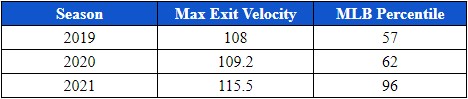
Although these statistics pertain to just three events, they are tantalizing because they show what Bichette is capable of — and this year he’s demonstrated a whole new power ceiling. It’s not as if the shortstop hit just one ball outside of his previous norms, either. The 18 hardest-hit balls Bichette has managed in his career have all come this season, as well as three of his longest four home runs. Even with the 23-year-old taking 57.4 per cent of his career plate appearances in 2021, those are remarkable numbers.
The perfect example of this step forward came at Fenway Park in June when Bichette hit a home run 27 feet farther — and 3.4 mph harder — than any round tripper he managed in 2019 or 2020.
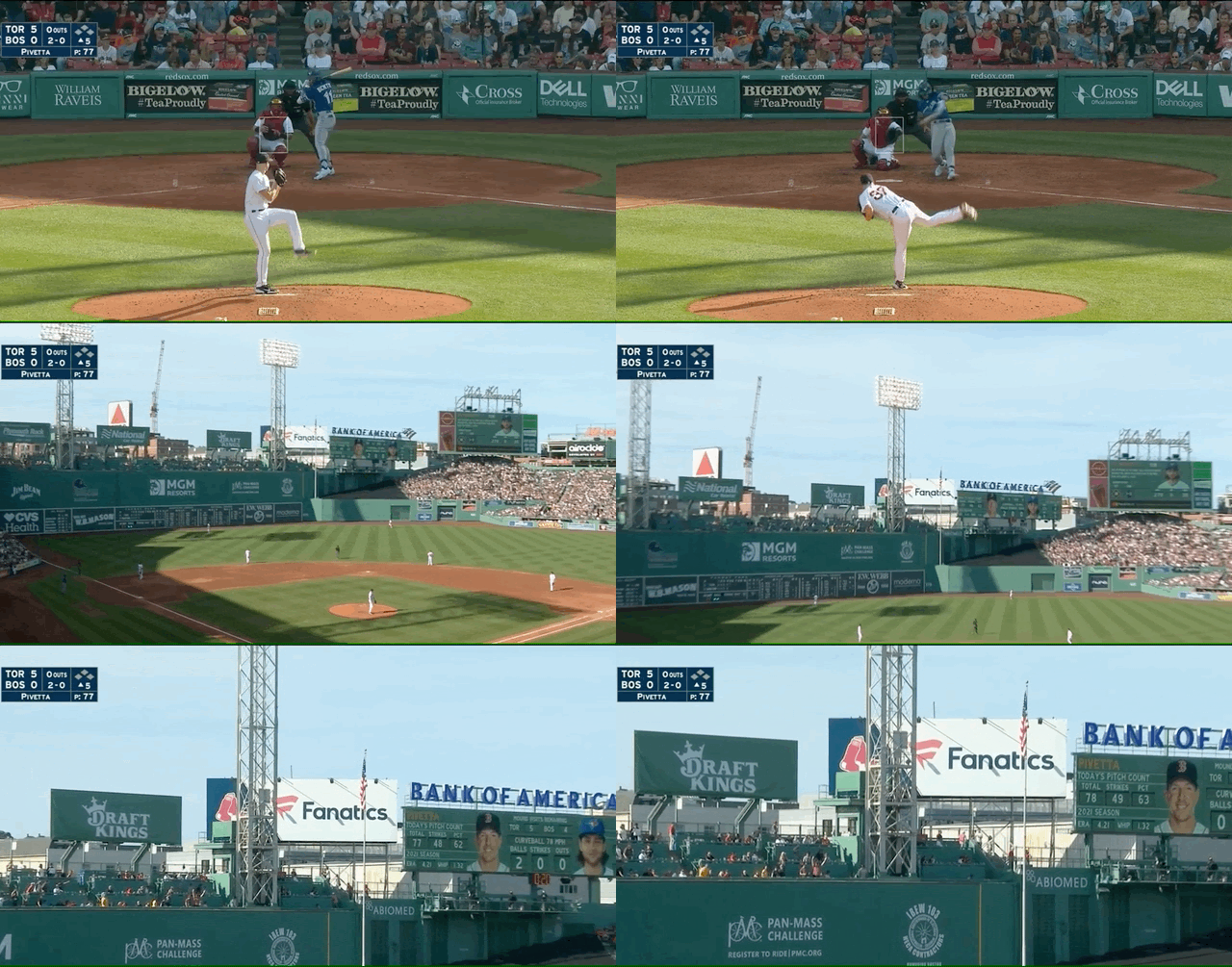
Bichette’s power wasn’t in question coming into the season, but we weren’t accustomed to seeing him hit moonshots like that.
While it may seem unfair to fixate on a player’s most impressive hits only, the best way to gauge power is to see its limits. There’s a reason Guerrero Jr.’s gaudy max exit velocity numbers were given so much attention even as he treaded water in his first two major league seasons.
In Eric Longenhagen and Kiley McDaniel’s book, Future Value: The Battle for Baseball’s Soul and How Teams Will Find the Next Superstar, the pair creates a rough grading system for power on the 20-80 scale based on exit velocity. A max exit velocity of 100 m.p.h. corresponds to a 20 grade and the grades increase along with the max velocities all the way up to 50 grades for 110 m.p.h. and 80 grades for the likes of Guerrero Jr. at 118 m.p.h.
While this is far from an exact science, Bichette’s power is jumping from approximately a 45-50 to a 60-70 based on this scale. That creates a new understanding of what he can be offensively, and is especially encouraging because his low-walk approach demands that he produce power numbers to be successful.
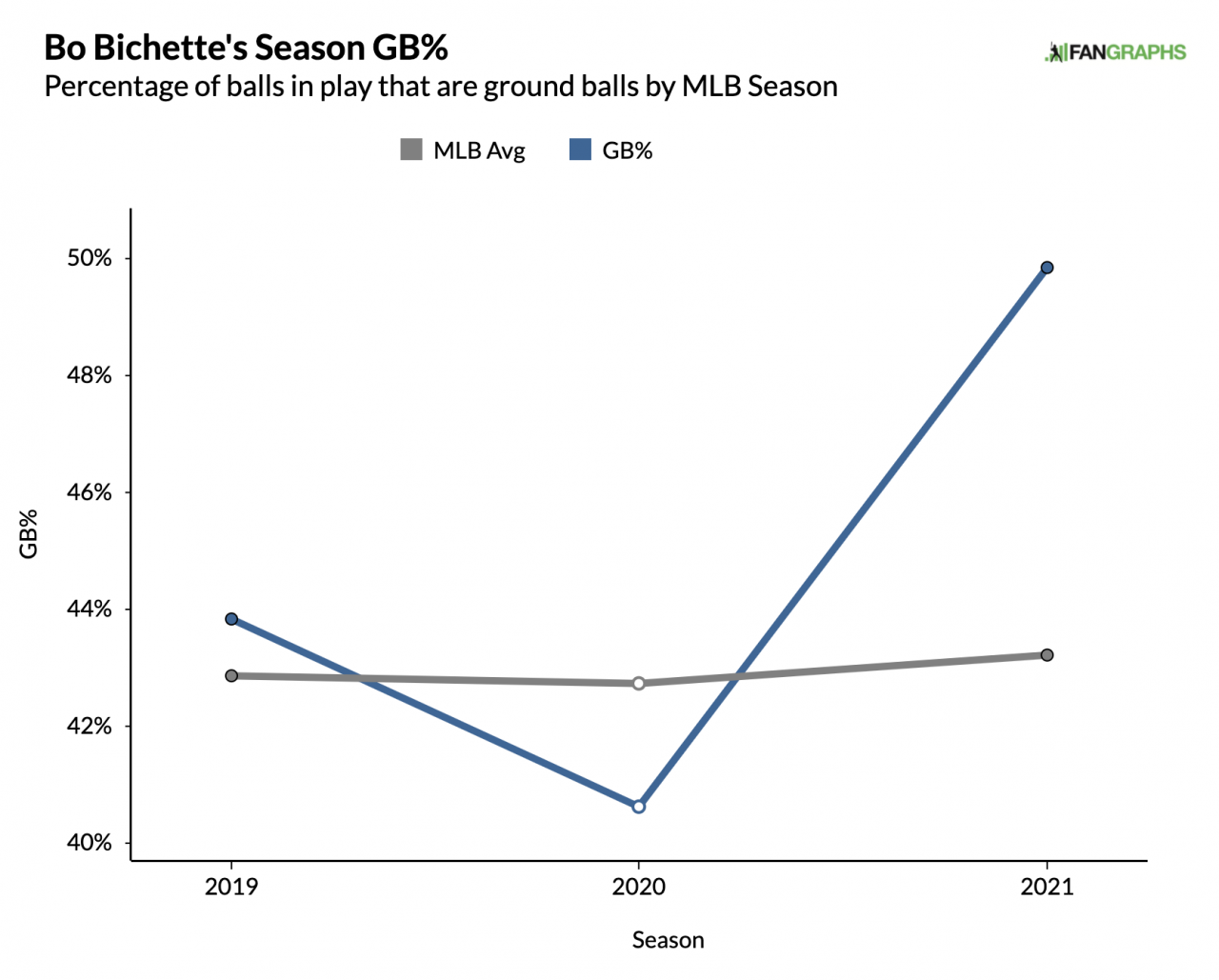
If Bichette is tapping into new power, the question is why that progression isn’t showing up in his statistics. Part of that is explained by a decrease in launch angle (from 12 degrees in 2020 to five this year) and resulting in rise in groundball rate:
In 2019 and 2020, Bichette had only been a groundball victim on low pitches…
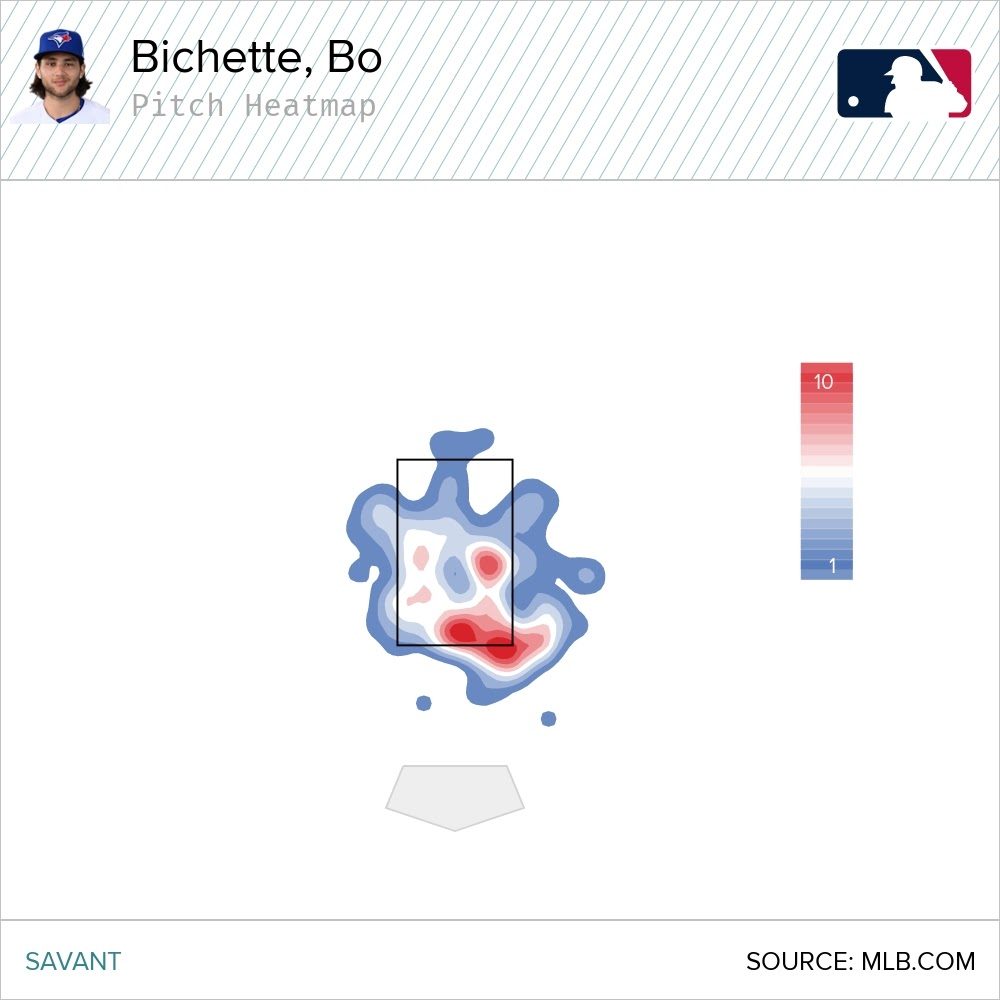
… while this year he’s topped the ball more even when it’s been in good spots.
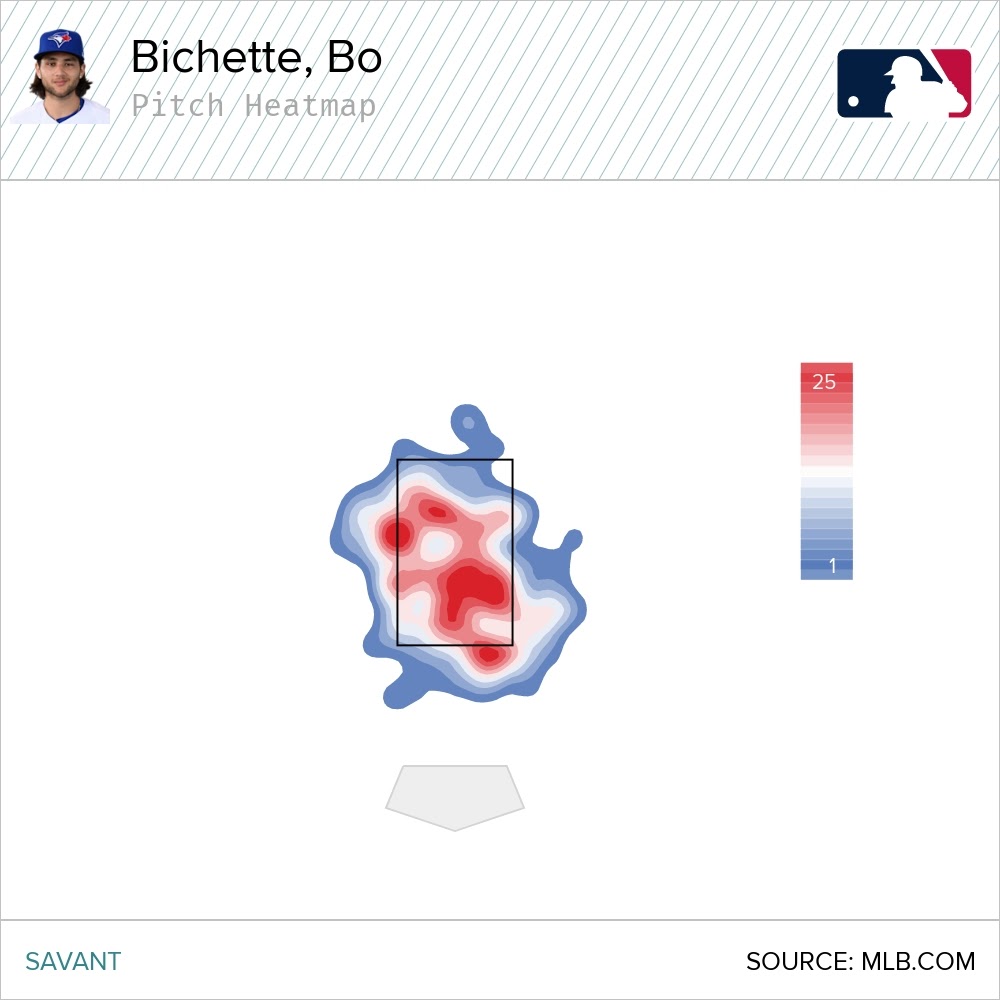
This has been particularly true on fastballs, which he’s hit an average launch angle of 0. As a result, he’s hit some Vladdy-esque ground rockets, like this 112.4 mph shot — the third hardest-hit ball of Bichette’s career on a pitch right down the middle.
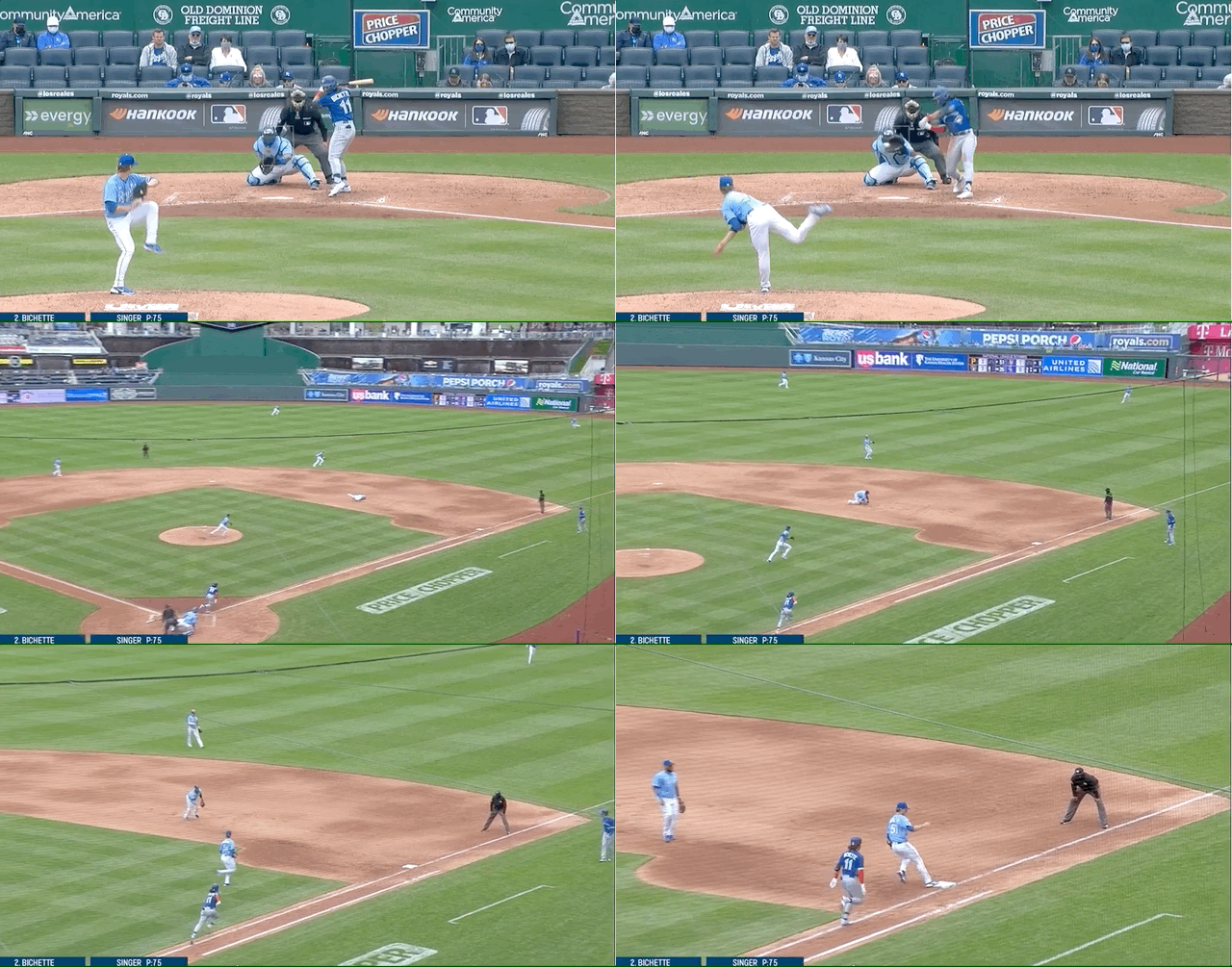
How he irons that out remains to be seen, but Guerrero Jr. famously did this year, and Bichette has only run a groundball rate like this once before in his pro career — during a 56-game stop at triple-A in 2019. In every other pro season he’s kept his grounders below 43.8 percent, so it’s hard to imagine this will be a persistent problem.
It’s still not clear how Bichette will tap into the new power he’s flashed in 2021, if he’s able to do it at all. He could continue doing exactly what he’s done thus far and remain one of the best players in the game, but the idea that there could be more in his bat is undoubtedly compelling.
Because Bichette has been so effective from the moment he stepped on an MLB diamond, he’s felt like a finished product for a while now. That makes it easy to forget that he’s just 23, and there could be plenty of development left for him. By showing a higher ceiling for his power this year he’s demonstrating one of the avenues that development could take.
[relatedlinks]