DUNEDIN, Fla. – The spring’s first reps with the ABS Challenge System for the Toronto Blue Jays didn’t quite start off as planned, as Dylan Cease flipped in a breaking ball for a called strike, RJ Schreck patted his head and was immediately told the mechanism was down.
It stayed that way until Mason Fluharty, the third pitcher working this session of live at-bats, caught Schreck looking at a third strike on the inner edge of the plate just as the system came back online. Alerted by a technician that he could challenge the call, the outfield prospect tapped his helmet and the video went up on the board at TD Ballpark, confirming the pitch just clipped the zone.
“Good job, blue,” a few players yelled to the umpire calling the session and they were off-and-running Wednesday, challenging four more pitches – a Fluharty strike that was overturned, and three Chase Lee strikes, each confirmed – before the round was done.
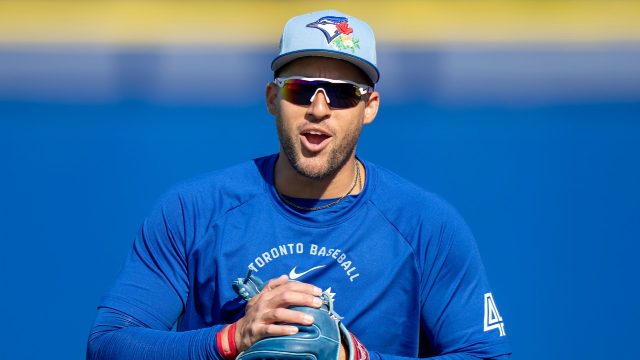
Blue Jays open spring training vs. Phillies on Sportsnet
The Toronto Blue Jays open spring training on Saturday against the Philadelphia Phillies. Watch the game on Sportsnet and Sportsnet+ at 1:10 p.m. ET/ 10:10 a.m. PT.
Broadcast schedule
The Blue Jays won’t be letting the challenges rip quite as freely once they begin Grapefruit League play Saturday, and certainly not in the regular season, so the practice reps are all part of an attempt to hasten their path through a vital learning curve.
Initially, manager John Schneider plans to limit ABS decisions to catchers Alejandro Kirk and Tyler Heineman, and his hitters. Given how effective pitch framing is at stealing strikes from umpires, it stands to reason pitchers, who are in motion coming down the mound as they deliver, may be in the worst position to judge.
Guardrails on when and why to challenge will also be in place, as each team can only make two mistakes in a nine-inning game before losing the ability to question a call, putting a new element of strategy into play.
Burn them early and a club loses the right to test a borderline pitch in late leverage. Don’t use it and perhaps allow an early opportunity to decide a game to slip away.
“The biggest thing is when you're using it,” said Schneider. “Is it really a good time to do it? What's the base state? What's the pitcher's pitch count at? How valuable or how high-leverage is this spot right here? Those are things we've got to address.”
Daulton Varsho doesn’t anticipate challenging strike calls too often, as he thinks ABS will benefit hitters with an elite sense of the zone like Kirk, George Springer and Davis Schneider most. But one fateful pitch he would have tested came in the second inning of the 6-5, 18-inning Game 3 loss to the Los Angeles Dodgers in the World Series, “because I knew it was a ball.”
Bo Bichette opened that inning with a single off Tyler Glasnow and Varsho was up 3-1 in the count when he took a pitch that looked very high. He turned for first, paused, then restarted his way down the line before it was clear home-plate Mark Wegner had called a strike, with Bichette getting picked off at first after turning to second in the confusion.
Varsho walked three pitches later, which would have put two on and none out and likely have led to at least a run as Kirk followed with a base hit, altering the game’s trajectory. Instead, Glasnow escaped the jam, the score remained 0-0 and the next day Schneider said he’s “glad that the challenge system is coming in; It was a two per-cent expected-strike call, so that's really tough to swallow.”
If ABS works as expected, there’s a path to avoiding such tough-to-swallow moments.
“During that time it was like, ‘Hey, he called a strike, keeping working the at-bat,’” said Varsho. “It could have been first and second, nobody out, and we could have had a big inning. Obviously that's behind me now. It's one of those things where yeah, you wish you could have had it then, but it was what it was at that point.”
Blue Jays fans will also remember the ninth inning of Game 6 in the 2015 American League Championship Series, when with runners on the corners and none out, Kansas City Royals closer Wade Davis struck out both Dioner Navarro and Ben Revere after debatable strike calls.
DeMarlo Hale, the Blue Jays’ associate manager who, back then, was John Gibbons’ bench coach, says he hasn’t thought about what might have been had ABS been in place at the time, but he remembers that “Ben was hot.”
“He was down in the dugout, he slammed his stuff, got emotional. And Navy, the same thing,” Hale continued. “That's playoff baseball. Every pitch that changes an at-bat, as we know, puts a higher probability of success one way or the other. But it has helped me over the years, in the playoffs, to understand the emotions are going to be like a roller-coaster. You try to have words and thoughts to help players control those emotions.”
Speaking of remaining in control, that’s the advice Davis Schneider has about using the ABS system effectively, something he learned to do on his way up to the majors.
“You can't get emotional with it,” he explained. “If you think it's a ball, I would call it if you're confident, whether that's no one on or bases loaded. But you've got to know the zone, first and foremost, you can't just be emotional. Guys with two strikes, they strike out and they challenge, that's when you get into trouble, just because they don't want to strike out. Know the zone and go from there.”
John Schneider said Davis Schneider is likely to be one of the Blue Jays players with the green light to challenge as he sees fit, along with Kirk and Springer. “I've learned to know when and when not to believe Vladimir (Guerrero Jr.) on a called strike or out-safe call,” the manager quipped.
Last year, triple-A games averaged 4.2 challenges per game with a 50 per cent overturn rate, with only 2.6 per cent of pitches challenged and only 20 per cent of missed calls tested, according to MLB data. Similar numbers are expected in the majors, underscoring how clubs sought value in their challenges by balancing the risk/reward against the potential for impact.
That’s why Kirk, speaking through interpreter Hector Lebron, said his approach will be to “save challenges as much as I can for late situations.”
“Obviously I'm not going to do it right away, first inning, first at-bat,” he added, aiming to ensure availability “for crucial at-bats, crucial pitches that I understand are close or not.”
Heinemann, too, intends to be cautious behind the plate, preferring that the Blue Jays’ top-of-the-order hitters have them in critical spots.
In Davis Schneider’s experience, caution is needed in trying to use early-game challenges as a way to help an umpire correct his zone.
“There were a couple games (in triple-A) where this umpire was calling the same ball a strike for the whole game, we were challenging every single time and he kept calling it a strike, so it really depends on the umpire,” he said. “Obviously some guys adjust in-game if they call this one a strike and it ends up being a ball.”
In the majors, umpires can request in-game feedback on their zone by marking specific pitches and then being told where they were at between innings.
“The goal isn't to try to bully an umpire into swaying one way or another – these guys have been doing it for a long time,” said John Schneider. “But I'm interested to see how the back and forth goes in real time. When you think about it, hitters are coming in and looking at the iPad, they're looking at their swing or the zone, whatever it is, and getting immediate feedback. It's a good tool.”
A fully automated strike zone would have eliminated the art of pitch framing from the sport and that was one of the arguments against going total robo-ump. Under the challenge system, framing may even be more important since triple-A data showed the vast majority of missed calls went untested, so there are still plenty of strikes out there to be stolen.
"That's the thing,” said John Schneider. “I don't think there are going to be many challenges on pitches that are in the buffer area, where guys have been used to them being called strikes for a long time. I think it's going to be the ones that are pretty clear misses where they're going to use them, and the time of the game is going to be important. … So we want the catchers to continue to do their thing. We talk a lot about those 50-50 pitches and if you can get a handful of those a game, it's usually pretty good outcome for us.”
Last season, Kirk was second in the majors in Catcher Framing Runs – a metric that puts a value on calls won by a backstop – at 17, while Heinemann was tied for eighth at five. Their team total of 23 was second only to the San Francisco Giants’ 27, consistently pushing the onus of challenge-or-not onto the batter.
“Coming up through the D-backs and having an understanding of how to make balls look like strikes, you take pride in that as a catcher,” said Varsho. “I know how good Kirkie and Heinie are, it's going to affect them a little bit with guys who know the zone super-well. If they make it look like a strike, it's going to be hard for the average guy to challenge those decisions.”
There are sure to be bumps along the way as the ABS Challenge System becomes a part of the sport.
If there are technical issues like the ones the Blue Jays experienced at TD Ballpark on Wednesday, for instance, the umpire is to inform both managers that usage is paused and make an in-stadium announcement so fans know. Decisions may be relayed verbally by an umpire if there is an issue displaying the pitch on the videoboard.
Runner placement on an overturned pitch has a chance to be tricky, too, although any doubt is to be resolved in favour of the last base legally touched at the time of the challenge.
No matter how it all plays out the game, in a number of ways, is going to be different.
"I love it,” said Davis Schneider. “As a short guy, you love a smaller zone and I feel like I know the zone pretty well, up and down, in and out, so I feel I do a good job of controlling the zone. I feel a strike should be a strike, no matter what. I know umpires are human and they make mistakes, but when a guy makes a good pitch off the plate and we make a good take, we want to be rewarded for that. Hitters get it wrong, too, so some people are going to get a little bit exposed – I know I've been wrong once or twice. But I think it's cool.”