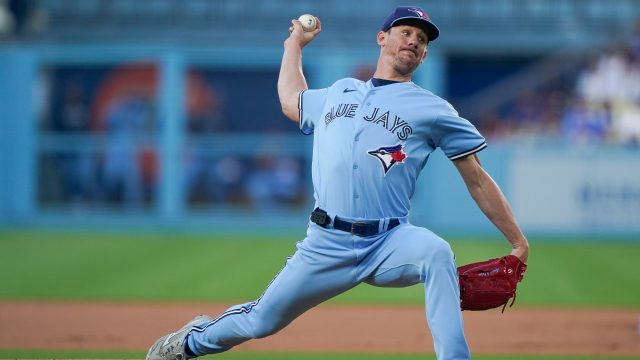
TORONTO – For much of the 2023 season, the handedness of the Toronto Blue Jays roster has received a great deal of attention.
Before the season, the additions of Dalton Varsho, Brandon Belt and Kevin Kiermaier were meant to even out the lineup. Génesis Cabrera was added near the trade deadline due to Tim Mayza’s status as the only lefty in the bullpen. The discourse surrounding the team at the deadline centred on whether it would add a right-handed bat.
These are the type of topics that come up for every MLB team, but because the Blue Jays were seen as righty-dominant for so long — including during their previous competitive iteration in 2015 and 2016 — it’s more salient for Toronto.
Despite the prominence of handedness for the Blue Jays, the team’s radical pitching splits have flown under the radar.
Entering Thursday’s action, Toronto has been absolutely dominant against right-handed hitters, holding them to a .236/.294/.373 line — good for the second-lowest wOBA in the major leagues. Meanwhile, lefties have hit .243/.322/.428 against Toronto, not a truly disastrous total, but still 19th among MLB teams by wOBA.
Although the Blue Jays' pitching has been excellent overall, some matchups have the potential to render it significantly less effective. For instance, on Friday they open a series against a Cleveland Guardians team that can put as many as seven lefties in its lineup on a given day.
Fortunately for Toronto, Cleveland’s popgun offence ranks dead-last in the majors in isolated slugging and 25th in wRC+, so they are unlikely to be the team to victimize the Blue Jays.
If the team earns a wild-card berth, then its splits will become more relevant. A matchup with the Houston Astros lineup looks promising on paper as the team has just three lefties. The Tampa Bay Rays are in the same boat.
On the other hand, the Seattle Mariners and Texas Rangers tend to use five lefties — including switch hitters — in their lineup against right-handed pitching.
We are early in the scoreboard-watching process and matchups aren’t going to be fully drilled down on until they are confirmed, but for a Blue Jays team that has won with its pitching in 2023, these things could play an important role.
An intriguing wrinkle to the team’s significant splits comes with how it might affect how it could deploy a wild-card rotation depending on the matchup the team drew. As Toronto’s clear ace, Kevin Gausman wouldn’t be affected — though he has had trouble with left-handers after running reverse splits in 2021 and 2022 — but the pitchers behind him project to perform differently against righty-dominant or lefty-dominant lineups, based on what we’ve seen this year.
Yusei Kikuchi’s incredible work since the All-Star break could conceivably force him into the Blue Jays’ top three, but in certain matchups he’s probably a better bet than Chris Bassitt — a statement that would’ve seemed preposterous before the season.
Although Jose Berríos has always been significantly better with the platoon advantage, his splits aren’t as extreme as the former New York Met, so he’s probably good to go no matter what. How effective he’ll be could be rather matchup-dependent, though.
Southpaw Hyun Jin Ryu bears mentioning here, but it’s worth noting that he’s run reverse splits in his career, largely due to his ability to pound harder stuff in on right-handers and get them waving at changeups away.
In the bullpen, it will be easier to manage individual matchups, particularly with the presence of Cabrera, but once the Blue Jays turn the ball over to their Jordans, the lefty problem could rear its ugly head.
Jordan Hicks has allowed lefties to produce a .375 OBP against him in 2023, and for his career their wOBA is 74 points higher than it is for righties. While Jordan Romano has run reverse splits earlier in his career, lefties did slightly better against him last year, and in 2023 their wOBA is 57 points higher than righties.
Both pitchers can still be effective when they lack the platoon advantage, but late in games, the Blue Jays will be happier dealing with right-handed bats.
Toronto has bigger problems than worrying about its splits in the midst of a tight playoff race, but if the Blue Jays find themselves in the post-season, they will come into play. The team may have balanced — or even overbalanced — its lineup, but its pitching staff looks significantly less intimidating when the big lefty bats come out.




 0:31
0:31