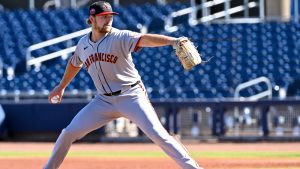
TORONTO — After he threw a three-up, three-down inning on Sunday, pounding the zone and pitching as well as he could’ve imagined in his final spring outing, Spencer Miles went home and packed his bags.
He wasn’t sure what he was packing for. Could be frigid Toronto, where winter’s last grasp is proving stubborn. Could be sunny San Francisco, where one only requires long sleeves at night. It could’ve been any of 28 other MLB markets if Miles, in camp with the Blue Jays as a Rule 5 pick selected from the Giants, didn’t crack Toronto’s opening day roster and ended up on waivers.
It wasn’t until Monday morning, after he’d hauled his stuff to Toronto’s player development complex, when the Blue Jays told him they were putting off their decision for another 48 hours and that he’d be flying with them to Toronto. It was good news to receive, in a way. Miles hadn’t been ruled out. But it didn’t exactly ease his nerves.
“It’s a little easier to sleep now,” Miles said Thursday, a day after learning he’d done the improbable and made the opening-day roster of the defending American League champions. “I was falling asleep well. And then I’d wake up at about five in the morning to go pee and I just could not fall back asleep. My mind was racing. Like, ‘When are they going to give me this news?’”
Wednesday, it turned out, as Blue Jays pitching coach Pete Walker pulled Miles away from a fresh plate of food in the Blue Jays clubhouse to join him in manager John Schneider’s office.
They started talking about MLB’s first game of the season that night in San Francisco between the New York Yankees and Miles’ old club, the Giants. Schneider asked Miles if he enjoyed pitching on the mound at Oracle Park. Miles told him he couldn’t say — he’d never pitched there. A trip to the Arizona Fall League last October and Grapefruit League games this spring were his first time pitching above A-ball.
Well, Schneider said, maybe he should try it out. But since the Giants were playing that night, there simply wasn’t enough time to get Miles on a plane to the west coast for first pitch. So, might as well stick around in Toronto to be in a Blue Jays uniform on Opening Night.
“My food got cold but I think that’s all right,” Miles says. “We’ll take cold food for hearing the news that you’re going to make your big-league debut.”
MLB on Sportsnet
Watch the Toronto Blue Jays, Blue Jays Central pre-game, marquee MLB matchups, Jays in 30, original documentaries, the wild card, divisional series, championship series and entire World Series on Sportsnet and Sportsnet+.
Broadcast schedule
It’s not easy being a Rule 5 pick. Either you make a big-league roster or return to your original organization. While other pitchers in camp are working on their arsenals and shaking off a long winter’s rust, you’re auditioning for a job every time out. And Miles carried the weight of that on his shoulders, particularly after his first three outings of spring when he walked four, allowed hard contact and made a throwing error trying to start a double play at second base.
But a strong afternoon striking out the side against the Tigers two-and-a-half weeks ago gave him confidence, which he rolled forward into his next two appearances, both stretching multiple innings as the Blue Jays tested his endurance. Before his final outing on Sunday, with no indication which way the Blue Jays were leaning, Miles sat at his locker and prayed quietly for good results.
“I was asking Him to take the wheel on it, take the pressure off my shoulders, let me just go use the gifts He's given me,” Miles says. “Because I’ve got a good right arm, good fastball. I got all the stuff. I just have to take a deep breath and really commit and execute each pitch.”
Miles certainly has a good arm, which let him throw 98 in multiple outings this spring. But what separates him from the many other hard-throwers crowding bullpens league-wide is his ability to utilize three different fastball shapes.
His four-seamer backspins up in the zone with natural arm-side movement. His two-seamer accentuates that run, tailing 17 inches in towards a right-handed hitter. And his slower cutter darts the opposite direction, featuring just enough glove-side movement to separate it from the other two fastballs that bore to his right.
Meanwhile, Miles’ best out pitch is his 80-m.p.h. high-spin curveball which moves on two planes, cutting a foot to his glove side while dropping over 50 inches on its way to the plate. The only other pitchers in Blue Jays camp with as much movement on their curveballs this spring were Lazaro Estrada, Eric Lauer, and Max Scherzer.
But those three all throw theirs in the low-to-mid 70’s, giving the pitch ample time to break. Miles throws his much harder but still achieves similar movement, which is what makes it so effective. Hitters have less time to recognize it and adjust.
“It’s a good pitch — it’s so high spin that it’s got a little second gear to it in terms of bite,” Miles says. “I feel like I can use it in any count. Early as a little get-me-over to steal a strike; late for swing-and-miss and put-away. I can go at a righty’s shoulder, pop it in the zone, kneecap guys. I can do a lot of things with it.”
So, how does a guy with this much arm talent make it to Toronto as a Rule 5 pick? It began in Columbia, Mo., where Miles grew up only minutes from University of Missouri’s campus.
He was wiry and athletic, playing both ways at Rock Bridge High School where he hit .429 as a senior. But as a 150-pound 18-year-old who couldn’t hit 90 on the radar gun, Miles’ college interest was limited. He had two offers from smaller NAIA schools — one to play baseball, the other to play basketball. But for Miles, it was baseball at a big school or bust. So, he enrolled at Missouri academically to stay close to home.
The Tigers baseball program took him as a walk-on in 2019, which felt like an accomplishment in and of itself. Particularly after growing up at Missouri games watching his brother, John, who pitched for the school from 2012 through 2015. While he didn’t throw a pitch for Missouri that fall, Miles made the most of his newfound exposure to a college-level strength and nutrition program, putting on considerable muscle for the first time in his life. By the time he left Missouri, Miles had added 40 pounds to his frame and 10 m.p.h. behind his fastball.
Hitting 97 as a junior got him noticed despite shaky results in games, and the Giants took a flier in the fourth round of the 2022 draft, signing Miles under slot as part of a strategy to select and sign first-round talent Carson Whisenhunt — the top-100 prospect made his MLB debut with the Giants last season — in the second.
It was a flier. Miles was known for trying to out-stuff college hitters rather than out-think them, which often led to a hefty price being paid for leaving too many pitches over the heart of the plate. The Giants viewed him as a starter but knew it would be a longer-term project to help Miles gain more pitchability and learn how to maximize his arsenal through sequencing and approach.
“I was ready to attack all of that. I’m a super late bloomer developmentally so I was really excited to get my feet wet,” Miles says. “Definitely didn’t expect to spend most of my time injured.”
When Miles was a high school junior, he played through a stress fracture in his lower back that stubbornly refused to close. He underwent a procedure that year to insert a screw into the problematic facet joint and apply bone growth to encourage healing. And after pitching with it over the four years following, Miles figured his back issues were behind him.
But after he was drafted by the Giants in 2022, Miles took his first extended off-season break from baseball since high school. And as the theory goes, that de-load period gave his spine time to properly respond and adapt to all the load and stress it had been under the prior four years. His problem was no longer that the bone wouldn’t grow — now it was growing too much.
As he ramped up for his first full professional season in 2023, something didn’t feel right. It was hard to access velocity; even harder to recover between mound sessions. A series of CT scans and MRIs revealed a bone blockage at the facet joint Miles had repaired — he refers to the unwanted mass as “a doorstop” — which necessitated a second surgery to shave down the growth and create more space for his back to extend and rotate.
That cost him all of 2023. Back on a mound at Giants camp the next year, everything felt fine until Miles pitched a bullpen and could barely throw the following day. An MRI revealed a flexor strain, which Miles originally tried to treat conservatively with rehab and a platelet-rich plasma injection. But only five outings into his rookieball season, as his symptoms worsened with each outing, a date with an orthopedist beckoned. And Tommy John surgery ended his season.
A year-and-a-half later, Miles finally returned to competition at the Arizona Fall League healthy and eager to get his career back on the rails. That’s where the Blue Jays gained interest in him as he struck out 32 per cent of the hitters he faced while walking only one across four starts and a relief appearance. At the Rule 5 draft two months later, he became a Blue Jay. And at Rogers Centre Friday night, he’ll become a big-leaguer.
It’s been a lot to process. It isn’t every day a 25-year-old with 14.2 professional innings and a 6.27 college ERA cracks an opening-day roster. And the pressure Miles pitched through all spring isn’t going away. As a Rule 5 pick, he must remain in the majors for the entire season. On a win-now team such as the Blue Jays, it isn’t as easy to stomach a run of bad outings as it would be for a less competitive club.
But that’s the story of his time in this game. A skinny kid who can’t crack 90 walks on at an SEC school, gets hit around, gets hurt, gets hurt again, reaches his mid-20’s without pitching above A-ball, and is plucked from obscurity onto a big-league mound. Nothing about it is probable. So, why would his first Opening Day be?
“I have two surgeries and no innings to show for it. It’s a little surreal. I don't think it's fully hit yet that I’m going to be a major leaguer,” he says. “But I know the stuff's there. I’ve just got to go out there, take a deep breath in between each pitch, drive the ball to where we want it, and let everything unfold as it will.”