NEW YORK — Two weeks ago, as his Blue Jays stared down a 13-game crucible against the Red Sox, Yankees, Rays, and Yankees again, John Schneider framed what lay ahead as a gift.
"There's still really meaningful baseball and that's fun,” he said. “There's nothing better than that when you're getting into the dog days of August.”
Here on the other side of it, after the Blue Jays fell, 8-3, to the Yankees on Sunday to seal an 8-5 record over that run of play, it turns out the crucible was its own reward. Even more meaningful baseball awaits as the Blue Jays wrestle for positioning with over half of a hyper-competitive — perhaps uncompetitive, depending on your perspective — American League.
“It's a tough stretch. It's good teams. A .500 road trip against in-division teams that are at the top. You want to say that's good, but we need to be a little bit better in certain situations,” Schneider said. “But, big picture, you get through this stretch and enjoy the off day. I like the way that we're playing and hopefully continue to take another step forward when we get home on Tuesday.”
Regular-season games against the AL’s top three teams — the Red Sox, Rays, and Yankees — are now in the rearview after José Soriano was tagged for five runs at Yankee Stadium while the left-handed relievers in Toronto’s bullpen couldn’t succeed in favourable matchups.
“Credit to their lineup — they're a very good lineup,” Soriano said. “I missed a couple of spots, that's when the damage came. But it's part of the game. Sometimes that's going to happen. We control what we can control.”
Working without his best stuff or command while facing a lineup featuring seven left-handed hitters, Soriano ran a near-even mix of sinkers, splitters, and curveballs, working in the odd four-seamer along the way.
He allowed a pair in the second, as the Yankees took advantage of some misplaced fastballs to string hits together, and began the sixth with three consecutive singles — the third a sacrifice bunt attempt Soriano fielded but was forced to swallow — before John Schneider lifted him and brought Braydon Fisher into a near-impossible spot with the bases loaded and none out.
Yet the right-hander nearly escaped it, striking out Austin Wells looking with an elevated, full-count curveball and getting Jose Caballero to hit a flyball too shallow to score the runner from third.
That was, until Trent Grisham worked Fisher for a six-pitch walk under a barrage of breaking balls — Fisher threw only one fastball in 13 pitches — before Ben Rice got just enough of Mason Fluharty’s full count slider for a softly-hit, left-on-left single to cash a couple more. Jazz Chisholm did more same-sided damage an inning later, taking Brendon Little deep to right with a runner on.
“With Rice against Flu, he didn't hit it all that hard. I think it probably looked harder off the bat for (right fielder Brett Bateman) than it actually was,” Schneider said. “Little's, that's just a hanger. That's just a hanging curveball.”
The Blue Jays offence, meanwhile, erased an early two-run deficit with sacrifice flies off the bats of Brett Bateman and Daz Cameron in the third and fourth innings, respectively. And Alejandro Kirk drove in one more in the eighth. But it was an otherwise punchless day to cap a series in which Toronto went 6-for-40 (.150) with runners in scoring position.
“The theme of this series was missing the big hit,” Schneider said. “I think it's just not being in a rush when you get in those spots. If you've got to get a guy over, get a guy over. If you need to get a hit, you've got to zone into a spot that you can drive the ball a little bit more consistently. … I think you've just got to be a little more patient.”
Now, 30 games remain for a Blue Jays team whose seven-series winning streak — interrupted only by this month’s one-game makeup date at Wrigley Field — was snapped Sunday. That doesn’t lessen what the team’s accomplished over its last four weeks, going 16-10 in that span to barge back into post-season contention.
“I think we’re in a good position right now,” Soriano said. “If we keep playing good, I think we can make it.”
One of the more compelling questions to be answered over the next five weeks is how many wins it will take for the AL’s third wild card team to sneak into the dance. The lowest win total an AL playoff team has had in the three-team wild card era is 86. But this season is tracking to drop that bar several notches.
Entering Sunday, FanGraphs projected that third wild card team to be one of the Blue Jays, Mariners, or Rangers — all of whom it forecasted to finish with 80 wins. Baseball Prospectus, which utilizes the PECOTA projection system (FanGraphs uses a blend of Steamer and ZiPS), saw it being one of the Mariners or Guardians with 82 wins, while the Blue Jays finished with 79.
To say the error bars of these projections are wide would be an understatement. We’re currently looking at a difference within tenths of a win between many of the teams in the race. Out there in the real world, wins are awarded in whole.
But while all models are wrong, some are useful. And the important takeaway here is it’s reasonable to predict that 82 wins could be enough to qualify for the tournament.
And Toronto’s path to 82 wins isn’t unfathomable. It would mean going 18-12 over these remaining 30 games — a .600 winning percentage, or 97-win full-season pace. That’s doable.
Yet nothing will come easily. You’ll hear a lot about strength of schedule in coming days, as the Blue Jays will exclusively play sub-.500 teams over these final 10 series. That’s certainly preferable to the alternative. But it’s no panacea.
For starters, 11 of 15 AL teams began Sunday either at or below .500, including the Blue Jays themselves, who have been a sub-.500 team since April 4 save for one day in May and another in June when they reached level. And recent performance matters more than long-term performance in this context. To that end, 60 per cent of Toronto’s remaining games are against teams with winning records since the all-star break.
Plus, six of Toronto’s next dozen are against the Kansas City Royals, who have won eight straight and 17 of their last 21 games at home. There’s also a series with the Detroit Tigers, who boast MLB’s highest run differential (plus-112) since the beginning of June, and the Cleveland Guardians, who have pitched to the AL’s fourth-best ERA (3.77) over the same span.
A better way to think about this is that the Blue Jays will play six of their final 10 series against teams within two games of them in the wild-card race. That means they can greatly influence their destiny if they play well and knock competitors down the standings.
Of the eight teams tightly bunched in the standings — who says MLB lacks competitive balance? — the Blue Jays play the most games within the group (18) by far. That’s a distinct advantage. The Astros (2 games remaining within the group), Mariners (8), Orioles (9), Rangers (9), Twins (12), Guardians (13), and Tigers (13) have much less opportunity to directly impact the race.
Several tiebreakers, which stand to be extremely important provided the AL remains this flat, will also be decided over this stretch. The post-season tiebreaker rabbit hole runs awfully deep, but MLB’s first and simplest method is via head-to-head record. And while the Blue Jays have already dropped season series to the Rangers, Twins, and White Sox direct tiebreakers with the Guardians, Mariners, Orioles, and Tigers remain in play.
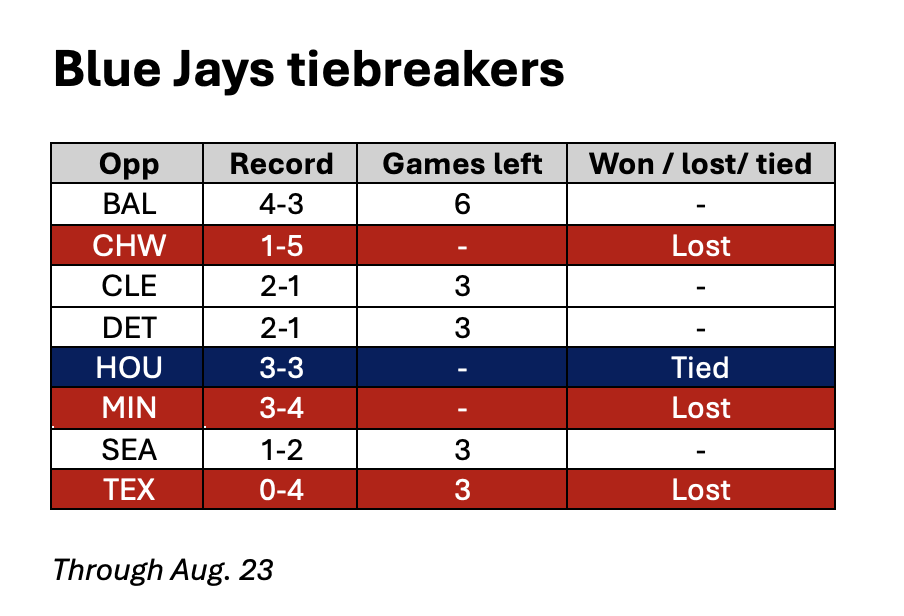
If the Blue Jays finished in a direct tie with Houston, who they split their season series with, it would be broken via intradivision record. Following Sunday’s games, the Blue Jays held a slight edge, going 23-23 against AL East opponents, while Houston has gone 22-24 within the West. (The next tiebreaker would be intraleague record, where the Astros currently have a sizeable advantage.)
So, five weeks, 10 series, and 30 games to find out if the defending AL champions can do what not long ago seemed implausible. The most important variable keeping the Blue Jays relevant — the overall weakness of their league — doesn’t need to be discussed. Another time. For now, there’s meaningful baseball to play.



 0:56
0:56

 0:43
0:43