TORONTO — Austin Smith’s teammates support what he’s doing. They praise him for the boldness required to be a two-way player and ask questions about his preparation, but along with that they like to give him a hard time.
During spring training, Smith would work out with minor-league pitchers every morning before transitioning over to the position players for outfield reps and baserunning drills. Some mornings, he’d get bemused looks as he loosened up his left arm.
"The pitchers think it's funny,” Smith says. “They're like, 'What are you doing over here? You’re an outfielder. Go with the outfielders!' They think it’s funny and they definitely make ‘Smitty Ohtani’ jokes. But it's definitely been really fun to be able to do this at a professional level.”
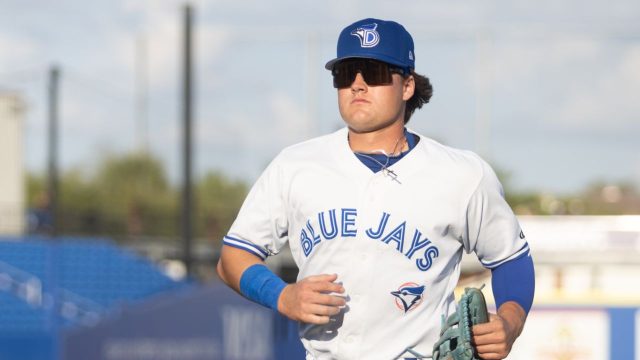
A 10th-round pick in 2025, the 23-year-old Smith is just now beginning his journey as a two-way player in professional baseball. He debuted as a position player last summer, but with the blessing of the Blue Jays he’s now pitching and hitting for the Class A Dunedin Blue Jays, pushing himself closer to his dream of being a big-league outfielder who also pitches in relief.
It’s a lofty goal that requires extra preparation, but his coaches say he embraces the challenge. Even for the Blue Jays, it’s something they’ve never done before — a chance to develop a talented young player while also signalling to other recruits that they’re open-minded and flexible.
“I didn't know what to expect,” recalls Ryan Casteel, the first-year manager of the Dunedin Blue Jays. “But I'm excited about it. I like Austin. I love Austin as a player. Great kid. It's been fun."
Growing up, Smith loved baseball. His father, Brian, played professionally in the Seattle Mariners organization for a couple years after being selected in the 49th round of the 1995 draft and his younger brother Trevor loves the sport, too. So from the age of four or five years old, the left-handed hitting, left-handed throwing Smith played lots of baseball.
By age seven, he was playing travel ball. By eight, he was throwing curveballs. A San Diego native, he grew up a Padres fan, but he also liked watching the Philadelphia Phillies, and especially Bryce Harper, whose game he tries to emulate to this day.
“I like his swagger,” Smith says. “He has that like mentality of he's the best and no one's better than him. It's kind of how I treat my game.”
Smith was just a hitter when he first enrolled at Granite Hills High School in San Diego, the alma mater of former big-leaguers like Brian Giles, Marcus Giles and Shane Spencer. But at some point during his sophomore year, coach James Davis needed a pitcher, put Smith on the mound and liked what he saw.
Get ready to do a lot of more of this, the coach told Smith. Because you’re going to be pitching and hitting.
From there, Smith’s two-way ambitions intensified. In college, he pitched and hit at the University of San Diego, where he was a John Olerud Two-Way Player of the Year Award semifinalist. As a hitter, he batted .305 with an .847 OPS in college. As a pitcher, he struck out 168 in 161.2 innings on his way to a 5.07 ERA.
Along the way, he drew inspiration from baseball’s biggest star.
“Oh, 100 per cent,” Smith said. “I mean, Shohei Ohtani, he's a special talent, such a distinct talent. Me watching Shohei play is like, one day I want to do that so that people can think of Austin Smith as being one of the greatest two-ways to play the game.”
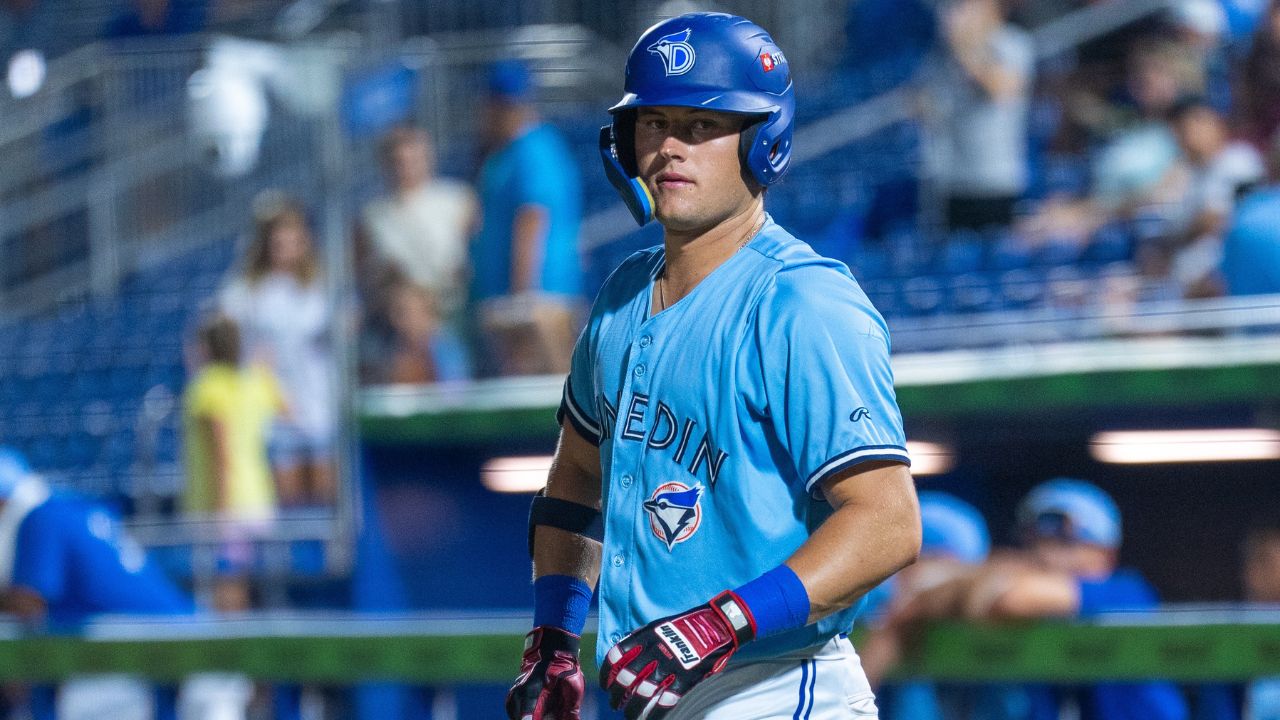
First, he had to get drafted. Led by area scout Tony Cho, the Blue Jays watched Smith carefully and expressed interest in a deal last summer when Smith was eligible as a senior. But while other teams wanted Smith as a hitter, the Blue Jays saw more potential, telling him they were considering letting him pitch also.
They selected him in the 10th round, offered him a modest $5,000 bonus and told him it was time to get to work.
“I was super excited,” Smith recalls.
Though they drafted Olerud as a hitter in 1989 and famously pursued Ohtani in free agency before the 2024 season, the Blue Jays haven’t actually developed a two-way player of their own before. They’ve put together development plans for potential draft picks, but this will be the first time they’ve undertaken this challenge. The more they spoke with Smith, the more his enthusiasm came through.
“He was all for it,” recalls Blue Jays player development director Joe Sclafani. “So we went into it trying to figure out what's the proper way to do that. How do we map out the season?”
In recent weeks, those challenges have gone from theoretical to real. After the draft last summer, Smith debuted as a position player, but he didn’t pitch in his first taste of pro ball. Then, as spring training ramped up, he and the Blue Jays developed a plan where he does both.
For a typical spring-training day, Smith would arrive at the field around 6 a.m. He’d then start his prep work, eat a quick breakfast and join the organization’s other pitching prospects. Along with the other pitchers, he’d play catch, complete various throwing drills and work on conditioning with sprints. Unlike Ohtani, Smith’s a reliever — but still, there’s a lot of work.
Next up was his outfield and hitting prep. After about two hours with the pitchers, Smith would join the position players for their work, including defensive drills, baserunning work and batting practice.
“And then if it was a lifting day, I'd lift at the end of all,” Smith recalls.
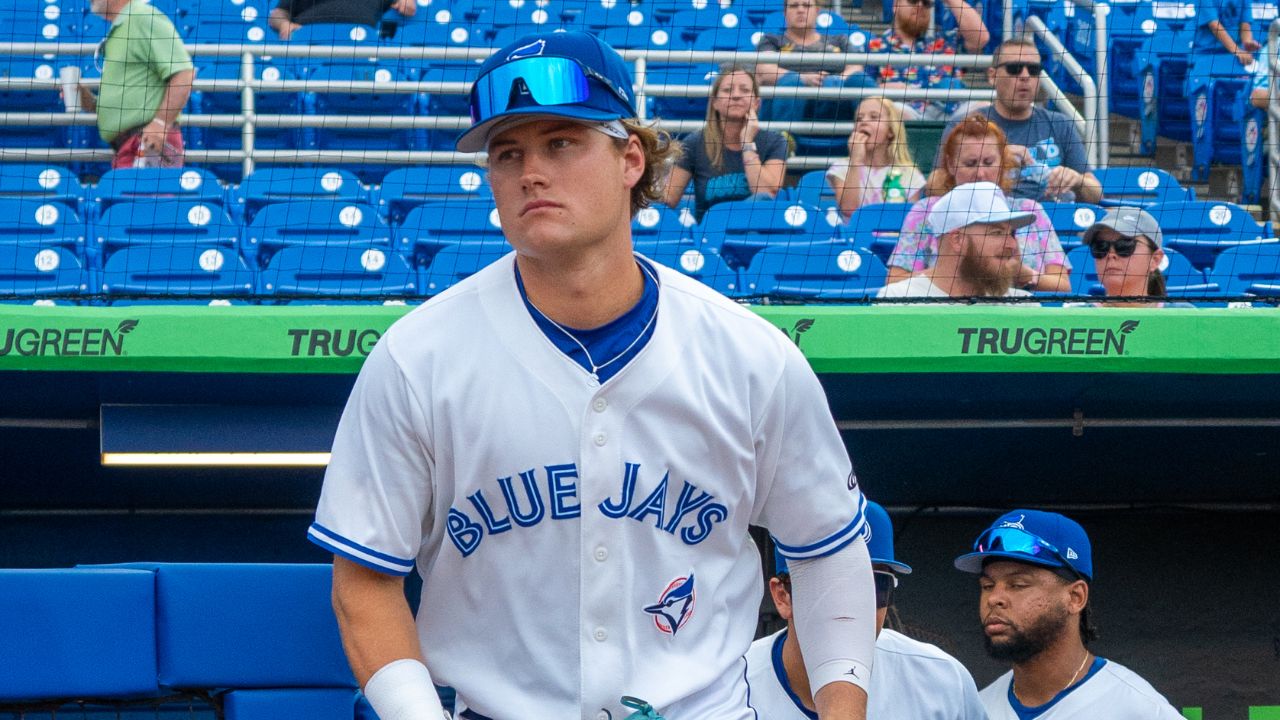
It’s a lot of work — but that’s not how the 23-year-old sees it.
“I wouldn't say it was too tiring,” Smith says. “I’d say it was more fun. But definitely I already know professional baseball's a grind. There's so many games, so at some point it's gonna be tiring, so that's when you dig deep and push past it.”
On that front, he’ll have some support. Casteel’s managing for the first time this year, but he’s familiar with the rhythm of professional baseball after 13 seasons playing in the minors. The 34-year-old skipper knows Smith’s taking on more work than most, so he makes a point of checking in daily to see how he’s doing.
“He’s super honest with me, but it's very organic,” Casteel says. “I trust my eyes on what I see if it looks like he's dragging, then it's obviously like it's time to give him a blow. We have to push guys, but we can't break guys.”
Now that the season’s begun, the Blue Jays have picked Thursdays as the day Smith pitches. There’s flexibility in all of this, but for now that gives him some clarity as he plans his week. He plays the outfield four or five times a week and typically throws a touch-and-feel bullpen ahead of his game appearance, but on Thursdays he’s just a pitcher, sitting in the bullpen until his name is called.
“It's definitely a little easier knowing that I'm just a pitcher and I'm not focused on any hitting stuff,” Smith says.
MLB on Sportsnet
Watch the Toronto Blue Jays, Blue Jays Central pre-game, marquee MLB matchups, Jays in 30, original documentaries, the wild card, divisional series, championship series and entire World Series on Sportsnet and Sportsnet+.
Broadcast schedule
Sclafani notes that Smith’s stuff is “maybe not overpowering,” but with a fastball that can reach 92 m.p.h., he has pitches that play against advanced competition. Plus, the Blue Jays like his confidence and competitiveness on the mound, even though it’s not his primary position.
“It's really simple for me,” Smith says. “I treat it as, like, ‘Give me the ball, and here's my fastball, try to hit it.’ Honestly, I just go up there like, mano a mano, ‘prove to me that you can hit this’ and then I'll start switching my gameplan a little bit, but I have the same gameplan every time I pitch. I compete and I try to have the quickest inning ever.”
On the position-player side, Smith’s upside is clear. Sclafani describes him as a hitter with a good feel for the strike zone and an ability to find the barrel and reach base. The Blue Jays like his power potential and his ability to make opposing pitchers work.
His manager describes Smith as a “super gritty” and “super refreshing” player who loves playing the game.
“This guy just wants to play baseball,” Casteel says. “He’s a dynamic player. He's got some speed, can throw obviously. He's got good bat-to-ball (skills), he's got some pop. He brings a lot of different areas that can impact the game.”
Asked to describe himself as an outfielder, Smith echoes that sentiment.
“A gamer,” he says. “I can do basically everything that’s needed at the plate. I can hit for power, I make contact, I can bunt, I can steal, I can play good defence. Even if I don't have that one tool that stands out, I’m just a scrappy player.”
While Smith’s off to a slow start at the plate with a .489 OPS through 13 games this year, he posted a .789 OPS with as many walks as strikeouts in 2025, reinforcing his status as an intriguing outfield prospect. Of course, the goal is to do it all at once.
“We should at least try it,” Sclafani says. “He can do some things, so let's figure it out. Obviously he has to prove that he can do it and we need to feel good about it, but let's pursue it.”
From the Blue Jays’ standpoint, a two-way player like Smith could help the major-league team even if he’s not quite Josh Hader or Aroldis Chapman on the mound. Even a pitcher capable of helping out in lower leverage situations would theoretically be valuable, allowing others in the bullpen to rest.
“It’s like if you have a guy that has caught in the past and can be an emergency catcher,” Sclafani says. “You only get those 26 (roster) spots and so it’d be having somebody out there that’s a viable option to come in and help when we need it.”
Plus, this aligns with the Blue Jays’ overall view on player development, which is catered to each player’s needs and abilities rather than one-size-fits-all. By working with Smith in this way, they’re indicating to other potential prospects that there’s open-mindedness to do things differently here.
“We try to work with what makes them great,” Sclafani says. “There's some freedom in that. We don't cookie-cutter everything, so I think the more examples that we have of that, the better. I do think it is a definite signal to the kids like, ‘Hey, we will work with you.’”
For Smith, this is an exciting time. He’s even given his younger brother Trevor some pointers and now Trevor’s a two-way player at Washington State University, a Division 1 college. And the work he’s putting in now — those early mornings and long days — it’s all pointing toward a vision. In Smith’s best-case scenario, he’s in the big-leagues as a scrappy outfielder who takes the mound late in games and closes out wins for his team.
“Oh yeah, 100 per cent,” he says. “I don't think that's really ever been done before. So it'd be sick to make it a first.”