LAS VEGAS — The day after the Kansas City Royals lost Game 7 of the 2014 World Series to the San Francisco Giants 3-2, J.J. Picollo remembers returning to Kauffman Stadium with other front-office members and wondering if they’d ever be back in the same situation.
There were the obvious what-ifs, especially with Alex Gordon left standing at third base after being wisely stopped by third-base coach Mike Jirschele on the play before Salvador Perez popped out to end it. And after a wild run that began with a remarkable 9-8, 13-inning comeback win over Oakland Athletics in the wild-card game, it was reasonable to wonder whether they could replicate that same magic.
“We'd worked so hard to get to that point and of course you don't know what your destiny is going to be,” said Picollo, an assistant general manager at the time who is now GM and vice-president of baseball operations for the Royals. “Once you sort of absorb the pain and that goes away, you quickly flip to spring training and the hunger to be great is still there, and you just continue to try to guide and lead the best way you can.
"But something that you can take out of a painful loss like that is that it's a major adversity,” he added. “Adversity brings toughness and hunger and desire to another level. And that's what good teams do, they will turn a negative into a positive. You've just got to bank on the professionals, the maturity and the veterans in that clubhouse to allow that to happen. And if it happens the right way, you can have magical things happen the following year.”
Magical things did indeed happen for the Royals in 2015, when they returned much of the same roster and beat the Toronto Blue Jays in the American League Championship Series en route to a decisive World Series victory over the New York Mets.
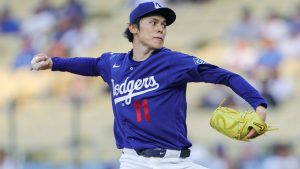
A decade onward their experience isn’t necessarily a model for the Blue Jays, who lost an even more heartbreaking World Series Game 7 to the Los Angeles Dodgers, but it does offer an interesting case study in how to return the following season and take the final step.
Already the Blue Jays have examined best practices in maintaining success, Blue Jays general manager Ross Atkins said Wednesday, “but we've tried to do that with a bigger sample size, as we think about what successful teams do, (rather) than looking at one or two examples.”
“It's more just about, what good teams do well in order to win more and also in the playoffs,” he added. “And just trying to learn from the history as much as we can.”
Those 2014-15 Royals teams feature some intriguing parallels, first-and-foremost with the contact-baserunning-pressure-defence style they played. The Blue Jays emphasized those same traits but with more capacity for damage at the plate, and are expected to return a largely similar core, just as those K.C. teams did.
The biggest divergence between them is in financial might, the Royals working within the limits of their smaller Midwest market, while the Blue Jays were a top-five payroll club in 2025.
That just means they’ll have more options for their reload than Picollo and his staff did, when James Shields, Nori Aoki and Billy Butler left the 2014 team and were replaced by Edinson Volquez, former Blue Jay Alex Rios and future Blue Jay Kendrys Morales.
Still, the heavy lifting was done by the returning Royals players, said Picollo, who “came into 2015 with such a tremendous focus on winning the World Series, not about just getting back to the playoffs.”
“Very similar to this year, Game 7, one-run difference, tight game all the way through — those things turned into motivators for us, so as a front office, it was just a matter of trying to keep things in perspective,” he said. “What we realized is for us in '14, running the bases and putting pressure on the defence was a big part of our identity. Guys embraced it. We wanted to continue to encourage it and it continued to be a big part of our game.
“The big thing for us going into the middle of ‘15 was trying to understand what the gaps were,” Picollo added. “We utilized the trade deadline in a way that was very beneficial, getting Ben Zobrist and Johnny Cueto. So, you'll still make those adjustments along the way. But I think the focus has to be to get in that position, let's not get complacent, let's not just assume we're going to be in the playoffs, still stay hungry. If the team can do that, then the front office can make the decision on what to add at the deadline.”
The latter part from Picollo is worth keeping in mind as the off-season may be the best time to add talent, but it’s not the only time and needs evolve as a season progresses. This winter, the most immediate roster need for the Blue Jays is in starting pitching, ideally someone from the upper-end of the market, although the free agency of Bo Bichette and either retaining or backfilling for him isn’t too far behind.
Injuries and underperformance will surely create different priorities come July, for which the Blue Jays will require continued progress from their farm system to create currency for summer shopping.
So many different elements, organization-wide, came together for the Blue Jays this season and those beneath-the-surface elements are just as essential for continued success in 2026.
From a distance, Picollo watched a Blue Jays team he expects “will come back very hungry in '26,” one that played in ways that reminded him of those past Royals teams.
“The energy was apparent,” he said. “The tight games, the back and forth. The beginning of our ‘14 playoff journey was the come-from-behind, 13-inning wild-card game. From there, we played well, but there were a lot of tough games along the way. But you could see that there's no back down, there was no moment too big for guys, they all wanted to be the guy. You could see that a lot on both sides, whether it was the Dodgers or the Blue Jays. Somebody's throwing a punch, we're going to counterpunch. It was an awesome World Series to watch.”
There may be consensus industry-wide on that, although that won’t ease the sting of losing Game 7 for the Blue Jays. The only thing that might help is winning the next World Series, chasing a bad memory with a good one like the 2014-15 Royals.
Seen and heard roaming The Cosmopolitan of Las Vegas during the GM Meetings:
CHANGING REP? — An intriguing dynamic around the Blue Jays after their run to the World Series is how their narrative is being reframed in baseball’s gossip circles. Typically, they’re described by agents and rival executives as being some combination of active, aggressive, eager, desperate, sometimes with respect, sometimes with snickering, and this year is no different. An emerging addendum now is how they’re being received differently in the market and to be fair, an impression was made on newcomers to the October experience north of the border, one that gives them some potential momentum in the market.
How much that matters is up for debate, although it’s probably time for the lazy, blanket free-agents-don’t-want-to-come-to-Canada framework to fade away. Prominent players to sign with the Blue Jays include Jack Morris, Dave Winfield, Paul Molitor, Dave Stewart and Rogers Clemens in the 1990’s; A.J. Burnett, B.J. Ryan and Frank Thomas during the frugal times of the century’s first decade; Russell Martin, J.A. Happ and Kendrys Morales in the transitionary 2010s; and Hyun Jin Ryu, George Springer, Kevin Gausman, Yusei Kikuchi, Chris Bassitt, Anthony Santander, Jeff Hoffman and Max Scherzer this decade.
The takeaway then should be, as it’s always been, is that when the baseball is right and money is there, players will head north. Perhaps then, the industry, with a renewed familiarity with the city thanks to October, will start to see things the way influential agent Scott Boras, at minimum, long has, when he says “Toronto is one of the top four or five major markets in the major leagues.”
“When you become a winning club, players take notice,” Boras added later. “They have done so much with their ballpark, where we hear about how families are treated, where among all the players’ wives and families to note how that's done, it's become very much a model for other major-league teams. There are a lot of things along those lines in the player community which have drawn players to Toronto. And when you have talent, you have certainly the bright lights that go with it. So I think that everything about what they've done in the past couple of years has proven to reward them with that placement, to say that in the player community, Toronto is a winning franchise and I would strongly consider being part of that.”
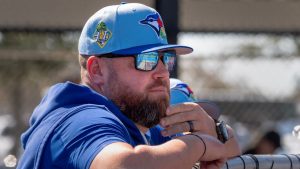
HITTING COACH WANTED — The Blue Jays have a second coaching vacancy to fill after hitting assistant Hunter Mense left to take the head spot with the San Francisco Giants.
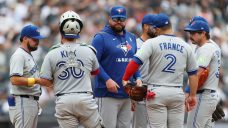
Hitting coach David Popkins “will have a huge say” as part of a process that manager “John Schneider will be driving” to backfill the position, said Ross Atkins. Don Mattingly also left his bench coach position, and the Blue Jays are considering different options for that role.
“To lose Hunter Mense and to lose Donnie is a hit. And we just have to turn that into the opportunity to think about how to get better moving forward,” said Atkins. “We always will focus internally first and think about even just internally on our staff, how responsibilities may or may not shift and obviously from our player-development system, or even from our broader baseball operations department. Those relationships are powerful.”
QUOTABLE: “Having a roster that really fits together and works together, and that chemistry that you look for with it, that's hard to find. You can try to plan in advance. You don't always know when it's going to click like that and when it does, sometimes it can seem a little fleeting. If you try to not change anything, to hold on to every little piece of it, usually that doesn't work. Change is just the part of the game. You have to lean into that. It gets down to your understanding of what is the identity of your group and what needs to be in place for that identity to continue. And then not looking past individual players, not holding on to nostalgia, just running something back because it felt good, but really trying to look forward. What do we have to do to plan this out again? Everybody starts from zero every off-season. So you can't just hope to bottle up whatever it was that you had the previous year, but you don't want to lose those important threads to your identity that bring teams together.” — Chaim Bloom, president of baseball operations for the St. Louis Cardinals, on the challenges of maintaining success with mix-and-match rosters.

 5:49
5:49