When Shane Bieber returned to the Toronto Blue Jays on June 23, the team was hopeful he would be a stabilizing force at the back of their rotation.
After three starts, the 31-year-old is carrying a 9.00 ERA that indicates he hasn’t come close to clearing that bar. Bieber taking some time to find his footing was expected to some degree, but there is a difference between not looking sharp and getting battered the way the veteran has so far. Even in a small sample, it’s impossible to give up a run per inning and produce a 13.41 expected ERA without raising serious questions.
Bieber is an extremely accomplished pitcher who was effective last year — and the Blue Jays aren’t overflowing with viable alternatives. That means that the right-hander should get some time to iron things out, but his start to the season has been troubling enough that it might not take too long for things to get existential. (He takes the mound Friday as the Jays face the Padres on Sportsnet and Sportsnet+, 9:30 p.m. / 6:30 p.m. PT.)
To get a better handle on whether worries about Bieber are hyperbolic or understandable requires an examination of his stuff, command and quality of contact against.
RAW STUFF
Bieber has never been a pitcher who has dominated thanks to high velocity and filthy secondary pitches. Stellar command, strong sequencing and a varied repertoire have always been foundational to his success.
That might make it sound like declines in the velocity and movement of his pitches aren’t relevant, because that’s not what he beats hitters with — but just because stuff isn’t his greatest strength, it doesn’t mean he can afford for it to be a crippling weakness.
What we’ve seen from Bieber so far is a slightly diminished version of the arsenal he deployed last season. That starts with a slight velocity dip, though he’s still above some of his other successful seasons, like 2022 when he produced a 2.88 ERA in 200 innings.
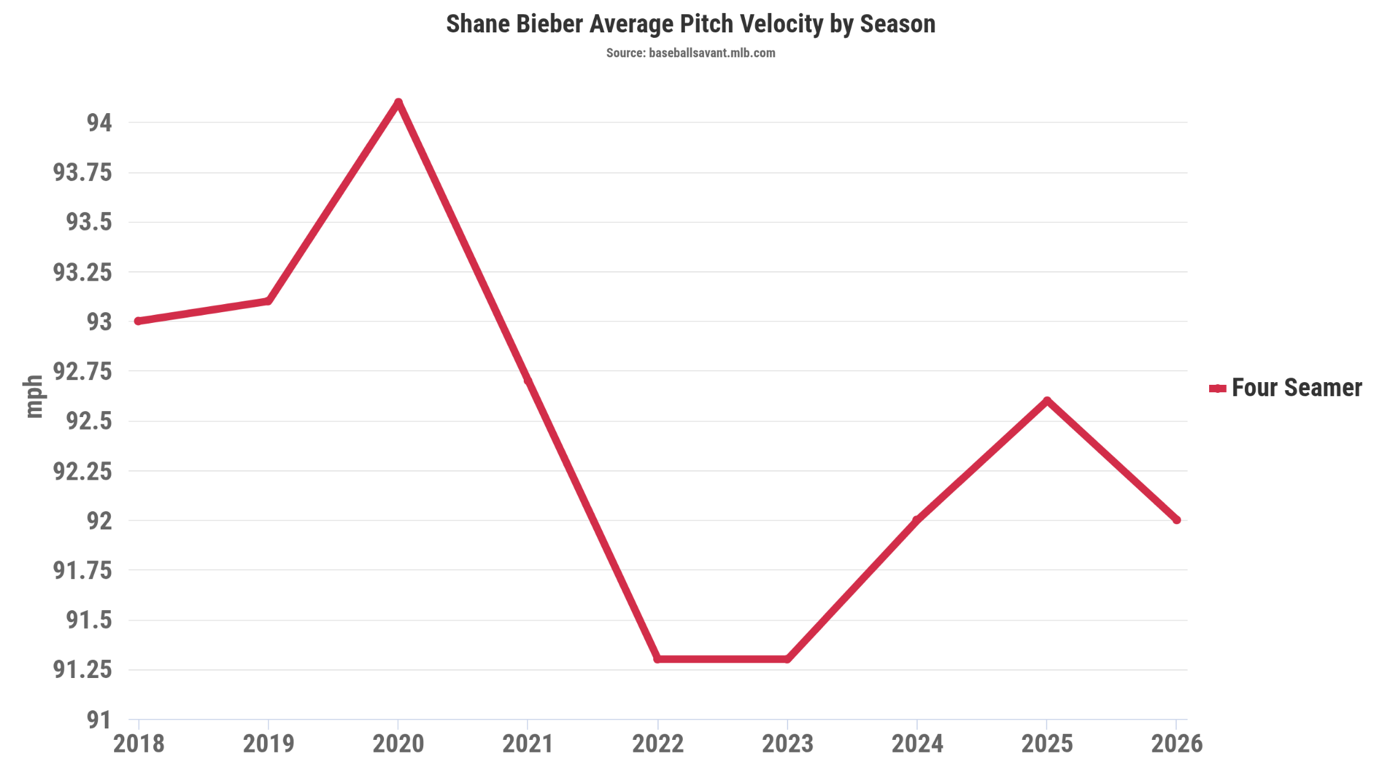
More concerning for Bieber is the lessened movement on some of his pitches from last season, both horizontally and vertically:
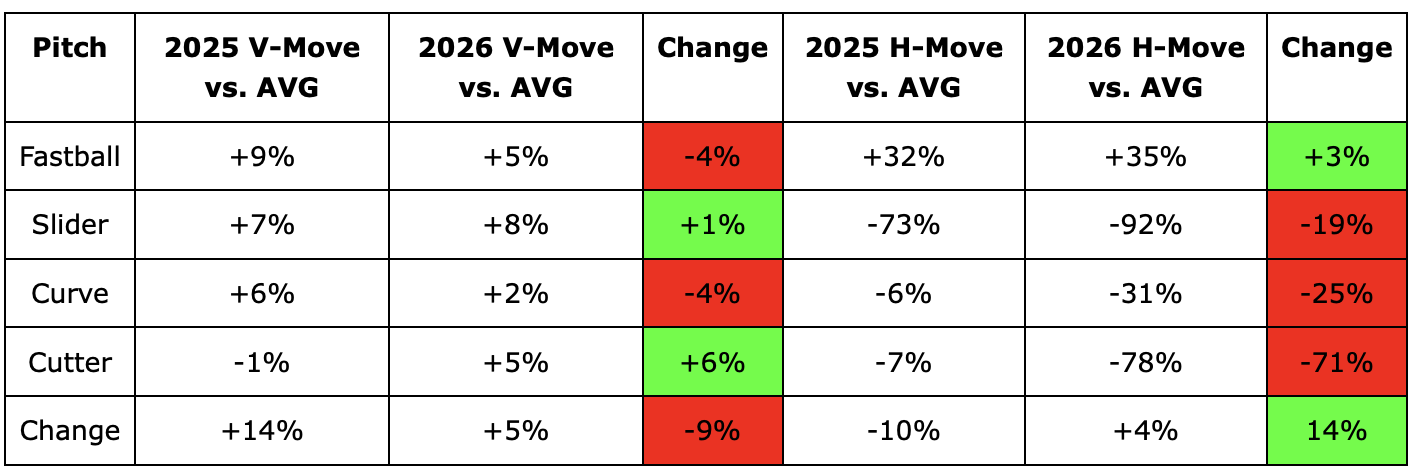
Much of what we see here is broadly the same as 2025, but there’s a notable dip in the horizontal movement on pitches that break to his glove side. His slider has always been dropped more and slid less than most, but that trend has been exaggerated, and his cutter and curve have become far below-average horizontally.
That’s not too problematic for the curveball — a pitch that gets its effectiveness from its drop — but the cutter and slider have almost no glove-side break right now. Four of the six home runs he’s allowed have come on those pitches, and they’ve accounted for just one strikeout. Last season his slider was his best strikeout pitch. He used it to get 40.5 per cent of his punchouts.
Theoretically, that duo of pitches is also critical for matching up with right-handed hitters as it breaks away from them and gets them reaching. Last year Bieber struggled with righties, even though the slider and cutter had more action, conceding a .937 OPS to them. In his first three starts, they’ve hit a comical .444/.483/.852 against him.
Trey Yesavage has shown that it’s possible to be effective when your pitches only break to one side of the plate, but Bieber doesn’t have the other things that make the 22-year-old effective, like a funky arm angle or a heater with elite vertical break.
While his stuff hasn’t completely deserted him, the combination of a minor velocity lull and a loss of glove-side movement is enough to warrant legitimate concern. That worry is magnified when his command is wonky.
COMMAND
Although command can be tricky to quantify, it’s clear Bieber is missing his spots. His overall zone rate (42.2 per cent) is well below his career average (48.2 per cent), and his Location+ has dropped to a below-average 98 after sitting at 106 last season.
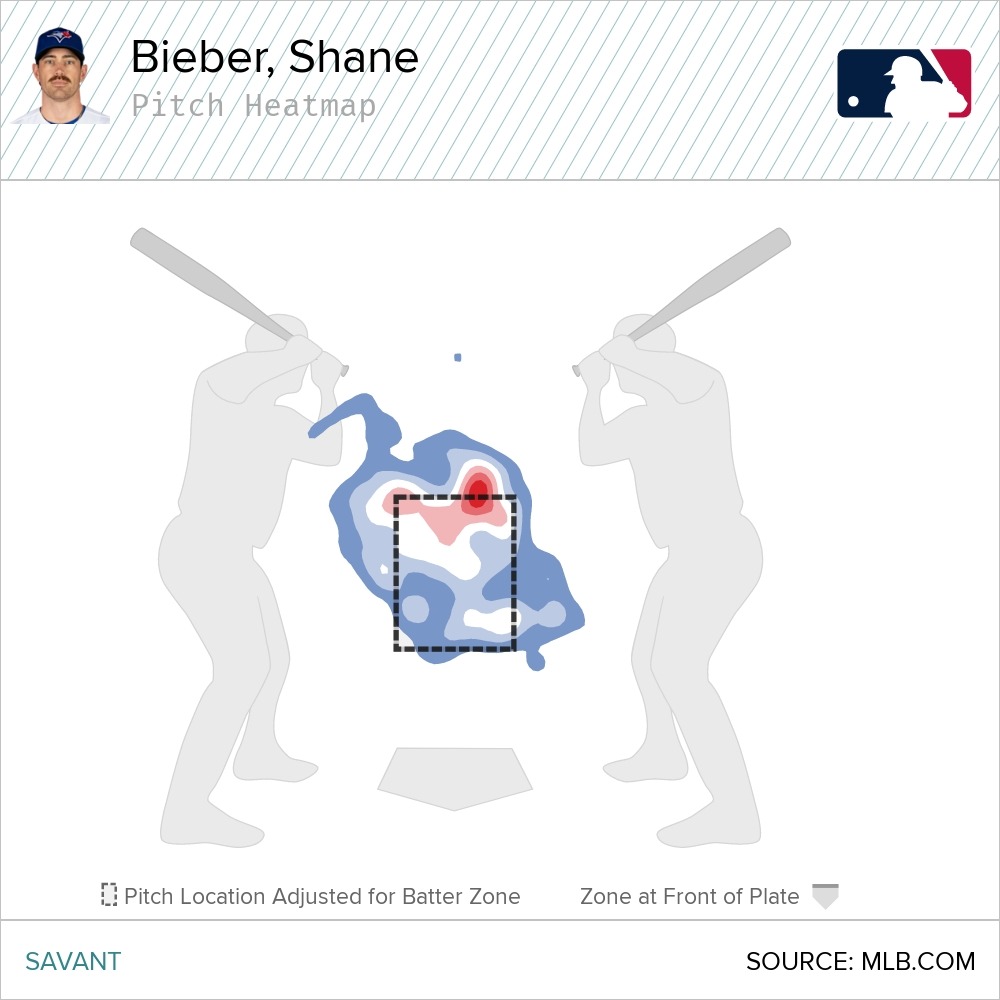
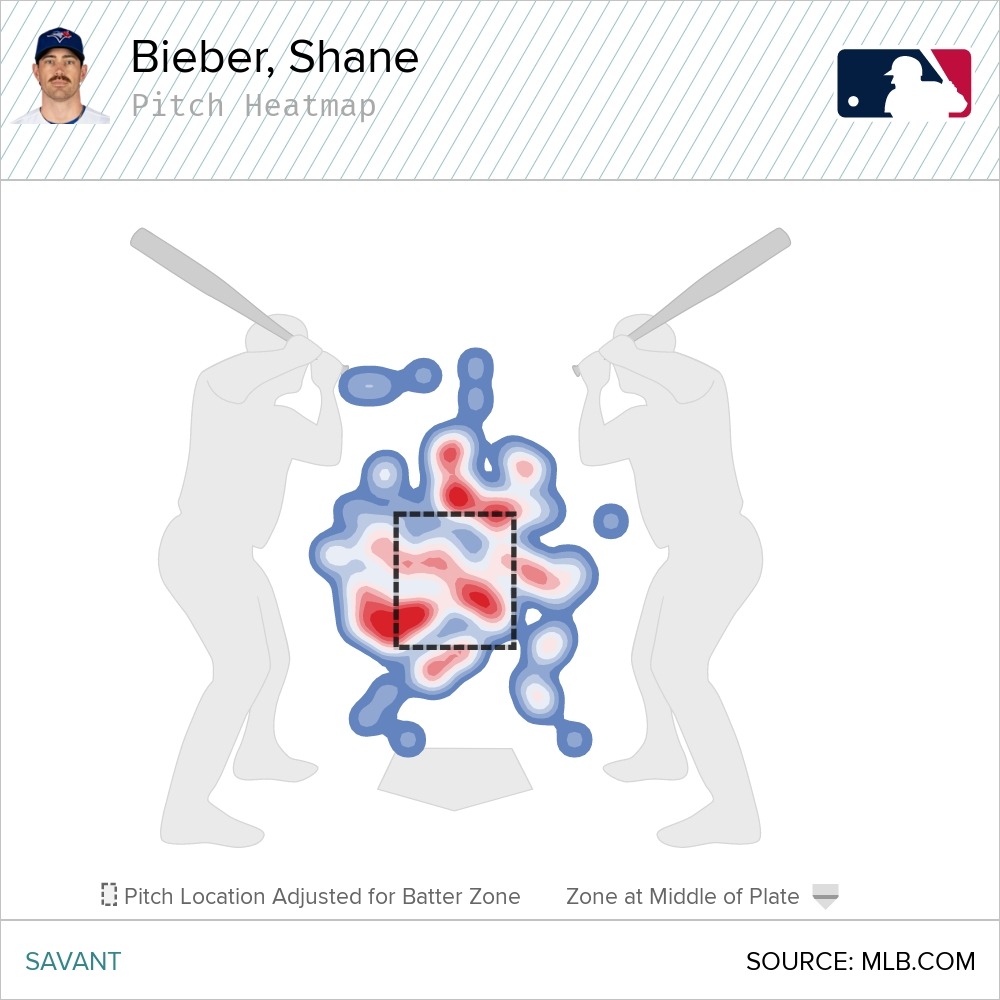
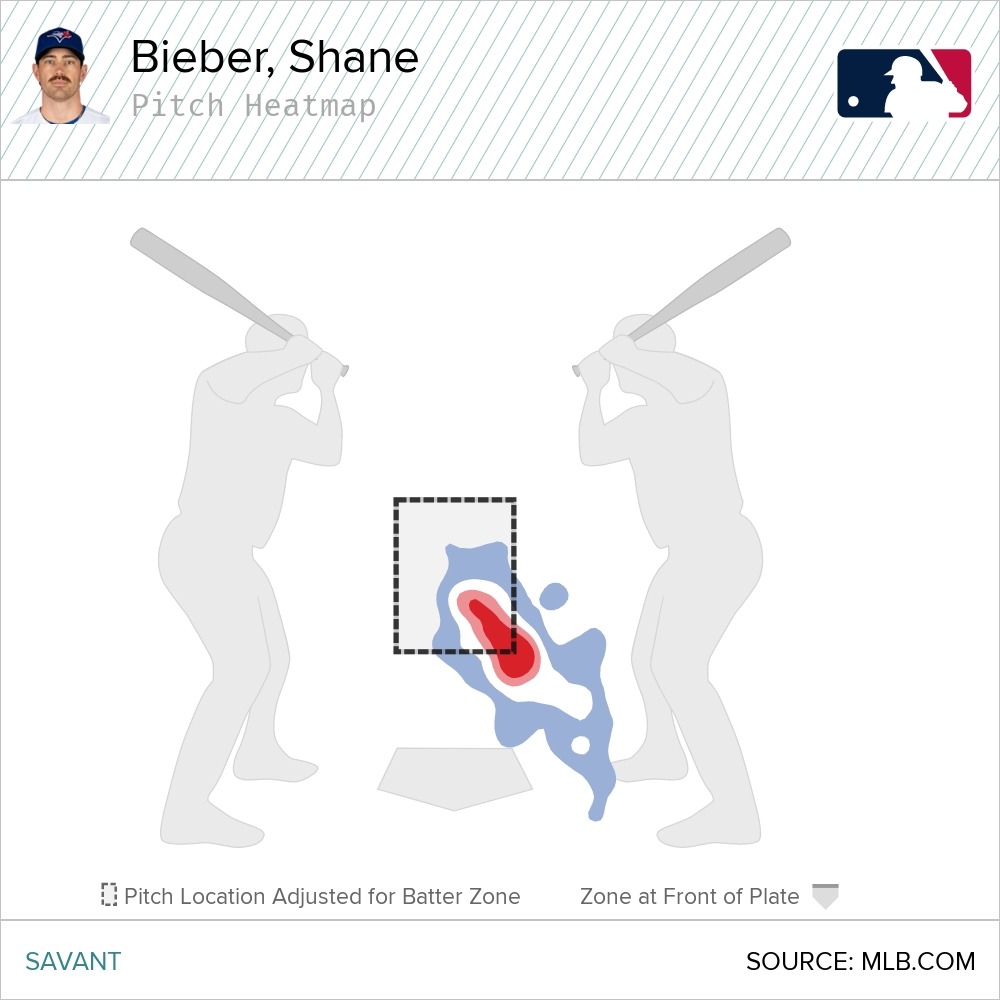
Bieber’s ability to harness his repertoire isn’t uniform among his pitches so far, though. His changeup and curveball have been located in a way that fits with where those pitches are most effective — namely below the zone, and with the curve leaning glove-side while the change goes arm-side — but the fastball and slider are off-kilter after living at the top of the zone and the low glove-side corner, respectively, last season:
2025 Fastball
2026 Fastball
2025 Slider
2026 Slider
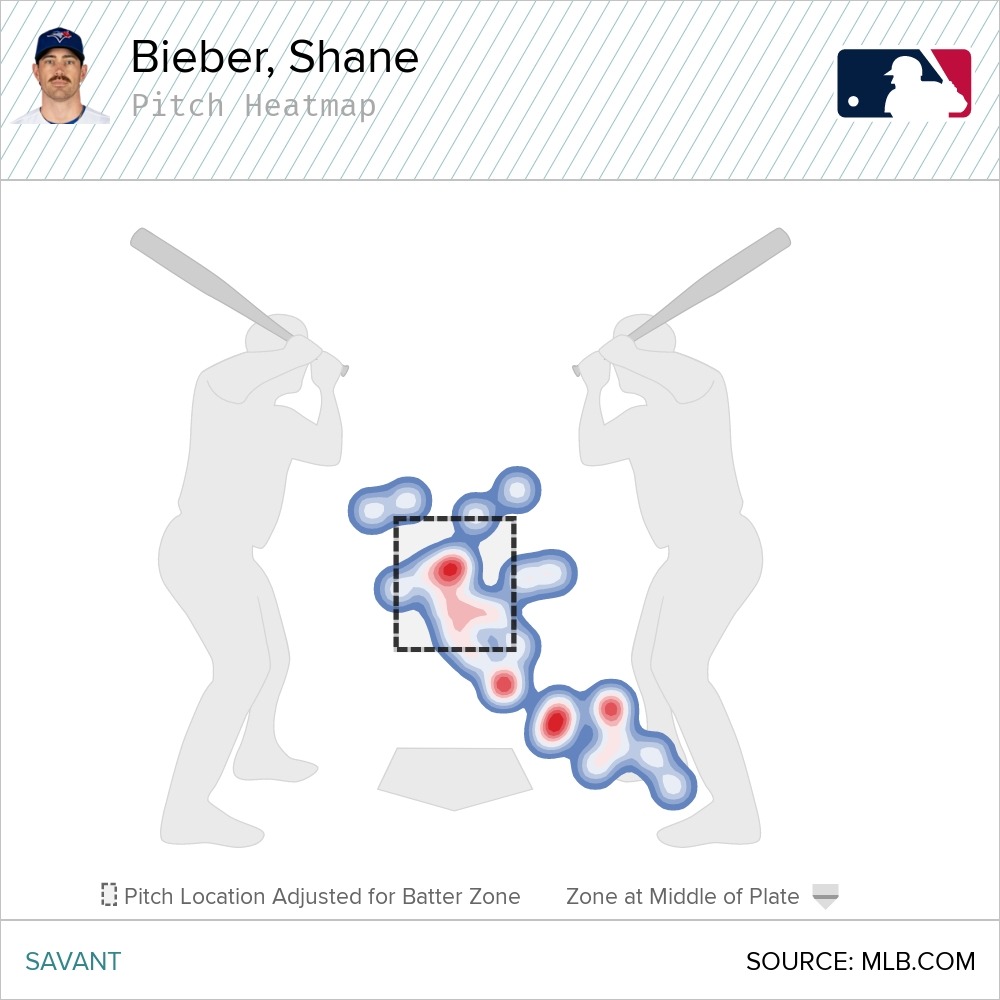
Last year, 55.9 per cent of Bieber’s pitches were heaters or sliders, and he was consistently painting corners with both pitches. This season, neither offering is landing where the right-hander wants it.
The good thing about command from Bieber’s perspective is that as long as he’s healthy, there’s no reason it can’t turn. The veteran has a long track record of hitting his spots. Failing to do that so far is a good explanation for why he’s struggled, but not proof he will continue to do so.
CONTACT QUALITY
It is difficult to put too much stock into how hard the 48 batted balls against Bieber have been this season. The sample is simply too small. It might be worth dismissing entirely if the right-hander hadn’t shown the same tendencies — albeit to less of an extreme — last season.
Underneath Bieber’s 3.57 ERA last season lay a 4.48 xERA, thanks to all the hard contact he was allowing. The back-to-back-to-back home runs he conceded in his 2026 debut made headlines, but he also allowed 1.79 home runs per nine innings last season, well above the league average of 1.18.
If we put Bieber’s 2025 and 2026 numbers together, he’s conceded the highest exit velocity (93.3 mph), third-highest barrel rate (13.6 per cent), and fifth-highest hard-hit rate (50 per cent) of the 468 pitchers who’ve tossed 50-plus innings over the last two years. Those contact quality numbers are a close match for what Shohei Ohtani has produced this season (93.5 EV, 9.9 per cent barrel rate 52.1 per cent hard-hit rate).
The sample here is still relatively small, but if a Blue Jays hitter produced those numbers on the same number of batted balls (162), there would be excitement about his power potential. Concern about Bieber’s inability to blunt the power of his opponents is valid.
WHAT’S THE VERDICT?
No pitcher should be completely buried for their performance in three starts, but Bieber’s early results are extreme. In fact, it’s the worst three-game stretch of his career by ERA:
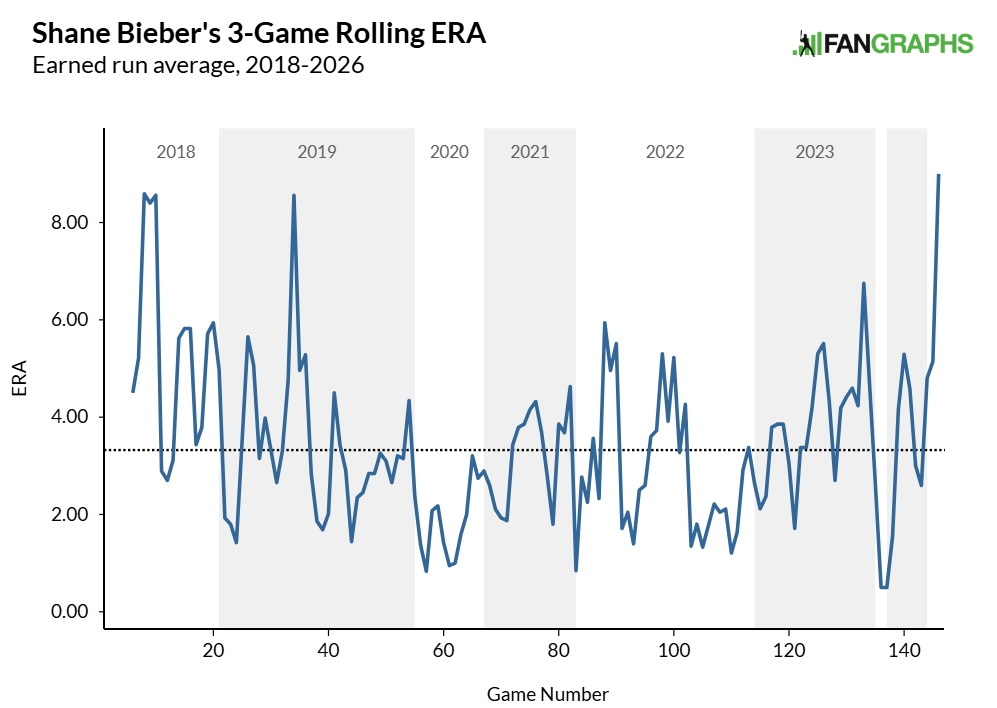
His stuff was already middling in 2025, and it seems to have taken at least a small step back. It’s clear that his inability to overwhelm hitters on raw pitch quality puts a great deal of pressure on his command — pressure it could usually bear last season, even if the cracks showed at times. So far in 2026, he’s struggled to locate his pitches, and he won’t be effective until he does.
Right now, both his stuff and command are below-average, and it shouldn’t be surprising to see hitters eating well in his starts. There’s every reason to believe he’ll get a better grasp on his arsenal in the starts to come. That could be enough for him to find success, but Bieber’s margin for error has been small since the moment he came to the Blue Jays, and what we’ve seen in recent starts suggests it’s only getting smaller.


 1:59
1:59