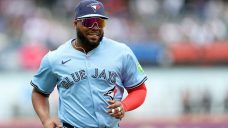
BOSTON — As Vladimir Guerrero Jr. worked through months of extension talks with the Toronto Blue Jays, his Hall of Fame father offered a sound piece of advice.
"My dad told me to trust God,” the four-time all-star first baseman shared via interpreter Hector Lebron, “and to try to get (every) last penny that I could from the organization.”
Guerrero did precisely that in a $500-million, 14-year contract signed, sealed and publicly confirmed in a news release at 2:15 p.m. ET Wednesday, announcing the second-biggest contract, in terms of present value, in baseball history.
The 26-year-old, positioned to be the franchise’s central figure by a deal that begins next year and runs through 2039, making it one of most consequential transactions in team history, both in financial scale and long-term implications.
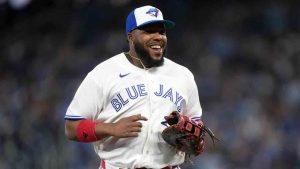
Guerrero described the deal’s completion as a big relief, saying “it's always been my goal to be here and I feel like I accomplished that,” while adding that “I've never seen this organization as an organization — I see it as a family.”
With the contract completed, he feels “the same responsibilities since the day I got here … to keep working hard and to help the team win a World Series,” and the next decade-and-a-half is an opportunity for him to be at the core of a new golden era, or a period of less promise.
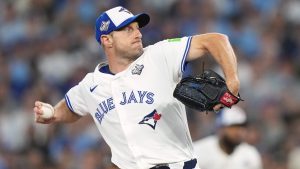
“I haven't had this conversation with him, but I think he understands that he can be the face of Canadian baseball for a long time if he continues to do what he's done already in his career,” said Kevin Gausman, who struck out 10 over eight brilliant innings, allowing only one unearned run in a 2-1, 11-inning win over the Boston Red Sox. “He's a superstar, he's exactly what you would want in a franchise guy, he's great with the fans, he's a very personable guy, speaks multiple languages, PR person's dream. Always smiling and always having fun. Happy it got done.”
Guerrero had three hits and scored a run in the first and the Blue Jays didn’t score again until Bo Bichette’s sacrifice fly in the 11th brought home the go-ahead run. That came after Jeff Hoffman threw two dominant innings of relief, while Nick Sandlin closed things out for his first save.
Longer-term, Guerrero is now uniquely positioned to tip the scales for the club, although it will also be up to the front office to ensure the next 6-to-8 years of his career peak are fully leveraged now that they’ve been secured at such great cost.
Buying him from his pending free agency impacts the Blue Jays’ competitive window “positively in many ways,” said GM Ross Atkins, “first and foremost, just the performance and what he'll do on a nightly basis to help us win games.”
“But he's also meaningful to his teammates, the players that are here,” Atkins continued. “In talking to Anthony Santander, Max Scherzer and players that we were recruiting in free agency and even as we acquired Andres Gimenez, they all wanted to know is that a part of the future, will Vladdy and others, Bo (Bichette) and (Daulton) Varsho and (Alejandro) Kirk be here. I think he'll continue to be attractive to all the stakeholders and players that we'll be recruiting in the future.”
Actions, of course, matter more than words, and closer Jeff Hoffman, who signed a $33-million, three-year deal as a free agent in January, said he didn’t need a Guerrero extension to trust the club’s intentions.
“Up until he signed, it was very apparent that they were trying to keep Vladdy here and that says a lot to me,” Hoffman said. “It's very clear that the Blue Jays are in a win-now mode. They've been in on all these guys and maybe they haven't landed some of the bigger names but the important part is knowing where they stand on it and knowing that they are in. I felt like we were going to be in a good spot. I feel like ownership is trying to compete and that's all it takes for me.”
The magnitude of his deal means that the stakes here are also industry-wide, with the guarantee he’s secured pulling the salaries of future players upward, while also forcing clubs to recalibrate the risk/reward between buying out the careers of elite young talent before they’re fully established or waiting until they are a more finished product.
As well, the contract’s structure, beyond no deferrals, no opt-outs and a full no-trade clause, will be duly noted for the way $325 million, or 65 per cent of the contract, will be paid out in the form of a signing bonus, $20 million of which will be paid out this year.
Atkins noted that “there is a benefit to the player that was attractive from a tax perspective,” but perhaps more important, especially with the potential for another lockout of players by owners once the CBA expires after the 2026 season, is that the signing bonus, which is spread out over the deal’s duration, is guaranteed in the event of any sort of stoppage.
Guerrero said the contract was structured in a way “both parties wanted and were pleased with,” but he also noted that “throughout the entire process I was all in on the business side.”
“I was all-in on every decision, every conversation, every meeting, I was aware of everything, because at the end of the day, I was the one that was going to make the my decision, not my agent,” he added. “So I was all-in on every conversation, every part of the process.”
As well, for a first-base market that’s largely stagnated since Miguel Cabrera’s $248-million, eight-year deal with the Detroit Tigers was signed in 2014 to cover 2016-2023, both the total outlay and the average annual salary of $35.7 million is something to build upon, although that’s contingent on his performance, too.
“If I put my union hat on ... really good for the first-base market,” said Max Scherzer, a former member of the MLB Players Association’s influential executive subcommittee. “We've seen first basemen just getting slaughtered in free agency as of recently. So for Vlad to be able to get that much value, hopefully that benefits the first-base market, the hitter market, as well and other guys are able to see years and dollars committed to them now. At the end of the day, it comes down to how well Vladdy executes the contract. You can sign this deal all you want, but you've got to execute for everybody else to get paid, as well.”
To that end, Scherzer believes Guerrero, with “his prime still in front of him … can still continue to evolve and push his highs even higher.”
“One thing I've always told guys through years is, look, you're not a finished product just because you're in year five, year six. There are still plenty of iterations for you to keep getting better at 26,” he continued. “I played with some of the best players ever, especially Miguel Cabrera. I watched him win MVP and then come back better. I always hold people to a high standard like that. I don't care how good you are. Get better.”
Guerrero worked relentlessly over the winter toward that goal after a brilliant 2024 that set him up for this payday. He batted .323/.396/.544 with 30 homers and 103 RBIs while often exposed as the sole threat in a thin lineup last year and more is expected of him this season, with Anthony Santander signed to bat behind him.
So far, batting out of the two-hole instead of his usual spot at three, he’s off to a cold start through the first 12 games at .255/.345/.319 with only three doubles and four RBIs.
That won’t last, of course, although the big contract will mean extra scrutiny, something that’s accompanied Guerrero at each step along the way.
“When you meet guys who are obviously talented and driven, you expect them to have a good career,” said manager John Schneider, who first met Guerrero in 2016 and then managed him at A-ball Dunedin and double-A New Hampshire en route to the majors for both. “I think when you're talking about hopefully doing it with one team and Vlad's already kind of turned into one of the faces of the game, very recognizable, he's been dealing with that for a while.”
Guerrero’s long-term future had been an issue the Blue Jays have been dealing with for a while, but especially since spring training, when he set a Feb. 18 deadline for an extension, only for the sides to quietly continue discussions leading to the deal.
The turning point came just before opening day, when the sides got close enough to a deal that it became a matter of when, not if. Now that the contract is across the finish line, questions about the bigger-picture directional possibilities for the club’s future beyond this year are nulled with Guerrero on the books.
"Having him here for a long period of time validates what we've been saying all along to free agents,” said Schneider. “I get where it's a little bit more of a set thing now when you do have him locked up, but our expectations haven't changed. …
The extension, he added, “shows one, that we can. There aren't a lot of organizations that can do a deal like this. Two, that we are very, very convicted and concerned about winning. When you're signing a contract like this to a player like Vlad, you want to not just build around you want to continue to add, you want to continue to be able to do more deals like this. It firmly puts us in the big-market category with a contract like that and it really, really says what we're trying to do going forward.”
And the resolution there is a good thing for Guerrero, personally, and the Blue Jays collectively.
“It's something that's been talked about from Day 1 of spring training until this moment right now,” Gausman said Monday when word first broke. “I wouldn't say it's been a distraction, but it has kind of been the elephant in the room, right? I'm just happy that it's done and that he's here to stay. Now we can just kind of focus on winning ballgames.”

 1:40
1:40
 2:44
2:44