The Toronto Blue Jays have experienced many flavours of disappointment in 2026, but one of the most painful has been the frequency of Jeff Hoffman implosions.
A closer struggling is always difficult, but it’s particularly tough to swallow for a squad that has gotten credible work from its rotation (which ranks ninth in the majors in fWAR despite multiple injuries) while struggling to score runs. That means the Blue Jays have often found themselves in tight low-scoring games with minuscule margins, magnifying the importance of high-leverage arms. Toronto’s relievers have entered games with the sixth-highest leverage index in the majors, but rank 23rd by ERA — a tough combination that Hoffman is at the heart of.
To his credit, the 33-year-old has done an incredible job of missing bats with a 42.1 per cent strikeout rate that is second only to the superhuman Mason Miller among the 124 relievers with 10-plus innings pitched. It’s almost impossible to be ineffective while racking up that many strikeouts, but that’s a fair description of Hoffman, who has a 7.59 ERA in the early going — a number that could’ve been higher if Louis Varland didn’t strand three inherited runners on Tuesday.
Hoffman’s issues have been particularly acute lately as he has a 21.00 ERA in his last four appearances with 14 of the 23 hitters he faced reaching base. As a result, the Blue Jays are re-evaluating his role before they start their series with the Cleveland Guardians on Friday.
While they do that, it seems like a good time to take a closer look at what’s gone into Hoffman’s difficult 2026.

Blue Jays on Sportsnet
Watch coverage of the reigning AL champion Toronto Blue Jays throughout the season on Sportsnet and Sportsnet+.
Blue Jays on Sportsnet
RESULTS
Even the most adamant defender of Hoffman would say that he has not helped the Blue Jays win games in 2026. The 33-year-old has been poor by any metric that measures keeping runs off the board, preserving leads, or contributing positively to win probability.
ERA | Saves | Blown Saves | Shutdowns | Meltdowns | Win Probability Added |
7.59 | 3 | 3 | 2 | 5 | -1.65 |
The win-probability numbers are particularly rough as Hoffman ranks dead last among 510 MLB pitchers who have appeared this season in WPA and no reliever has more meltdowns.
For some, this is sufficiently damning to say that the veteran is broken — or at the very least no longer suited for high-leverage work. However, there is only so much a sample as small as 10.2 innings can tell us.
Just because Hoffman has hurt the Blue Jays, it doesn’t mean he’ll continue to do so. As an example, last season he posted a 13.50 ERA in 10 May innings before producing a 3.38 ERA from June 1 on and a 1.46 mark in the playoffs.
The early-season results are indefensible, but that doesn’t necessarily mean Hoffman is a lost cause.
EXPECTED RESULTS
Perhaps the best argument for a Hoffman bounce-back is that bad luck is clearly a factor in his poor start.
Despite his bloated ERA, his expected ERA based on his strikeouts, walks and contact quality allowed is a respectable 3.36. So far, his batting average allowed on balls in play (.609) is more than twice the league average (.289). Some of the difference there is hard contact, but it’s still a freakish result.
Since 2002 when BABIP became a publicly-available metric there have been 14,176 instances of a pitcher logging at least 10 innings in a season. Hoffman’s .609 BABIP is the highest in that group, and the second highest isn’t particularly close (.523).
This doesn’t account for all the issues that have plagued Hoffman, but he has dealt with a disproportionate number of weak hits. If his actual batting average and SLG against (.327 and .469) resembled his xAVG and xSLG (.220 and .338), his 2026 wouldn’t look so grim.
CONTROL
Balls falling in for hits isn’t Hoffman’s only problem. The right-hander’s also not throwing enough strikes. His walk rate (5.06 BB/9) is high for a high-leverage reliever, and even in the context of a 12-game sample, it’s one of his biggest spikes in recent years.
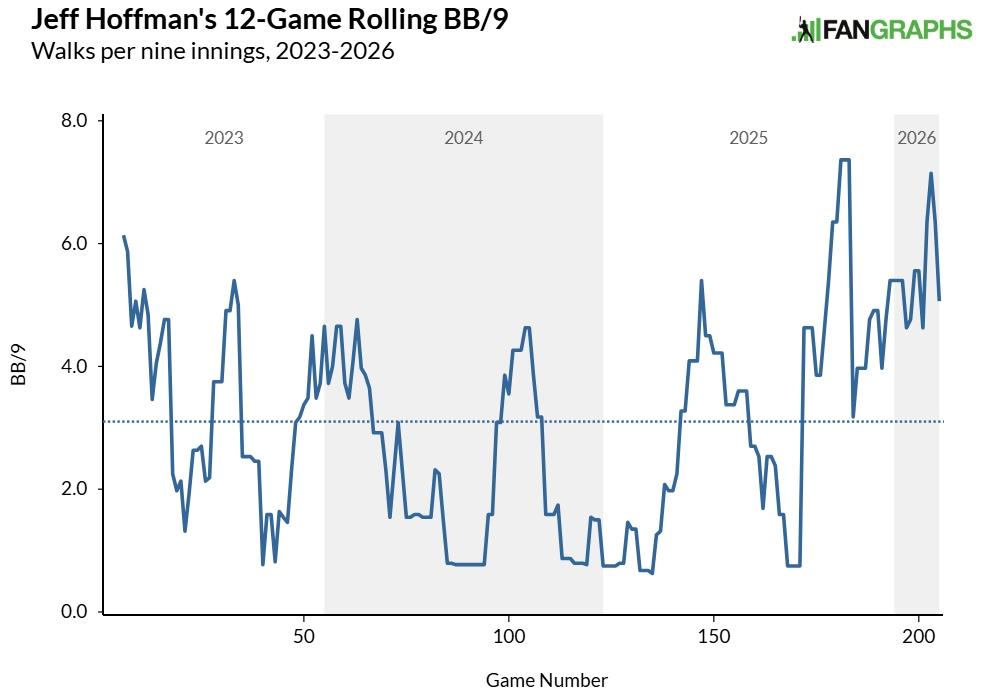
Looking beyond the pure walk rate, Hoffman has been around the zone less frequently than he’s been in years past while falling behind in the count more often.
Season | First-Pitch Strike% | Zone% |
2023 | 62.8% | 48.2% |
2024 | 66.40% | 50.00% |
2025 | 68.20% | 48.40% |
2026 | 57.10% | 41.00% |
The change in zone rate is by design to some degree as Hoffman is throwing more splitters than ever before, but he may have gone a step too far. The first-pitch strike difference is definitely a problem; this season he’s walking 20 per cent of hitters he falls behind 1-0 to and just 3.4 per cent he gets ahead 0-1 on. Those numbers may seem extreme, but they’re not far from his career averages (18.2 per cent and 5.8 per cent).
Failing to get ahead of hitters is a significant issue for Hoffman. Whether it’s a case of nibbling too much, or simply missing spots, he’s getting himself into difficult positions too often.
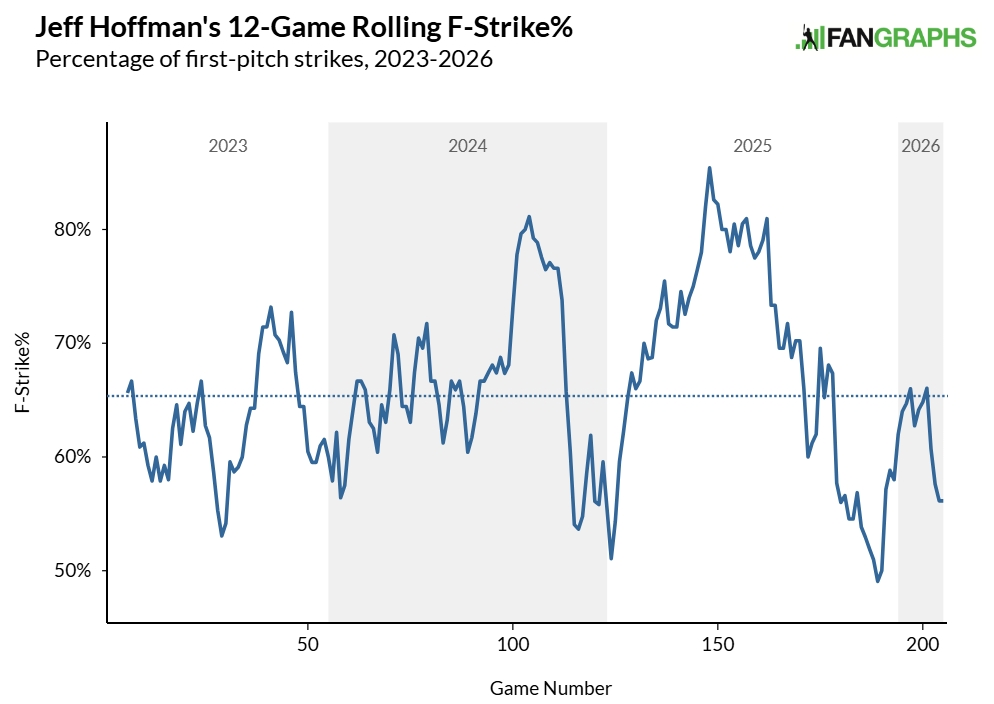
The good news for the right-hander is that his first-pitch strike rate has fluctuated greatly during his time as a high-leverage reliever and there’s no reason to believe he can’t get back on track there.
The zone-rate situation is more ambiguous. Hoffman hasn’t always been at his most effective when he’s in the zone the most, but he’s also rarely been in it as little as he has in 2026.
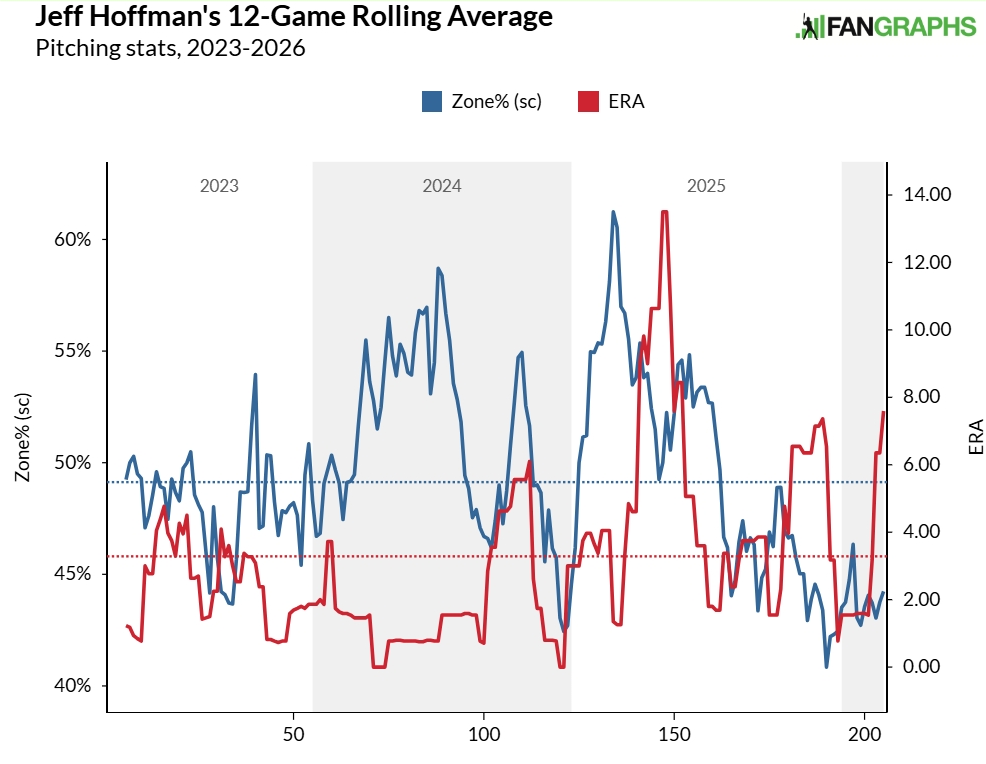
It seems that he’d probably be better served by a more direct approach and his Tuesday outing that included two hit batters shows there are moments when he’s losing the handle completely, which is indisputably an issue.
THE STUFF
Hoffman optimists would suggest that when a pitcher is striking out more than 40 per cent of the hitters he faces there’s nothing wrong with his stuff.
That’s a fair assessment overall. Hoffman’s fastball velocity (96.6 mph) is right in line with last season and changes to the way his pitches are moving have generally been modest enough to look like small-sample noise.
The one exception to that is the slider, which has lost a lot of horizontal movement.
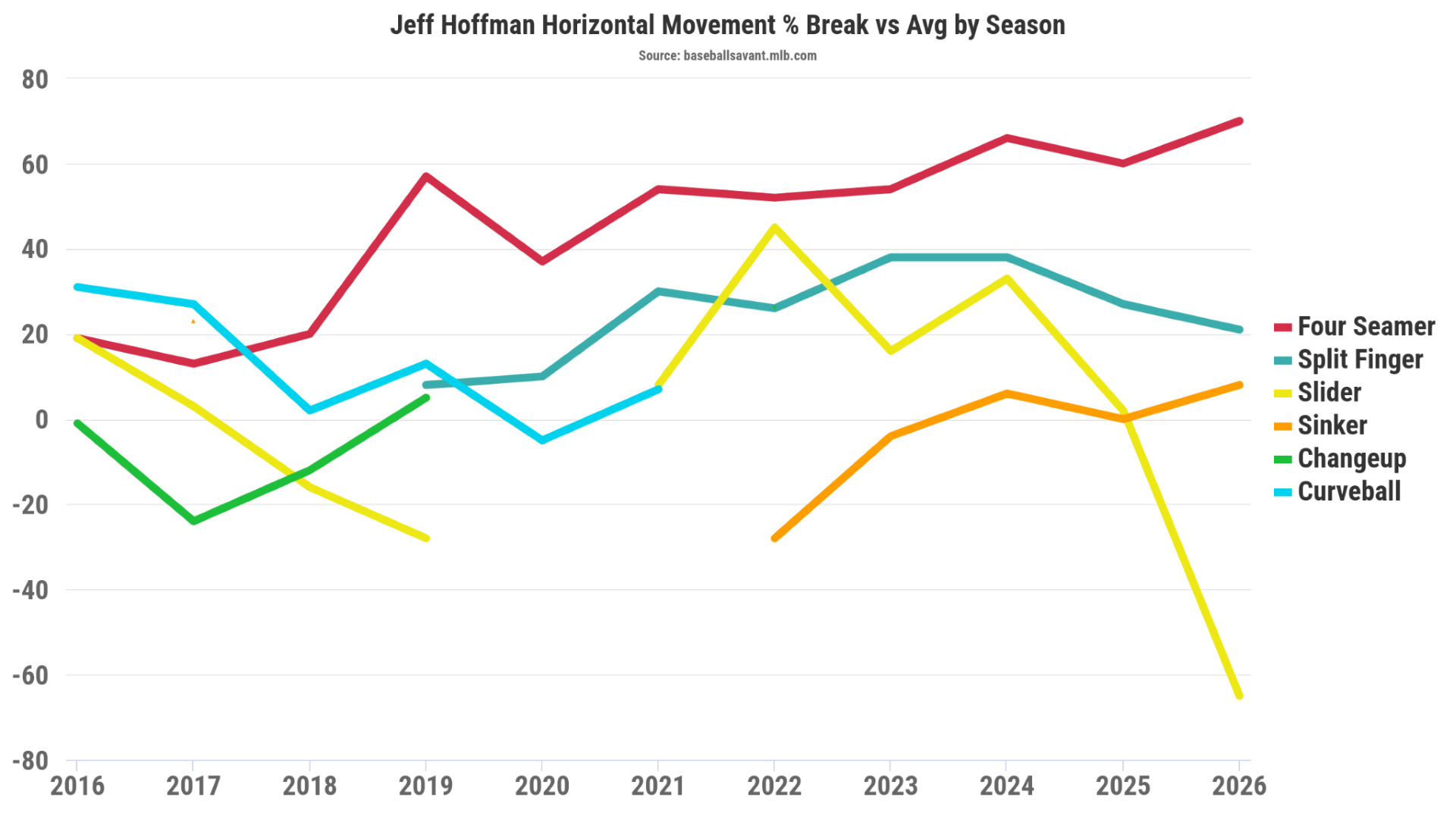
That’s an interesting trend worth monitoring, but it doesn’t do much to explain what’s happened to Hoffman this season. Despite the movement loss, the right-hander’s slider has been his best pitch by run value in 2026 (plus-1) with hitters whiffing against it 63.3 per cent of the time.
During Hoffman’s rocky Blue Jays tenure, the quality of his stuff has rarely been questioned, and it hasn’t deserted him this season.
WHAT’S THE VERDICT?
The extent of Hoffman’s early-season wobbles — along with some lingering disappointment about the end of the World Series — have a large section of the fanbase not wanting to see him closing games again. There are plenty of fans who’d be happy to see the 33-year-old dropped from the team entirely.
Some of the vitriol Hoffman inspires is over the top. Despite his recent results, he remains a very talented reliever. Unfortunately for the Blue Jays, he has been at his worst at a moment when the team has played a disproportionate number of close games and wins have been hard to come by.
The negativity around him isn’t just an emotional response with no substance, though. Some aspects of Hoffman’s struggles can be dismissed as bad luck, or a normal slump, but he’s also not throwing enough strikes, which has either led to walks or getting forced into difficult counts where hard contact against is more likely.
Watching him hit two hitters in a row on Tuesday was also jarring because that brand of wildness hadn’t been an issue in the past. Before that game he hit approximately 1.1 per cent of the hitters he’d faced (and never more than five in a full season), making two in a row approximately a one in 8,264 outcome. That might overstate things a bit because if a pitcher hits one batter it might mean that he’s way off and increase the chances of another coming. Still, before his ugly outing against the Los Angeles Angels, Hoffman had made 338 MLB outings without plunking two opponents, and 50 of those were starts.
Hoffman isn’t in as bad a place as his ERA or percentage of blown saves suggests. It also feels unfair to take his expected statistics at face value and say everything we’re seeing is noise. This is a meaningful rut.
That doesn’t mean there isn’t a way out. Hoffman is likely to be an important and effective part of the Blue Jays bullpen at some point this season. The most important questions are when that will happen and what the best route to that outcome is.
As the team ponders his role it will be prioritizing the two objectives of maximizing winning in the short term and getting Hoffman right. Having him jog in from the bullpen in the game’s most pivotal moments might not accomplish either of those goals right now.






 2:32
2:32