The Toronto Blue Jays’ $37 million investment in Tyler Rogers was simultaneously intuitive and surprising.
On one hand, it’s hard to knock a team with a clear need for high-leverage help for locking in a guy who leads all relievers in innings since 2021 (378.1 IP) with an excellent ERA (2.71) and the ability to slither out of trouble thanks to an elite groundball rate (56.3 per cent). Rogers is also coming off a stellar season (1.98 ERA, 2.65 ERA, 1.3 fWAR) and was highly valued around the league at the trade deadline, yielding a strong three-player package from the New York Mets.
At the same time, it’s hard to ignore that Rogers is about to enter his age-35 season and just ranked in the first percentile in average fastball velocity (83.5 m.p.h.) and whiff rate (15.9 per cent). Coming up short in those areas theoretically doesn’t matter if you get outs, but velocity and bat-missing are often what get relievers paid. Public-facing contract projections for Rogers came in well below the contract the Blue Jays gave him.
Those projections are low in the context of what Rogers has accomplished, but they baked in a discount for the right-hander’s status as a soft-tossing submariner as opposed to a traditional fire-balling late-game arm. That seems reasonable given there is less proof of concept for pitchers like Rogers producing at a high level than high-performing bullpen arms with a more conventional skill set.
Based on the Blue Jays’ investment in Rogers, it seems like they view his unorthodox delivery as a value-add rather than a cause for concern. While many relievers are said to give opponents 'a different look,' Rogers is the outlier of all outliers when it comes to arm angle.
He’s not hard to spot in the bottom right corner of the chart below:
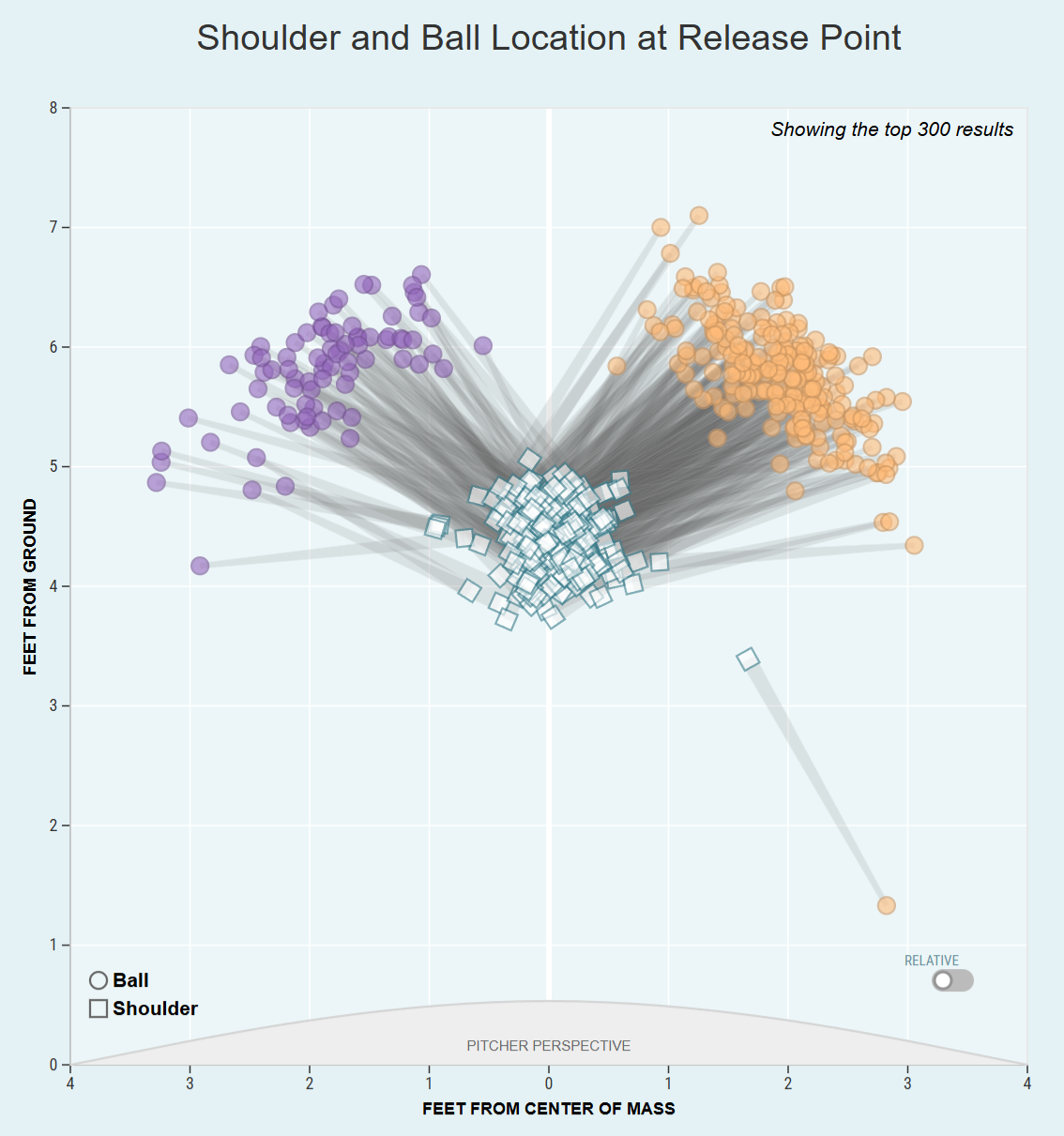
Last season, Trey Yesavage earned plenty of attention for his 64-degree arm angle, but there are five other pitchers with at least 60. Meanwhile, no MLB pitcher was within 35 degrees of Rogers.
Standing apart from his peers undoubtedly helps the newest Blue Jays reliever succeed, but it also makes him tricky to project. Does his distinct style mean he’ll age better because he’s not so velocity-reliant, or does his funky action put his arm in peril? Is the league going to figure him out more the longer his career goes, or does his distance from his peers mean he’ll always deliver an effective change of pace?
There aren’t definitive answers to these questions, but there are hints. As unusual as Rogers is, pitchers like him aren’t entirely unprecedented. Stitching together a Baseball Reference list of submariners/underhand/low side-arm pitchers and Baseball Savant’s arm angle data going back to 2021, looking for pitchers with negative arm angles, yields a list of 24 submariners who’ve appeared in the last 50 years.
While going further back in time would grant the opportunity to dive into the careers of players with top-tier names like Three Finger Brown, Dizzy Trout, Chief Hogsett, and Hod Lisenbee, it’s unlikely that how those players aged in such a different era has much to say about the trajectory of Rogers.
The 24 submariners we’re left with fall into four broad categories:
Burned out well before reaching 35
Bob Long, Steve Olin, Brad Clontz, Byung-Hun Kim, Mike Venafro, Kell Wunsch, Eddie Oropesa, Pret Prinz, Ben Rowan, Eric Yardley
These pitchers had varying degrees of success, but they didn’t get nearly as far as Rogers has already, giving them minimal utility as comparables.
Didn't get past 35, but could be instructive
Mark Eichhorn, Chad Bradford, Adam Cimber
Rogers has already been effective at the age of 34, which is something nobody in this trio accomplished, but each of them provides a reminder of why some teams might be wary of submariners. All three were extremely successful for a time before abruptly falling off in their 30s.
Eichhorn was one of the best relievers in Blue Jays history and ranked fifth among all bullpen arms in fWAR between 1986 and 1994 (14.5). After losing his age-34 season to injury, he came back at 35 without much success (5.06 ERA) and made multiple comeback attempts, but couldn’t get back to MLB.
Among the 60 relievers who pitched 400-plus innings between 2000 and 2008, Bradford’s 3.11 ERA ranked 10th. He dealt with multiple injuries in his age-34 season, spending more time in the minors than the majors, and then didn’t log a pro inning from 2010 on.
Blue Jays fans witnessed Cimber give the team excellent innings in 2021 and 2022 before the wheels fell off in 2023. From age 27-31, he delivered 278.2 innings of 3.20 ERA ball before that number ballooned to 7.20 in the final 45 frames of his career split between 2023 and 2024.
This small cohort is comprised of living examples of the sudden decline some teams might’ve feared with Rogers. When a player comes by his success through unusual means, it’s easy to see that success as fragile. Clearly, the Blue Jays don’t feel that way with Rogers, and one of the categories below gives some credence to that idea.
The story of 35-plus years is yet to be written
Hoby Milner, Ryan Thompson, Justin Lawrence, Chase Lee, Tim Hill
Hill pitched as a 35-year-old in 2025, but we don’t really know how this group of current pitchers will fare in their mid-30s yet.
The best comparables for Rogers
Kent Tekulve, Dan Quisenberry, Terry Leach, Steve Reed, Mike Myers, Brad Ziegler
This is a relatively small group, but these guys were successful submariner types who pitched deep into their 30s. That only a quarter of the group made it this far is notable, but relievers are volatile in general, and some of the current players may flesh out this group in the years to come, so the fact that this group is just a quarter of the total isn’t as grim as it looks on the surface.
Tekulve, Quisenberry, Leach, Reed, Myers and Ziegler were collectively an effective group before reaching their mid-30s, and aged gracefully.
Out of the six, only one had the trajectory the Blue Jays might fear with Rogers, as Quisenberry had a 2.52 ERA through age 34 (with five top-five Cy Young finishes) and a 4.19 mark in his last three seasons.
The most recent comparable is one of the most encouraging. Ziegler piled up 72 saves with a 3.09 ERA after his 35th birthday, often serving as the Arizona Diamondbacks' primary closer.
Making any broad statements about this type of pitcher based on six players would be irresponsible, but the bet the Blue Jays are making on Rogers performing well as he ages is based on some precedent. His reliance on a deceptive motion that won’t abandon him in the years to come — and the fact that he’s had immense success with minimal velocity already — provides a logical framework for his contract, but the history of submariners was likely considered too.
Rogers has another ace up his sleeve that undoubtedly contributed to the Blue Jays taking the plunge with him: unlike most of his submariner compatriots, he’s equally effective whether he has the platoon advantage or not.
In most cases, pitchers of his ilk are excellent against same-handed hitters and struggle when they don’t have the platoon advantage, which helps explain why they are deployed as relievers. Rogers doesn’t have that problem. The chart below shows the submariners who have debuted since 2002, when FanGraphs began to feature reliable platoon data, and how they fared with and without the platoon advantage:
Fellow recent Blue Jays addition Lee has freakish numbers that are probably best explained by his limited MLB experience (37.1 IP), but beyond that, Rogers stands alone with Thompson.
Over time, he’s become more and more sinker-heavy against lefties, and they don’t seem to have an answer for it.
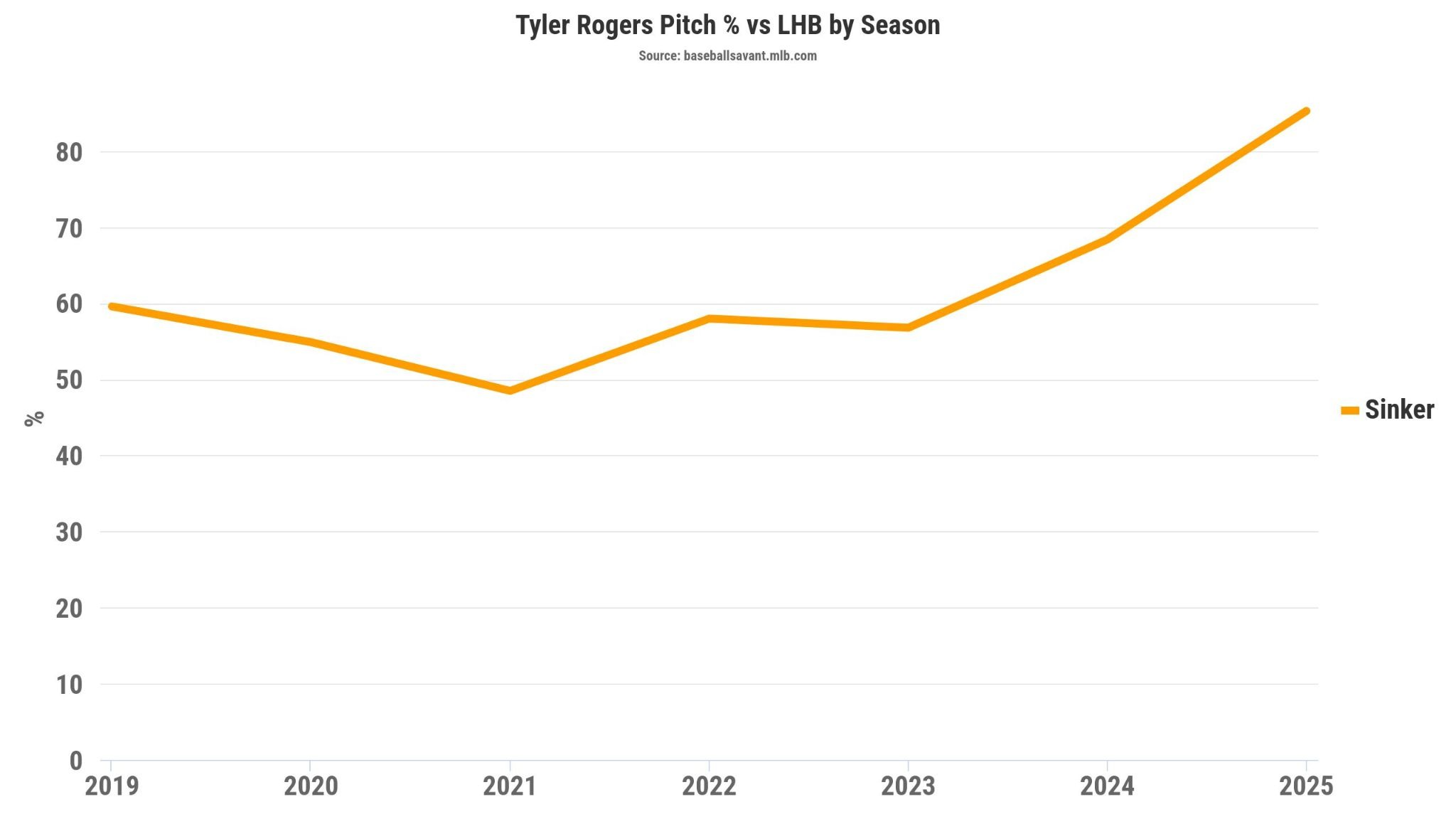
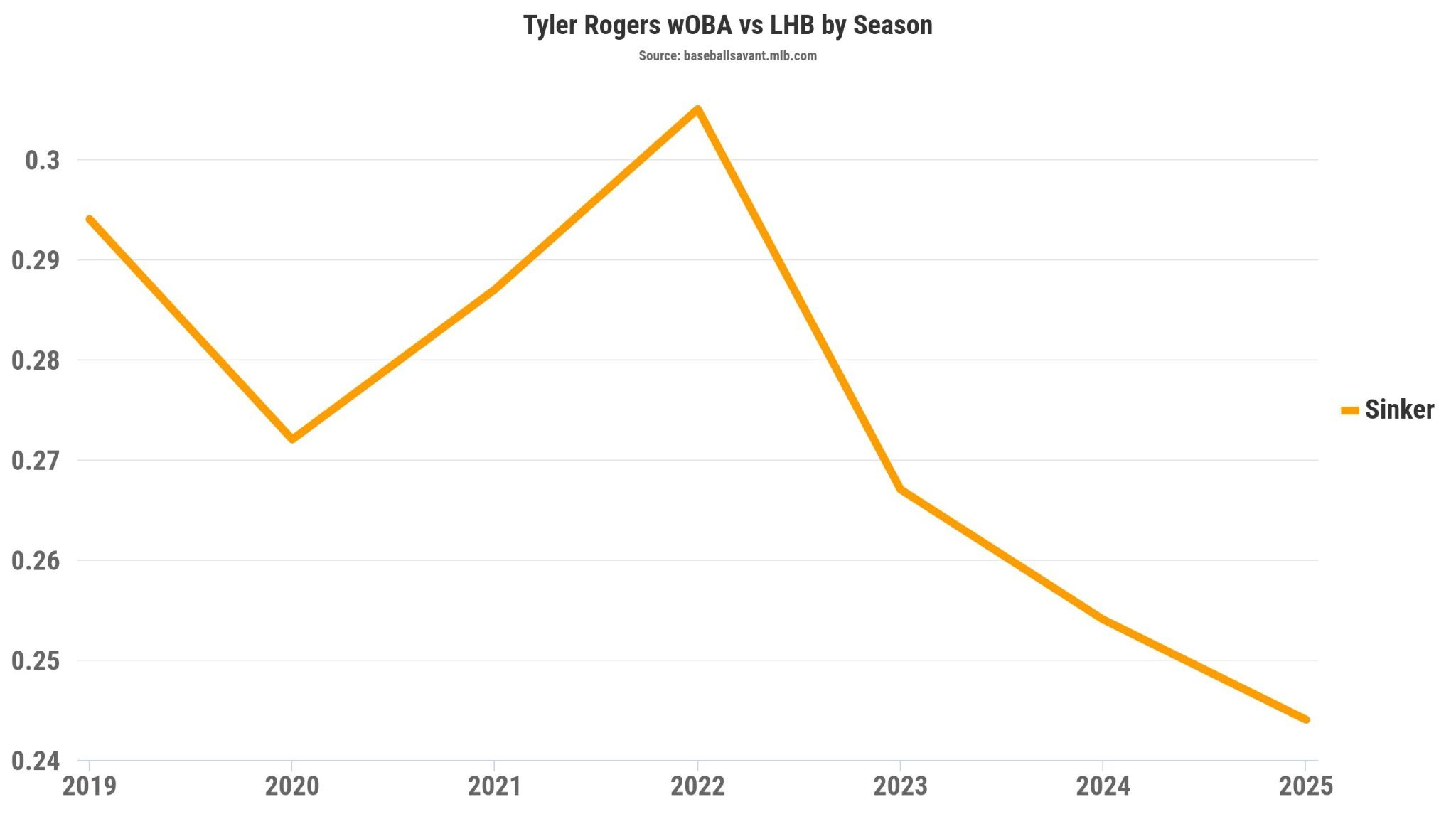
This characteristic makes Rogers situationally versatile and well-equipped for high-leverage work, while many of his brethren have had something of a specialist role. It’s not as unique as his arm angle, but it makes him special even within the confines of the small group of pitchers he belongs to.
Every heavy investment in a reliever is risky, and going all-in on Rogers was not an obvious masterstroke by the Blue Jays. He does not blow hitters away like most high-leverage arms in his new tax bracket, and his age isn’t insignificant.
For any valid concerns, it’s easy to understand what Toronto sees in him. His production is consistently outstanding, his arm angle is tough to handle, he doesn’t have the one weakness most common in his pitcher type, and there’s some evidence that type ages well. Whether that’s a $37 million package or not is up for debate, but it’s a compelling one.