
On Nov. 12, the Ultimate Fighting Championship celebrated its 20th anniversary. I have been lucky enough to enjoy the ride since day one, and have been reminiscing about how it all started and how much it has changed my life. Then a tweet popped up on my timeline, asking me to share some of these memories.
It all started in a bar in midtown Toronto. It was a Friday night and I was just hanging out with some friends when I noticed an advertisement for a pay-per-view event that was going to air that same evening. I asked the owner of the bar if he was going to show it, and after watching the same commercial, he said “For sure … that looks crazy”.
None of us could have predicted what we were about to see, and little did I realize I was about to witness a moment that would change my life forever.
The event started and Gerard Gordeau, a Dutch Savate champion, stepped away from a charging 434-pound Teila Tuli, allowing him to fall to the mat. The monstrous Hawaiian then looked up at Gordeau, who launched a devastating kick to his face, knocking out a tooth in the process.
The McNichols Sports Arena in Denver went silent, as did the bar I was in. “What the **** was that?” was what I remember hearing all around me. “Holy ****!” And my view of martial arts changed forever. That is, until Royce Gracie stepped into the octagon.
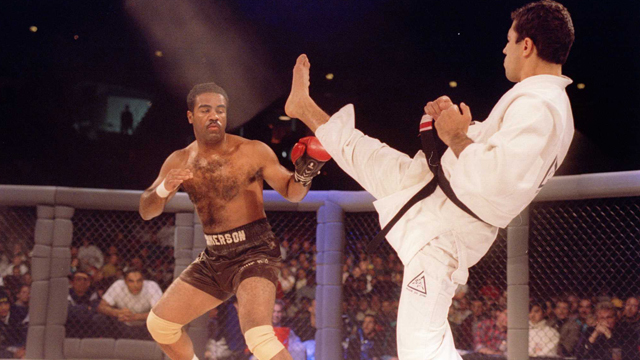
The young, skinny Brazilian won his first fight by taking his opponent to the ground and simply mounting him. Boxer Art Jimmerson tapped from sheer fear just 26 seconds into the “fight.” Then Gracie submitted Ken Shamrock in 57 seconds with rear naked choke. Gracie followed that up by submitting Gordeau in the final of the one-night, eight-man tournament.
In one night and one tournament, the man with the white Brazilian jiu-jitsu gi changed martial arts forever. And while I was arguing with my friends that what Gracie did wasn’t cheap or cheating, and could be used in real life, they weren’t buying it. I, on the other hand, sought out the nearest Brazilian jiu-jitsu school I could find.
It took nearly two years until I really found a legitimate BJJ school in my area, and with a close friend, we joined the Grappling Arts Academy in Woodbridge. We couldn’t get enough. One day was BJJ class, followed by boxing. The next day, Muay Thai and BJJ. Wash, rinse and repeat — for five days a week.
I was hell bent on becoming a pro fighter, but it never panned out. Too many injuries kept me off the mat, but I knew I needed to stay involved with the sport.
In the late ‘90s I contacted the Ontario government about sanctioning MMA events, both at the amateur and professional level. That project took nearly 13 years to finally become a reality, mostly in part to the UFC’s lobbying efforts.
In 2000, I co-founded a clothing and equipment line called “Showdown Fightwear” and “Showdown Boxing.” We began sponsoring athletes competing in Montreal. In June 2000, I went to my first grass roots MMA event: the Universal Combat Challenge. Over the next seven years, I would build my resume doing various work as a match maker, colour commentator, producer, vice president, manager, sponsor and so much more. But the key was networking.
Throughout this time I visited with various television stations, pitching the idea of an MMA magazine, TV and radio show. Numerous doors were shut in my face, until 2007 when I was given a trial run on The Fan 590 in Toronto. “The Showdown” radio show helped me get an analyst position on Sportsnet, which was followed by some great news.
I was told I was going to Las Vegas to cover UFC 79. Tears ran down my face as the reality set in I would finally get to see the big show, live and in person. I was accompanied by my boss, Bob Torrens, who had no idea what I was going to pitch to him that week. While in Sin City, sitting at a lobby bar in Caesar’s, I pitched him the idea of the MMA magazine show. He loved it.
MMA Connected was born. It then became UFC Connected and now UFC Central.
Throughout my time, I have been lucky enough to interview nearly every major MMA superstar the sport has ever seen. I can count on one hand those who I unfortunately never crossed paths with; Fedor Emelianenko is the one I wanted to speak with most.
I have seen champions crowned, contenders defeated, superstars born and legends retire. But arguably the biggest highlight of my career has been my friendship with Georges St-Pierre. I first met him when I was doing colour commentary for the UCC. In January 2002, Georges made his debut versus Ivan Menjivar. I called that fight, as well as his next four. Before you know it, he was in the UFC. Then he became the champ. Now he is the sport’s biggest pay-per-view star.
I have seen exactly what it takes for an unproven mixed martial arts rookie to become the biggest star in the sport, while also arguably evolving into the greatest martial artist in history.
Many may balk at this theory, but they also said he would never win a fight. The first 20 years of the UFC gave us GSP, Anderson Silva and Jon Jones. These are outliers and trail blazers. I can just imagine how incredible the next 20 years are going to be.
I owe all of these memories to the UFC and to that infamous event that took place Nov. 12, 1993.