I just returned from Calgary on the weekend working an MMA referee assignment and had the privilege of working with Adam Cheadle, who is Manitoba’s top MMA referee. Coincidently while driving to the event, Cheadle brought up eyepoke procedures with longtime commissioner Dale Kliparchuk and I, and how best to handle the ongoing problem. We went through numerous scenarios, which is standard for referees preparing for their officiating duties.
Cheadle was in Calgary getting extra work in and to be mentored in preparation for an upcoming officiating assignment. It is well known that Kliparchuk is one of the best mentors of MMA referees and judges in the industry today, hence why I and Cheadle travel to Alberta to work under him. Now, back to where I was headed with this article.
As a professional firefighter I’ve responded to numerous incidents involving traffic accidents over the course of my career. Ask any emergency responder and they can quickly tell you that within any city, there are well known intersections that because of their design (or lack thereof) it often results in the creation of many of these traffic issues. As a result first responders are continually spending copious amounts of their time and energy at these locations trying to clean up a mess.
MMA is no different. This weekend at UFC 159 we witnessed a series of issues much like the poorly designed intersections, only in this case it was eyepokes that plagued the fighters and the referees. Eyepokes are becoming much more of the norm in MMA, and are now a growing cause for concern.
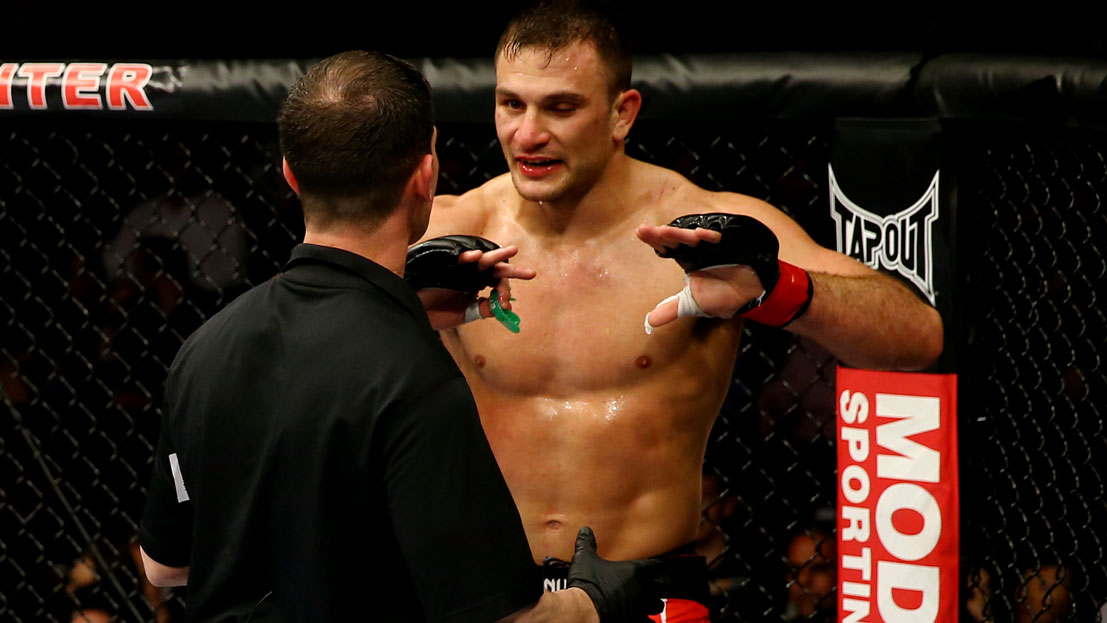
On the undercard of the event, Ovince St. Preux and Gian Villante, both Strikeforce veterans, battled away for two rounds. In the third round Villante received an eyepoke from St. Preux. Villante immediately clutched his eye, in a natural reaction to the poke. Referee Kevin Mulhall, from New Jersey, went in to assist Villante and check on the fighter. Mulhall then asked the injured fighter if he could see. Villante indicated that he could not see, and immediately Mulhall waved off the fight.
As a referee, I understand what Mulhall was doing in that if a fighter cannot see, then obviously the fight needs to be called. There is little choice in the matter. However this situation is a bit more complicated than that. The referee does have time on his side where he or she can assess the situation and doesn’t have to rush into making a quick decision. Any time a fighter takes a poke to the eye and experiences any trauma then by all accounts they generally won’t be able to see, at least within the first few seconds. This doesn’t necessarily mean they can’t fight.
Mulhall could have taken some time and inspected the eye. I like to look for abrasions to the eye that are severe and can cause damage if not treated. The referee also has the option to bring in a doctor and let them make a more detailed evaluation. This is perhaps the safest and the smartest plan of action. For one thing, it is much more prudent to differ to the higher medical authority, and secondly it allows the fighter some recovery time from the initial injury and usually this can clear up most problems. If the fighter cannot see after this or under a recommendation from the doctor, then obviously the fight needs to be stopped.
With eyepokes becoming much more the norm, many fans have taken to the chat rooms to offer their solutions to what appears an ongoing issue. Some have suggested modifying the MMA gloves that are currently used in the sport. These are open-fingered gloves that allow for a transition from striking to grappling. Anytime you have the fingers exposed then you greatly increase the chance for eyepokes.
As a referee I am generally moving so that I am trying to create a triangle between me and the two fighters. That way I have a clear view of the strikes, kicks, takedowns, submission attempts and fouls for that matter. Sometimes this doesn’t work out as a fight is a living, breathing thing and I must move to retain the view that best suits my understanding of what is happening in the fight.
Most eyepokes are not planned and are accidental and a product of not closing the hand or retreating from an offensive attack by your opponent. In my experience it is normal for a fighter to say he cannot see even if he was not poked in the eye but has trauma around the orbital bone, the eyelid or tear duct. If a fighter is faking or you did not see it you can say “fight on,” but as I have 20 years of medical training, a safe option is to call time, put the fighters in a neutral corner and examine the eye and the surrounding area for trauma.
Boxing in the early 1970s had a similar problem with boxers getting poked in the eye and the sport made a major redesign of the glove, utilizing an attached thumb. This reduced the eye injuries significantly. Perhaps MMA can remodel the glove. However, in doing so they must still remember that this is mixed martial arts and the redesign should not affect the ability to open the hand and achieve grip, which is vital for grappling. I’m all for change as long as the sport isn’t affected.
Other suggestions have involved a rule design which would affect the foul procedure, or the severity of the foul. You don’t want a rule in place where an offending fighter can manipulate the rule and still win the fight, which can happen with respect to eyepokes. However, this would be in the hands of the rules committee of the Association of Boxing Commissions, and it would take time to implement. In the interim, referees need to be more cognizant of foul procedures and to take a stronger approach to fighters who routinely like to keep their hands open during the contest.
The biggest thing is that everyone is more aware of the issues and I’m certain that from both the side of the commissions to the way referees handle the foul procedures, things will improve.
Brian Beauchamp is a professional MMA referee and judge and has worked for Bellator, Maximum Fighting Championship, Super Fight League, Aggression, King of the Cage and various other organizations.
He has an extensive combative sports background and is a double black belt in both Judo and Brazilian Jiu-Jitsu. He was a former member of the Canadian National Judo Team and recently won a gold medal at the 2012 IBJJF World Championships (Black Belt) in Brazilian Jiu-Jitsu. He will blog regularly for Sportsnet.ca, giving his thoughts on the world of MMA from an insider’s perspective of an official.