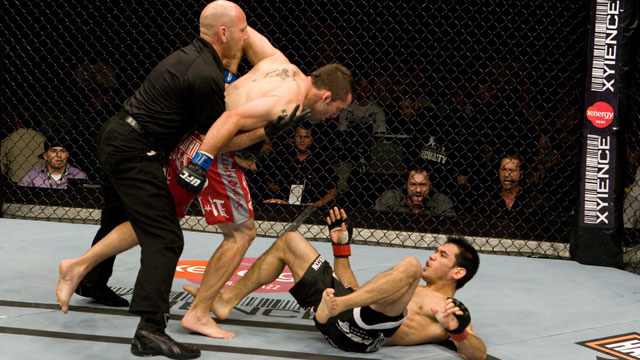
Our newest MMA blogger, referee and judge Brian Beauchamp — aka our “Third Man in the Cage” — gives his thoughts on the stoppage in Saturday’s UFC 158 that many are thinking was an early one.
It seems you can’t have any MMA events these days in which officiating isn’t discussed. Case in point is Saturday’s UFC 158 in Montreal. In particular, people are talking about referee Yves Lavigne and what some people are considering an early stoppage by referee Yves Lavigne in the bout between Antonio Carvalho and Darren Elkins.
In the first round, Elkins landed a blow to the head of Carvalho, who was wobbled by the strong impact. Yves did not miss this and immediately went in to monitor the action. A few seconds later a flurry of punches dropped Carvalho to the cage floor, at which point Lavigne had seen enough and stopped the action. The problem was that after falling to the mat, Carvalho immediately regained his composure and stood up, causing many to consider if in fact this was an early stoppage.
For those watching on TV, UFC commentator Joe Rogan said he felt it was too early of a stoppage. Many fans and trolls who post on various internet websites also felt it was an early stoppage. In particular, the numerous Canadian fans who watched one of their fighters lose this way deemed the stoppage to be too sudden.
Lavigne has custody of the bout and is the sole arbitrator. It is his responsibility to be in care and control of the fighters and to ensure their safety during the match. From the instructions given backstage to both Carvalho and Elkins to the time they engage in unarmed combat, those fighters are the referee’s responsibility.
In a post-fight interview, Carvalho showed respect and class in his response to the role of the referees and their job to take care of the fighters. And he stated his respect for Yves as a referee. Carvalho said he gave Lavigne an excuse to jump in and protect him when he was wobbled and ultimately knocked down to the mat.
As a referee, I have to respect what Carvalho said for a couple of reasons: Firstly, he didn’t offer any excuses as to why he lost and recognized that he was in trouble in the fight; secondly, he understood the complexities of the job that officials do.
This is a fighter that gets it and knows what his job is as an athlete and the role of the referee who is there to protect him. In today’s sport culture, it becomes too easy to blame the officials for losses.
That being said I acknowledge that there have been some terrible calls by referees and judges alike, but it takes maturity to look inward and accept defeat as perhaps something to which you have contributed.
Carvalho has my utmost respect for this.
Referees are always interpreting trauma that a fighter receives during the course of a bout. Keep in mind that any time there is some type of engagement occurring between fighters, trauma occurs. Every punch, kick, takedown, throw or submission inflicts trauma to the receiving fighter. Our job is to identify the degree and severity of that trauma, and to stop the fight when that trauma warrants a stoppage.
Fighters are a unique breed of athlete. Think of the mindset and commitment of the Terminator role played by Arnold Schwarzenegger. Despite receiving damage which was irreparable, the machine kept coming and coming. Many athletes, especially at the elite UFC level, have developed this mindset and are conditioned to ignore the pain, fatigue and injuries that would shut down the average individual.
When Carvalho’s knees wobbled, it is a classic telltale sign for a referee to look for that a strike has just inflicted neuro trauma. Lavigne had committed to a course of action to monitor the fighter, which was evident when he moved in aggressively to protect the fighter. Over the next several seconds, Carvalho was knocked down to the floor and Lavigne had decided it was time to step in and end the bout.
There are things as a referee we are privy to, especially with our vantage point, that that no one else can experience. Maybe Lavigne saw the eyes of Carvalho or maybe he witnessed something else that made him decide to stop the fight. This is something to which we are not privy and may never know the exact reason.
There is a fine line sometimes between stopping a fight too early and stopping a fight too late. As a referee I would rather be accused of stopping a fight too early and erring on the side of caution versus allowing a fighter to undergo too much damage and risk his or her life.
There is a statement found within the combative sports industry that has its origins in the sport of boxing: A referee is there to protect a fighter from himself. Despite his best intentions of wanting to continue, Carvalho was in no condition to continue. Lavigne not only protected Carvalho from Elkins but also from himself.
Carvalho is a huge talent and will be back, much of that because Yves Lavigne made a decision that will allow the Canadian fighter to extend his career.
Brian Beauchamp is a professional MMA referee and judge and has worked for Bellator, Maximum Fighting Championship, Super Fight League, Aggression, King of the Cage and various other organizations.
He has an extensive combative sports background and is a double black belt in both Judo and Brazilian Jiu-Jitsu. He was a former member of the Canadian National Judo Team and recently won a gold medal at the 2012 IBJJF World Championships (Black Belt) in Brazilian Jiu-Jitsu. He will blog regularly for Sportsnet.ca, giving his thoughts on the world of MMA from an insider’s perspective of an official.