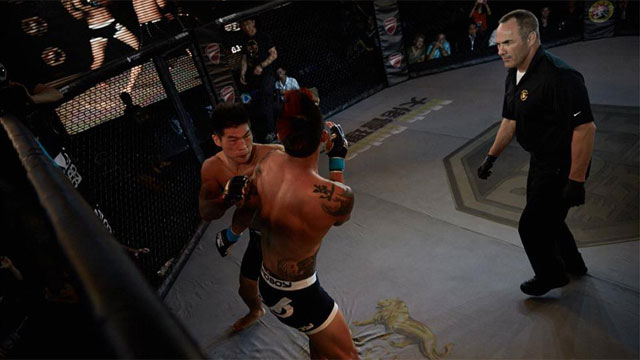
China, best known for its massive population, the Great Wall, the Forbidden City, and the Silk Road, has now embraced the world of MMA.
It is a country with a rich and historic background in the martial arts. In roughly 500 BC, Sun Tzu wrote the now very famous book The Art of War, emphasizing the importance of martial arts for living and fighting. And the Chinese people have a deeply rooted foundation in the arts.
Chinese martial arts generally referred to as Kung Fu or Gung Fu is also known by the Chinese as Wushu, and have been developed over the centuries in China.
For me my trip to China last month to referee the ninth show of the Shanghai-based Ranik Ultimate Fighting Federation was a historic one, as I learned Judo when I went to its birthplace, Japan, and I learned Brazilian Jiu Jitsu I when to its birthplace Brazil. China is the birth place of the standing martial arts and has been attributed to the need for self defence, hunting techniques and military training.
My trip began with an invitation to referee the main card at RUFF 9 being held in Sanya, China. RUFF was founded by Canadian businessman Joel Resnick and Saul Rajsky, and the former’s son Brandon Resnick is currently the director of talent and matchmaking. RUFF is the only government-sanctioned professional MMA fight promotion in mainland China and is operationally run by the father and son team with a great support staff.
RUFF was granted a permit when it made a unique commitment on growing, nurturing and supporting the sport within the boundaries of China by allowing Chinese nationals and foreigners as long they are citizens or can provide a valid work permit for china, Hong Kong, Macau or Taiwan. RUFF has quickly got the attention of some big-time sponsors, working with Bad Boy Clothing, Ducati, and MMAheat.com.
In my past travels to referee MMA in developing countries I have learned to keep an open mind and not to hold it to the standards now deployed in the North American commissions. Arriving after an exhausting two-day trip and a 12-hour time change, it can be difficult to get your bearings and concentrate on the task at hand. Weigh-ins were conducted on time and medicals were under the supervision of proper staff. Six fights on the undercard with five fights being on the main card which was broadcast on free network television to approximately seven million viewers.
As an official I was surprised at the level of the MMA skills for a country that is new to the sport. That being said with the rich history of Wushu, Sandu and Gung Fu as well as the close proximity to Thailand for Muay Thai and the recent introduction of some BJJ Black Belts from Brazil, the Chinese have a very well-rounded game. The Chinese are hungry for knowledge and are quick learners and with 1.4 billion people I expect MMA to explode in the next few years in mainland china.
Victory was reached in every way possible at RUFF 9 from a KO, TKO, to a decision and finally a technical submission with one fighter putting another to sleep with a beautiful triangle. RUFF is expecting three to four more events this year as well as a possible six events in 2014. Some of the uniqueness of refereeing in a country that most of the fighters and corners don’t speak English is that the rules meetings and private instructions to the fighters have to be conducted through an interpreter. As well, you are introduced to the television viewers and all the media play-by-play as well as ring introduction and after-fight interviews are obviously in Chinese.
During the fights the interpreter walks around on the outside of the catwalk listening to my instructions and translates on the fly. On a funny but serious note, I refereed a great fight that ended quickly with a knock out and I called in the trauma doctor as well as the medical team do an assessment on the fighter and the nurses brought in an automatic defibrillator, maybe not understanding that the fighter was knocked out but quickly recovered as opposed to having vital signs absent.
China is in great hands having RUFF as promoters and leading the way to educate the masses, while bringing in the right people and emphasizing the most important element — fighter safety, NOT the almighty dollar.
I look forward to my return trip to the Forbidden City in the fall…
Brian Beauchamp is a professional MMA referee and judge and has worked for Bellator, Maximum Fighting Championship, Super Fight League, Aggression, King of the Cage and various other organizations.
He has an extensive combative sports background and is a double black belt in both Judo and Brazilian Jiu-Jitsu. He was a former member of the Canadian National Judo Team and recently won a gold medal at the 2012 IBJJF World Championships (Black Belt) in Brazilian Jiu-Jitsu. He will blog regularly for Sportsnet.ca, giving his thoughts on the world of MMA from an insider’s perspective of an official.