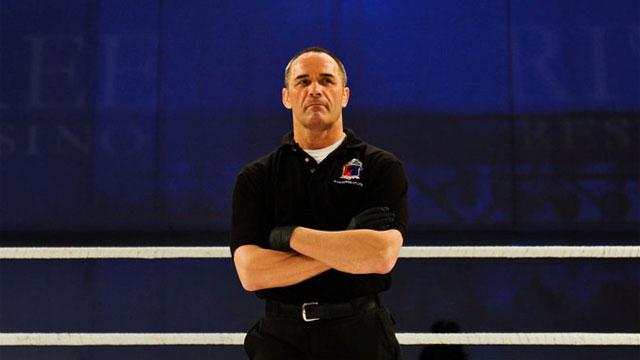

Brian Beauchamp is a professional mixed martial arts referee and judge and has worked for Bellator, Maximum Fighting Championship, Super Fight League, Aggression, King of the Cage and various other organizations. He has an extensive combative sports background and is a double black belt in both Judo and Brazilian Jiu-Jitsu. He was a former member of the Canadian National Judo Team and recently won a gold medal at the 2012 IBJJF World Championships (Black Belt) in Brazilian Jiu-Jitsu.
Starting this year, he will blog regularly for Sportsnet.ca, giving his thoughts on the world of MMA from an insider’s perspective of an official and judge. In this introductory piece, Beauchamp shares his experience in October and November working as a referee in India for the Super Fight League, which debuted in March 2012.
By Brian Beauchamp
In October, I set off on my journey to India to officiate at the Super Fight League, not sure what to expect. Despite having traveled around the world competing in Judo and Brazilian jiu-jitsu, India was still a country I had never visited, and certainly not one I would associate with MMA. I always look for new challenges and opportunities, and since the Super Fight League is getting a lot of promotion all over the internet, I decided to put my officiating skills to use in Mumbai.
The format for the Super Fight League is simple: To expose and develop the emerging Indian market to mixed martial arts. India is currently the second most populous country in the world with over 1.21 billion people which is more than a sixth of the world’s population. It is projected that by 2025 it will pass China as the world’s number one.
The key to those stats is that more than 50 per cent of India’s population is below the age of 25. In North America, most people under 25 have been exposed to MMA and have embraced it and the promoters in India are hoping for the same thing. These key numbers are some of the demographics used by the UFC in their plans for global expansion.
Bollywood and cricket are the two undeniable faces of the Indian entertainment sector and have always and will always remain the main focal point for passion for almost all Indians. The Super Fight League is owned by Bollywood actor Sanjay Dutt and wealthy businessman and Cricket team owner Raj Kundra. They have a strong background in business and entertainment in India and are putting those skills to good use.
Part of exposing the Indian market involves some creative strategies. Anyone watching the fights notices that the fights are part MMA with some Bollywood entertainment thrown in. It’s a good combination because it allows Indian culture to become a part of the show and draws in more viewers looking for something they are familiar with.
The shows consist of a Friday night weekly fight card that operates out of a television studio and is shown on NeoPrime (a sports channel in India) and is simultaneously streamed around the world on YouTube. The goal is for mass exposure of their product. The studio has a cage with seating for about 200 people, some of which is VIP seating for actors and Bollywood stars.
India has developed their own athletic commission which oversees the events. The Unified Rules of MMA are used, and yes, there are doctors at ringside. In short, regulation is a part of their product.
The competitors are still in the early stages of development with respect to MMA. Fighters in India predominantly come from one signature style when they enter the cage although a high percentage of them have a wrestling or Wushu base.
Fans that have a strong background in MMA and witnessing this for the first time can be somewhat bewildered as the fighters are not as refined with MMA skills as they have been used to seeing. Some have compared it to the early days of the UFC where the object was to see which martial art was better than the rest.
Eventually fighters recognized that there was no superior style and that a combination of effective styles, combined with athleticism, seemed to be the ticket to becoming champion. Give these fighters time; I’m certain they will come to the same conclusions.
For anyone interested in seeing how one country is attempting to develop the fastest growing sport of MMA within their own country I would encourage you to give the Super Fight League a try. The SFL has a long way to go in both developing fighters as well as their business practices but that blog is for another day.