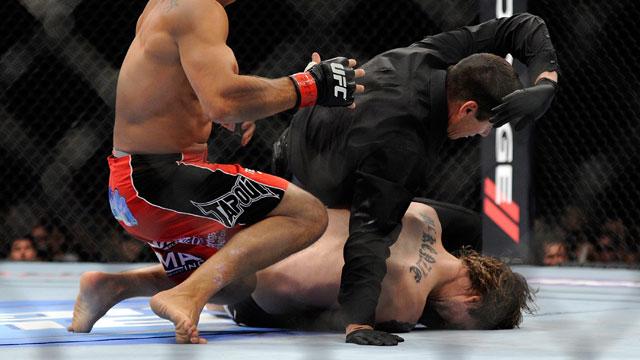
Our newest blogger, MMA referee and judge Brian Beauchamp — aka our “Third Man in the Cage” — gives his thoughts on the officiating problem in the sport of MMA.
What can you learn in day?
Apparently quite a lot if you look at the number of MMA officials courses that have recently come out on the market and sprung up on the internet over the last three years. In this week’s blog I want to address the problem of officiating and give my own opinion as to why we have a problem with officials in the sport of MMA.
Before I begin this article, and in the interest of fairness, I need to disclose a few things. I have taken many MMA officials courses (both refereeing and judging) with various instructors throughout Canada and the U.S. I have passed most and failed some. I offer no excuses. My goal as an athlete and now as an official has been to always try to be one of the best in world. I also need to state that I am in total agreement with officials taking courses, participating in annual training, and being personally active in one of the core disciplines of MMA. I will, in all likelihood, continue to take courses myself. Now that I have that off of my chest, let’s get to my opinion.
Let me begin by giving you an example: On Friday, on my way to work, I could pull my car up to the drive thru window at Tim Horton’s and order a coffee from an attendant. On Sunday I can go back to the same drive thru window with the same attendant, only now this attendant is qualified to be an MMA official.
I’m not trying to say anything negative about the drive-through service industry; I could have inserted any profession. The point is that in the scope of 48 hours any individual can be now qualified to officiate a sport as complex as MMA.
Unfortunately, some of these types of people have been hired on by commissions to officiate and judge events around the world. If I put a hockey official through a one-day course, could I reasonably expect that official to have any degree of success refereeing a hockey game 48 hours later? Hockey, at least, has multiple officiating tiers where officials are graduated to higher-level games based on competency and experience. In the NHL your performance is monitored all year, and you don’t get an NHL playoff game assignment, let alone a Stanley Cup final, unless you’re one of the best. MMA, sadly, does not have this. So the guy serving you coffee at Timmy’s is now responsible for your fight record, career, and life if you are a fighter.
Not to digress, the issue isn’t the courses. There are in fact competent instructors teaching material that is a necessity to the MMA industry. For the most part, these instructors are good at exposing individuals to MMA regulation. Learning the Unified Rules of MMA is important. Looking and analyzing videos of fights is important.
The problem is that many athletic commissions (the organizations entrusted to oversee combative sports regulation) solely assign officials on the basis that they have passed a course. The real issue is that many athletic commissions have passed the buck and assumed that as long as an official is certified then their work is finished. Their investment in their officials is minimal or non-existent and in many commissions you are responsible to pay all of the fees to get an education yourself. This in my opinion is where the system breaks down.
Because of the criminal code and several other reasons, MMA is regulated by the government. These are the same people who have brought us the eHealth scandal Ornge, the gun registry, and many other scandals brought forward by gross mismanagement. Commissioners and commission members are political appointments and many commissions do not have the technical skills to oversee officials.
When I leave the cage after a bout, and if I went over to a commissioner and articulated a brief description of what transpired in a bout such as: Fighter “A” used an Uchi Mata, then went to side control, in which they initiated a kimura to gain a submission over Fighter “B,” most commissions would not have a clue what I just described. I could insert any word as a substitute as a technique and they would assume I would know what I was talking about, without correcting me.
If they have no clue as to any of the technical skills of the fighters, then chances are they are not going to know if a referee or judge is performing up to speed. In short, we as officials can get away with almost anything if we are not being adequately supervised.
Let’s face it, we passed a course, and that should be good enough. Most commissions do not assign officials based on their competency in the cage but on their familiarity with those officials. Nepotism and cronyism has become the norm in mixed martial arts. I could give you examples, but I’m sure you will come up with some yourself. Is it any wonder why many promoters and fans are voicing their concerns in the media as to the problem with officials?
So what’s the solution? MMA courses need to be only one part on deciding who officiates. Unfortunately as it stands now, it is becoming the only part. Commissions need to facilitate a learning environment for their officials at every event and after every bout. When you come out of the cage, you need feedback — both good and bad — as to how you handled each bout. This goes beyond just saying “Good job, Brian. Here is your cheque. Last one to the buffet table is a rotten egg.” It involves technical skills and feedback as to how you moved, where you positioned yourself, why you reacted the way you did.
In short, the mentorship feedback is critical. This not only applies to referees but to judges as well. During any skills debriefing you need to articulate why you scored a fight the way you did.
Few commissions have the in-depth knowledge to be able to effectively debrief officials. In short that makes officials unable to improve or worse, it keeps them making the same mistakes and ingraining those mistakes into their mindset.
Commissions need to be leaders from the top down, and become subject matter experts at the sports they regulate. In doing so they can continue the education process from the training courses, and keep their officials sharp. If we look at learning and training as a lifelong commitment and that it involves more than a quick fix, then we are going to be well on the way to improvements in the sport.