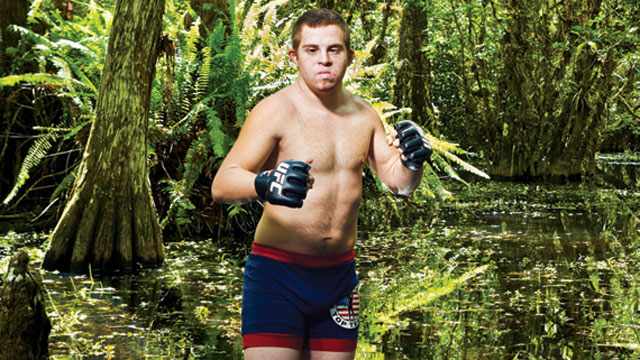

In the current issue of Sportsnet magazine (on sale until Thursday), there is a great article about 23-year-old mixed martial artist Garrett Holeve, aka “G-Money,” who trains out of American Top Team in Florida and has even been mentored by former UFC star Stephan Bonnar.
Haven’t heard of him? That’s not a surprise. He doesn’t have a fighter bio page on Sherdog. He only has a couple of exhibition MMA fights to his name, and despite his extensive training for his age and his tremendous heart, he will likely never compete professionally.
Holeve has Down syndrome, a chromosomal abnormality that affects one’s cognitive and physical abilities. Individuals with the condition often have limited opportunities. But that wasn’t about to stop Holeve from pursuing the unlikely dream of competing in a cage with four-ounce gloves and the potential to be knocked out by individuals who are much stronger and have better eye-hand coordination simply because of genetics.
I first heard about this brave and inspiring individual in December when I read a piece posted in USA Today talking about him and how he was having trouble finding fights. It was of specific personal interest to me beyond the fact that I cover MMA. That’s because my sister has Down syndrome.
Sonia, who is two years younger than me, has also been involved in athletic competitions. She has competed and won medals in rhythmic gymnastics at the Special Olympics. But we’re talking about competitions that are all geared toward people with physical and mental disabilities. There, it’s a level playing field and separated from the “mainstream” competitions. With Holeve, his endeavour involves competing against “abled” competitors – IE: those without the genetic disadvantage.
The Sportsnet magazine piece was written by Dan Robson after he attended Holeve’s most recent fight in Florida on Feb. 23 — the same night Ronda Rousey was “breaking the UFC gender barrier” on the other coast in California. The contest, while still an exhibition, was his first to feature full-out striking on the feet and it was also chronicled by ESPN’s video cameras.
Not too surprisingly, the common question that has arisen is: “Should a man with Down syndrome fight in MMA?”
That’s not an easy question for me to answer. I would like to see people like my sister get as many opportunities as they can, either integrated or in special programs. Indeed we in our family have pushed for it and supported her, whether it means getting a part-time or full-time job, involvement in extra-curricular activities, etc. And ultimately, we also want them to have a certain degree of independence when it comes to decisions.
However, the family of those with Down syndrome also has a responsibility to look out for what’s best for them when we know their decision-making process is naturally not as attuned as those without Down syndrome.
Holeve first got involved in MMA after he and his two brothers — one older, one younger — were watching a UFC fight with their dad, who asked them if they would be interested in taking up the sport. Holeve, who had previously played basketball, was the only one who said yes. This shows there was no peer pressure or brotherly competition; he wanted to fight because it genuinely interested him. And his family, which had not sheltered him in any facet of his life, including putting him in regular school and refusing to enroll him in special programs, wanted to see him pursue things that he desired, regardless of the risks. And going into MMA offered many, and not just physical, but social and emotional risks.
Since he began competing in MMA, his father has been commended by some, but he has also been called “sick” for exploiting his son and putting him in unnecessary physical danger. I say it’s not up to us to decide if that decision was the appropriate one for his son. I would personally have trouble with my sister competing in such a sport as MMA, but Sonia is not Garrett. One person with Down syndrome might not have the ability to react to a dangerous situation, of which there are many in MMA for the untrained, quickly or properly enough. Perhaps Garrett can.
But right now, whether he should be fighting at a higher level is somewhat moot, because he has been having a lot of trouble finding opponents, and likely will continue to. One quote from that first article in December sums up the situation he finds himself in:
“Few fighters want to be the one who knocks out a guy with Down syndrome or, worse, gets knocked out by him.”
The second part may not sound particularly politically correct, suggesting that a person would be worried about being made fun of for losing to an individual with Down syndrome, but the fact is it’s not unreasonable to feel that it’s a lose-lose proposition. It may be sad, but it’s true.
This will present a major obstacle for Holeve, not to mention the fact that an athletic commission would almost certainly never approve him to compete in a professional bout, if even just because there are too many variables (MMAjunkie.com’s “Fight Doc” gets into some of the medical ones here. So while Holeve would love to fight in the UFC — he speaks about that as a goal — he will likely have to accept the reality that as aspiring a target as he can set, it will fall short.
But, at least for one special night, he was able to compete and accomplish the goal of applying the skills and training he learned from some of the best trainers in the business, which he did on Feb. 23 by making it through three rounds of a mixed martial arts fight – albeit with no headshots on the mat, no punching at 100 per cent and no winner. He even applied a late kneebar, which he later said “was real tight” and ultimately had the crowd celebrating. Holeve left the ring with all the bruises and swelling you’d expect, but he survived alright.
Oh, and by the way, his opponent Mike Wilson suffered the same nasty injury to his toe that UFC light-heavyweight champion Jon Jones did this past weekend in New Jersey. At one point in the fight Wilson broke the toe when he kicked Holeve and because of the adrenalin, like Jones, he hadn’t noticed the pain until after the fight was over.
So that puts Holeve in pretty good company. While just an exhibition, he and his opponent still draw the same blood that a UFC world champion and challenger do inside the famed Octagon.
Unfortunately, that may be as close a connection as he’ll ever have to a UFC superstar when it comes to competing. But that doesn’t mean he won’t inspire just as much.
If not more.