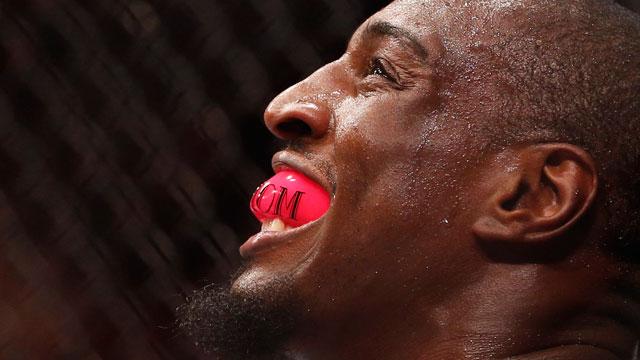

Phil Davis sat behind a folding table in a dimly lit resource room in the bowels of Seattle’s KeyArena, fresh off a unanimous decision win over veteran Antonio Rogerio Nogueira in the main event of Ultimate Fight Night 24.
It was March 26, 2011, and “Mr. Wonderful” was the top light heavyweight prospect in the UFC. A four-time All-American and 2008 NCAA Division I national champion, Davis had just pushed his record to 9-0, notching the biggest win of his career, and his fifth UFC win in 13 months.
A week earlier, Jon Jones had completed his rapid ascent to the top of the 205-pound ranks, dominating Mauricio “Shogun” Rua at UFC 128 to become the youngest champion in UFC history. In the six days between their fights, Davis had been asked so many questions about Jones that he and his teammates joked that they would take a shot every time the new champion’s name was mentioned.
There in the quiet, empty recesses of the KeyArena, Dominick Cruz and Jared Platt lean against a wall, listening to Davis answer query after query about his victory, pantomiming taking a shot and giggling the instance they hear one of the media members utter the name “Jon Jones.”
At the time, Davis was tabbed as the man to potentially dethrone the man who only a week early forced Rua out of the big seat. He was athletic, a powerful wrestler and underrated grappler, and came from a great gym, Alliance MMA in San Diego. In a year – two at the most – the two young standouts would surely meet, and many believed Davis would be the man to emerge victorious.
Those two years have already passed, and Jones and Davis have yet to meet in the Octagon. They haven’t come close to meeting, in fact.
After dispatching Nogueira in March 2011, Davis’ next assignment was a match-up with “Suga” Rashad Evans in the main event of the first complete fight card televised on FOX. The winner would advance to face Jones for the light heavyweight title.
It wasn’t Davis’ night. Evans controlled the action over five rounds, out-striking him by a solid margin, and beating him at his own game, completing three out of four takedowns, while stuffing all but two of the nine Davis attempted in return.
Losing to a former champion and perennial contender shouldn’t have done much to diminish Davis’ standing in the division or weaken his prospects going forward.
Inexplicably, the UFC opted to next book Davis against Chad Griggs, a former Strikeforce heavyweight who earned his 15-minutes of fame by outlasting exhausted former WWE competitor Bobby Lashley. Griggs would eventually have to withdraw due to injury, and was replaced by newcomer Wagner Prado, who was heralded as a Team Nogueira prospect and pseudo-celebrity in his native Brazilian following an appearance on the top-rated television program Caldeirao do Huck.
Less than 90 seconds into the opening round, Davis inadvertently poked Prado in the eye. The bout was stopped and declared a “no contest.” Rather than move on from the bout and get Davis back in the cage with a fellow top-ranked light heavyweight, they rebooked him with Prado two months later.
It went how you would expect a bout between a 9-0 former national champion wrestler with five UFC wins to his credit and an 8-0 Brazilian who only faced mediocre club fighters in his native Brazil to go, with Davis dominating the first before submitting Prado late in the second round.
Davis followed up his win over the over-matched Prado with a unanimous decision victory over Vinny Magalhaes at UFC 159. It was another fight that made little sense for the top-10 ranked light heavyweight, and the high risk/low reward pairing produced a tepid affair that did little to rejuvenate the momentum the 28-year-old Davis had lost in following his loss to Evans and the Prado debacle.
Saturday night, Davis steps into the cage with former light heavyweight champion Lyoto “The Dragon” Machida in the co-main event of UFC 163. With a win, Davis will put himself back on the short list of potential title challengers; if he wins convincingly, he might even move to the head of the list.
But what if Davis loses?
It’s a question that is far from out of place. Machida has lost just three times in his career, and one of those defeats – UFC 127 versus Quinton “Rampage” Jackson – was a shaky judges decision. He was once viewed as the future of the 205-pound ranks, and has twice been christened the “#1 contender” by UFC President Dana White.
This is where things get dicey for Davis.
While he’s been working his way back from his loss to Evans by facing middling competition, Davis has been overtaken in the climb towards contention. He’s currently ranked seventh in the official UFC rankings, two spots behind Nogueira, and five spots behind his teammate and training partner Alexander Gustafsson, who will face Jones for the light heavyweight title later this year.
Davis submitted Gustafsson three years ago at UFC 110, before they were teammates. It’s a fact that gets forgotten or explained away with a simple “Sure, but Gustafsson has really improved since then” as if Davis remains the same fighter today.
A loss would once again force Davis to regroup and start over. Losing to a former champion and perennial top contender shouldn’t drop him too far down the divisional ladder, but that’s what everyone rightfully thought when he lost to Evans as well, and we saw how that turned out. It took 18 months of dealing with over-matched opponents to get back within arm’s reach of contention this time, and going 0-for-2 in “get to the next level” fights is a rough place to land.
Unlike Michael Bisping, Davis doesn’t have a nation of fans behind him and a pre-established level of recognition from competing on The Ultimate Fighter buoying him within the division, keeping him close to contention regardless of his results in the cage.
If anything, Davis has become the forgotten man over the last 18 months since losing to Evans. His previous impressive performances against Gustafsson, Nogueira, Brian Stann and Tim Boetsch have been eroded by time, washed out to sea as fight fans and observers fixate on their most recent impression of a fighter.
Should that most salient memory of Davis be of a loss to Machida on Saturday, “Mr. Wonderful” could once again find himself lost in the shuffle in the light heavyweight division.
Considering he’s only on the fringes now, and with Machida, Glover Teixeira, and potentially Daniel Cormier all waiting in the wings – plus a host of other fighters already ahead of him in the rankings – a loss this weekend might just erase Davis from the title picture entirely.