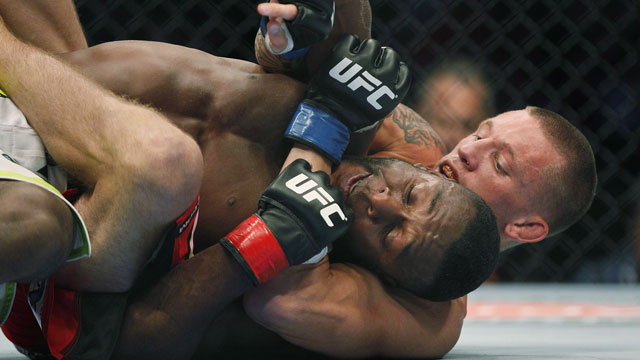

Nine fights went the distance Saturday night in Winnipeg, and the usual issues with judging were on full display.
We need to improve the state of judging in mixed martial arts.
I know that isn’t a new revelation, but watching UFC 161 Saturday night with its plethora of head-scratching results really brought it home.
This isn’t going to be one of those "this guy got robbed" columns because what’s done is done and complaining about Dustin Pague getting hosed isn’t going to change the fact Dustin Pague got hosed. Additionally, the term "robbed" gets thrown around way too liberally; sometimes there is nothing wrong with a split decision.
Instead, this is going to be a closer examination of a couple of Saturday’s more curious scorecards with special attention paid to how to potentially prevent the same missteps from continuing to happen in the future.
The obvious, over-arching answer is further education, but it feels like we’ve been saying that for a number of years and yet we’re still waiting for judges to be required to have certification before they can fill out scorecards.
That being said, if I can take (and pass) "Big" John McCarthy’s COMMAND course in an effort to become more knowledgeable and get a better understanding of how to score fights, wouldn’t it make sense for these Athletic Commissions to require prospective judges to do the same?
The fights
If it wasn’t clear from the opening, I think Dustin Pague got hosed on Saturday night, losing a split decision in a fight that I wouldn’t have objected to seeing scored 30-27 in his favour. At the very worst, you could make a case for him losing the final round, but even that was a close frame.
Pague lost this fight because two of the three judges still believe that being on top constitutes being in control and winning the round, even though Yves Jabouin spent the majority of the opening round (and large portions of the fight) defending submission attempts.
In a bout where the majority of the action is taking place on the ground, effective grappling becomes the lead criterion for scoring that round. Two clean, heavy punches doesn’t outweigh being locked in a triangle choke or having your opponent frequently transitioning to dominant positions over the course of the fight.
Additionally – and this is my biggest pet peeve with the scoring of this fight – it’s not like there was time in any of the three rounds where Jabouin was far and away the one dictating the action and doing significant work. If he wasn’t being seriously out-grappled, things were fairly close, as the final FightMetric numbers show.
Pague controlled the action throughout that fight, and in each round the most impactful offensive moments came from the former Ultimate Fighter contestant. Getting mounted or having your back taken – even if only for 30 seconds – are the grappling equivalents of staggering your opponent with a right hand down the pipe. It’s time for judges to understand that and start scoring fights accordingly.
In the welterweight bout between Sean Pierson and Kenny Robertson, the issue wasn’t who won each round, but rather the way the final round was scored.
The first two rounds were both 10-9 rounds; close, hard fought rounds where neither fighter had a significant advantage. The third round, however, was nothing like the first two frames, and yet two judges scored it 10-9, resulting in Robertson dropping a split decision to his Canadian opponent.
Personally, I don’t know how you could have watched the first two rounds of that fight, where the action was relatively close and neither fighter was in any real danger of being finished, correctly score them 10-9 and then think that Robertson’s dominant final frame, where he had Pierson in trouble throughout, was deserving of the same valuation.
Robertson out-landed Pierson 83-2 in the final frame according to FightMetric. No, that isn’t a typo – he out-landed him 83-2 – and yet two judges felt he didn’t do enough to merit a 10-8 round.
For all the complaints about the 10-point-must system and its flaws, it’s surprising to me that we don’t hear a louder call for judges to be less hesitant in awarding 10-8 rounds or greater.
Too many officials have it in their head that the 10-point-must system means the round winner gets 10 and the other guy gets 9, no matter what happened. That is simply not the case. When one fighter dominates the way Robertson did in the third round, the scoring needs to reflect that.
Unfortunately, that wasn’t the case on Saturday night, and it resulted in Robertson taking a loss in a fight where he deserved a better result.
I will say this: I’m not a big fan of handing out 10-10 rounds, simply because the judges are there to determine who won each round. Saying "it was even" and scoring a frame 10-10 is a bit of a cop-out to me. Most of the time, something happened that defines who won the round and the judges, if properly trained and paying close attention, can pick out those moments.
The third and final fight on Saturday’s card that deserves attention from a judging/scoring perspective is the most difficult of the three to score and the one that is sure to spark the greatest debate: the preliminary finale between Jake Shields and Tyron Woodley.
After 15 minutes, the scores came in at 30-27 Woodley, 29-28 Shields and 29-28 Shields, resulting in a split decision win for the former Strikeforce middleweight champion. Dana White took to Twitter claiming Woodley was robbed, and innumerable people responded that the UFC President had lost his mind.
Personally, I side with White, having scored the fight 29-28 Woodley on fight night, with Shields taking the middle stanza.
Shields threw a lot of strikes (267 to Woodley’s 131 according to FightMetric), but as is often the case, there wasn’t a lot of jam on anything he landed, and this wasn’t a "punches in bunches" Diaz-esque performance either. This was a lot of ineffective striking combined with ineffective grappling as well, considering Shields was 0-for-17 on takedown attempts over the course of the 15-minute affair.
Now, Woodley didn’t do a whole heck of a lot, but the strikes he landed were more effective than those Shields connected with. Go back and watch the exchanges in the clinch where Shields is throwing knees and Woodley is digging punches into his body, and tell me which of the two has more impact.
And if you’re handing out points for "Octagon Control," I’d say the guy who kept it standing by stuffing 100 per cent of his opponent’s takedown attempts dictated where the fight took place. Shields clearly wanted the fight on the ground and Woodley was having none of it. Once he realized he couldn’t get the fight to the canvas, Shields was content to press in along the fence and hang out for long periods of time.
There is a difference between doing work along the cage – dirty boxing, working short knees, annoying little elbows inside – and clinching for the sake of clinching. Shields’ approach on Saturday felt more like the latter, and I just don’t know how you can award a fighter a victory when he goes 0-for-17 on takedowns and does little damage with his striking?
Summary
I know it’s been said innumerable times in the past, but the Athletic Commissions need to start taking proactive steps to improve the state of judging.
Until officials are held accountable for the missteps, and regular training and certification is made mandatory, we’re going to continue to have poor decisions marring the sport. That is unacceptable.
I really like doing these kinds of breakdowns, so let us know in the comments section if you want to see more of these kinds of pieces in the future.
I think there is plenty of value in talking about the intricacies of a fight and how to score them. You may not always agree with my assessments, but building a conversation and discussion about scoring feels more beneficial to everyone than simply saying, "Dustin Pague got robbed!" and leaving it at that.