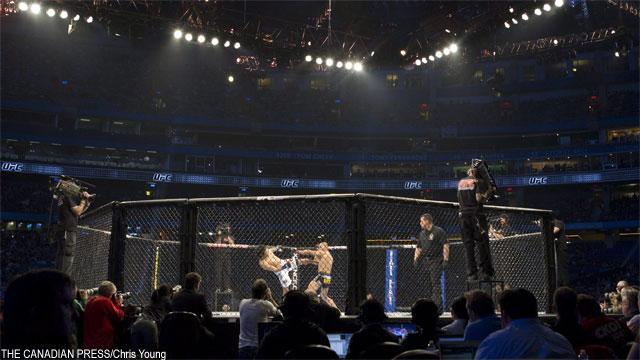

It’s one thing to pay to see a UFC card in the Toronto area. It’s quite another to shell out money to a see a grass-roots card in which the fighters aren’t known to the general public.
While the UFC has made an annual stop in Toronto since 2011 after the Ontario government changed the regulation the year before to allow professional mixed martial arts, it has not grown appreciably in the province.
If anything, it actually went backwards to the point of extinction. Up until this past Saturday night, there had not been a card in Ontario in almost seven months.
So a card called Substance Cage Combat 1, which took place Saturday night in a sweltering old hockey arena in Toronto, became the start of what is expected to be a return of the sport.
Neil Forester, a longtime promoter/event organizer and owner of Grants MMA gym in Toronto, ventured forth with a card that had only six bouts due to injuries and other circumstances.
It attracted a crowd of about 1,000 – of which only 200 or so received comps – most of them family and friends of the fighters. This was not an event to see and be seen, but rather a chance to offer support to the individual fighters who do what they do for the pure love of the game, not because they expect to be richly rewarded or think they will be noticed by the UFC.
The fighters receive little pay, most of them doing it because they train at Forester’s gym and were happy to have a chance to compete. As it turned out, all of Forester’s fighters lost their bouts.
As for the UFC dream, well, it’s a lot like being a needle in a haystack. There are simply too many places throughout the world where the UFC is canvassing for potential talent, and Toronto – and by even greater extent Ontario – is not the place to make those great discoveries when there are no cards.
Although recently-passed regulation will allow all provinces and territories in Canada to have professional MMA, it’s a process which will take time. In Ontario, it’s said that too much regulation places too many restrictions and financial burdens to make it worthwhile for promoters to take the risk.
Forester wholeheartedly believes in MMA, and putting on a card allowed him to give something back to the fighters in his gym and aspiring Ontario competitors.
Following the card, Forester said he probably broke even on the show, which at best could be considered a financial success. Through the support of friends, sponsors and business associates, Forester put together a professional show.
“It was a really emotional kind of night. You’re wearing a promoter hat and gym owner hat who has his fighters on the card,” Forester said. “At the end of the day I’m happy because we pulled it off. It was a success. Everyone is coming up to me
and congratulating me, the (Ontario Athletic Commission) said I pulled off a great show, people were telling me the fights were great. It wasn’t too short, it wasn’t too long of a card. I think everything came out the way we wanted it to.”
When asked if he’d do another show, Forester replied: “Hell yeah.”
He’s planning for the third week of October to avoid conflicting with a UFC event.
“I’ve been a promoter guy for 15 years, an events guy for 15 years, doing events is in my blood,” he said. “I’ve been training in mixed martial arts for 20 years,
I’ve owned a gym for three years, so it’s a combination of my job and my passion. I had a blast tonight. I had friends I hadn’t seen in three or four years. I had friends drive in from Ottawa to help volunteer. I had friends from Montreal drive down to support the card. I had people wishing me well from across Canada. I had people messaging me on Twitter and Facebook saying ‘good luck.’ That’s what it was all about. The most important thing was seeing my guys get an opportunity to fight in their hometown. Not making excuses for anybody, but I think even for them it’s jitters. You’re fighting in front of your friends and family. They got some experience under their belt and you keep going.”
Forester represents hope for what seemed like a dead end for professional MMA in Toronto, aside from that one show a year in which the UFC rolls into town with all of its promotion and stars then packs up and leaves. There have been three UFC shows so far, beginning with the first one at the Rogers Centre that packed the place with more than 55,000 and then moved into an arena a third of the size. It has gone from a must-see event in which scalpers could sell tickets to for two or three times the face value to one in which you can buy a seat on the day of the show without getting gouged.
The UFC knows it can still put on a show and produce a profit, albeit the first shows in Calgary and Winnipeg have not produced the entertainment advertised or expected, but there are no guarantees. Whether it’s a multi-billion dollar company such as the UFC or a small-promoter such as Forester, things happen to compromise the card, either with injuries or an insufficient amount of action. The UFC can afford the luxury of a product that fails to hit its objective because there are cities that will line up for the opportunity to play host to an event for the first time.
Insofar as Canada, which the UFC has been called the ‘Mecca of MMA,’ Montreal and Toronto are primary cities to bring their product annually. Saskatoon and Halifax loom as possibilities for the future and at some point both Winnipeg and Calgary will be given shows again. A return to Vancouver for the first time since June 2011 also looms largely.
But that’s pro MMA at the elite level with all the bright lights, booming music and elite stars. The same people who made it to the top began in small promotions such as SCC. The changed regulatory rules allowed for the opening of more gyms because people of all ages can participate in a sport which has now become popular and more accepted.
But all the fighting in a gym won’t matter unless there are cards to allow for true competition literally under the lights.
“Now that people saw we pulled it off, we did it and we honoured our word and followed through with it, I think the support is going to be there,” Forester said. “You’ve got to build. Now that I’m going to be providing fight opportunities for these fighters, I need to help promote this sport to the casual fans. You’re either a UFC fan or you’re not a fan of mixed martial arts. There’s probably not more than a dozen people at the show that didn’t have a connection to it. Everyone was a friend, a family member of a gym owner or a fighter. My goal next time is to try and sell a couple hundred tickets to people who just want to go to a fight night.”