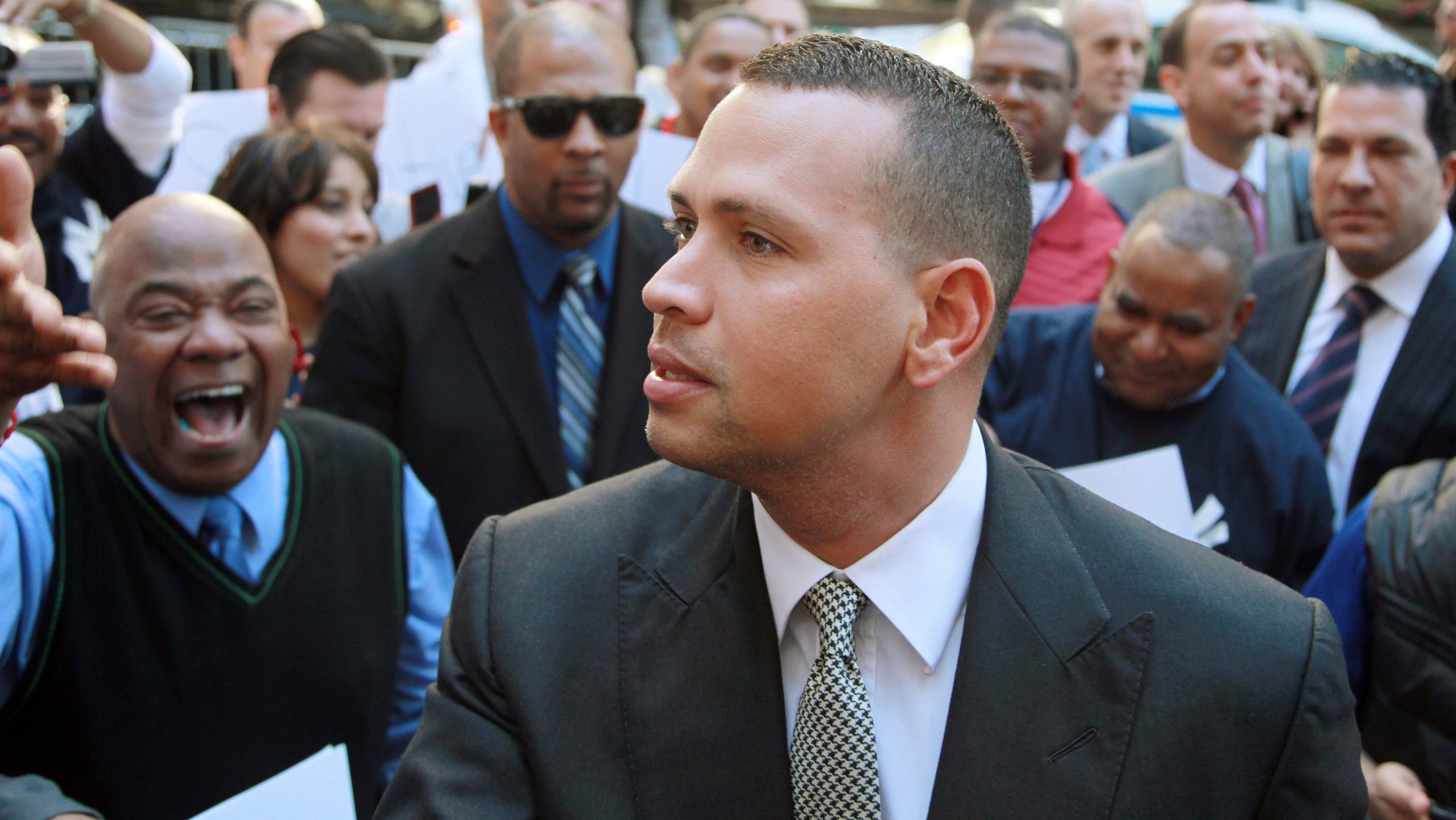

There’s not much that’s more schadenfreude-y delicious than watching writers pounce on the legitimately loopy actions of a public figure they’ve all held their nose over for a long time. This week, Alex Rodriguez had a definitely, not at all calculated meltdown at his arbitration hearing—only to appear a short time later in an absolutely spontaneous interview on Mike Francesca’s show—and provided an early Christmas gift of an opportunity. A lot of people had a lot of fun taking a run at it, and Jeff Passan and Jonah Keri have two of the best takedowns. Passan writes about how Rodriguez’s performance this week will never accomplish whatever manipulative purpose he was driving at, so out of hand is his arrogance and hypocrisy. “Even for him—for a habitual liar whose drama-queen antics have devolved into that toxic reality-show marriage of amusement and sadness—Wednesday represented an altogether new level of hissy fitting, which is saying something,” he writes.
Keri, on the other hand, believes Rodriguez makes some valid and important points beneath his steaming pile of self-serving bluster—MLB’s arbitrarily harsh punishment of him relative to others, for a start—but points out that the slugger’s “historic lack of self-awareness” basically precludes anyone listening to him. “MLB overstepped its bounds in levying a 211-game suspension. Rodriguez is a megalomaniac and a liar,” Keri writes. “These things aren’t mutually exclusive.”
Student-athlete privilege
Adam Weinstein, an instructor at Florida State University, offers a pretty chilling account of how things work, at FSU at least, between the most revered NCAA athletes and the educators forced to treat them as anything but normal students. You just end up feeling sad and angry for almost everyone involved: the instructors, at best frustrated and irritated, at worst viscerally terrified by a handful of seemingly aggressive thugs; the young athletes who are obscenely privileged and petted, but also used up like a commodity; the advisers caught in the middle; the “normal” students who don’t get these strings pulled for them. It’s only one man’s account, of course, but if it’s accurate, the question of how some young athletes fly off the rails or their alleged crimes get swept under tidy rugs doesn’t even need to be asked.
RG III’s leadership
Sally Jenkins writes about the powder keg a losing locker room can become, and why some teams and players (the Redskins, Robert Griffin III) cannibalize each other while others (the Giants, Eli Manning) stand proudly by each other’s sides. So far, she writes, RG III has fumbled the statesmanship test, passive-aggressively blaming coaches or the offence for losses, while ducking blame for his own blunders on the field. Washington’s ongoing struggles will be a test of exactly who “this kid, so heavily lacquered with talent and glamour,” is, and whether he’s really a leader. “Griffin clearly wants to be the kind of guy his teammates will climb the mast in a hurricane for—and at 23, he still has plenty of time and good enough habits to become that,” she writes. “But these were the manners he showed on Sunday: After his worst personal performance to date, he criticized the coaching staff. It’s not enough to voice the right sentiment; you have to feel it.”
World Cup drama
Brian Phillips takes an intelligent, but I think misguided, look at the hysterical narratives popping up around the World Cup in Brazil as a result of two brutal murders. He makes the very valid point that the unconnected killings almost certainly have much to do with drug gangs and zero to do with would-be soccer tourists, yet plenty of publications are running chintzy concern-troll stories pointing nervously at next summer’s event. I’m a fan of Phillips’s writing (his recent portrait of Peyton Manning is fantastic), but here’s where he gets a bit high-horsey and loses the trail: “It’s a code that pops up again and again when a developing or newly industrialized country hosts the World Cup,” he writes. “Here in this Holiday Inn Express in Lincoln, Neb., you are safe; in South America, life is cheap.” This is a journalistic (or societal) tic that says more about a lazy devotion to drama than it is a “sleight of late-colonialist hand,” as Phillips describes. Remember when someone suggested the Vancouver Olympics were the worst ever, about, oh, three days in? This is a thing we do, regardless of the host country: We fixate on a couple of mildly problematic—or profoundly disturbing—events loosely connected to a massive tournament (or any type of global event, or even a vacation destination), forcing them to be harbingers of something they aren’t.
“That’s a really interesting voice”
Richard Deitsch has an (unintentionally?) amusing piece about Tia Texada, a voiceover artist who entices viewers to stick with CBS’s The NFL Today through commercial breaks. Texada is the lone female voice on the program, but this quote from producer Drew Kalinski explaining her appeal is just hilariously absurd: “When women around the country are watching The NFL Today, I really do think that when they hear a woman’s voice, they turn to their husbands or boyfriends or kids and say, ‘That’s a really interesting voice,'” Deitsch quotes him as saying. “It’s creating a conversation in living rooms amongst families, people and fans of the game.” I honestly can’t tell if Deitsch is writing the piece straight or with his tongue shoved in his cheek, but I suspect the former. And you’ll notice that of the two voiceover artists introduced in the piece, there’s a headshot of only one. But absolutely, I’m sure it’s the women in the audience they’re hoping will comment on her “interesting voice.”