There is a dread known only to writers who commit to print true-but-unflattering anecdotes about innocent subjects of profiles and then happen to bump into them afterwards. There is an additional level of fear for those writers when the aggrieved individuals are capable of doing them bodily, possibly mortal harm. The latter was the case when I bumped into George Chuvalo a few weeks after profiling him back in 1987. This chance meeting prompted immediate introspection — questions about my career choices, medical benefits and life insurance. I had insulted if not defamed a guy who could kill me with a handshake and almost did.
You might presume my luck was all bad when my path crossed with Chuvalo’s. But this toughest of all the tough guys in the toughest of games — boxing — couldn’t have taken it easier on me. Out of the game for nearly 10 years by that point, Chuvalo had faced some of the biggest hitters in a great era for heavyweight boxing, none of whom knocked him down. If Ali, Frazier and Foreman couldn’t drop him to the canvas or even back him up, then I should have guessed that he wouldn’t even feel the sting of what to the objective reader might be read as a cheap shot.
Let me back up: I had written a piece about Chuvalo for a magazine that catered to hipsters who are now the parents of hipsters. While his name was shorthand for toughness to boxing fans, most sports fans and many Torontonians of that era, his history was little known to my intended readership, so I had to lead them through the fact and lore.
To capture the man, I recounted what were the most brutal of moments in his career: the night he stepped into the ring with Joe Frazier, then a star ascendant, already owner of a left hook that stands as the greatest of all time. The fight went only three awful rounds before the ref stepped in and stopped it, raising Frazier’s hand. I remember watching it as a kid and having nightmares that night. In the gruesome and presumably offending passage, I wrote: “You can’t forget how Smokin’ Joe Frazier almost knocked George’s eye out of its socket.”
When Chuvalo walked over to me the night of the dreaded run-in, he probably could have smelled my fear. And he went right to the line about the Frazier fight.
“You wrote that Frazier was knocking my eye out of the socket, but that wasn’t what happened,” he said. “The fact is that he knocked my eye into the back of the socket. Other than that, I liked the story.”
Chuvalo liked it so much that over the next two or three years we spent a fair bit of time together. We grabbed late-night meals at Macedonian Village on Queen St. We watched fights in bars. And once, we wound up at Gold’s Gym, which was open 24 hours back in those days. We showed up in the 24th hour, and Chuvalo prefaced his workout by telling me he hadn’t been in a gym for a couple of years. He then picked up two 125-pound dumbbells, took a seat on an incline bench and machine-gunned a couple of dozen alternating curls, expending what seemed to be no more effort than if he were hoisting cans of apple juice. And that’s what the dumbbells looked like to scale when Chuvalo wrapped his massive hands around the handles. Working out with a 50-something former heavyweight contender can humble you.
Chuvalo, who passed away on Saturday on his 89th birthday, had been fighting professionally since the year of my birth, debuting with knockouts of four guys in one night in a tournament for novices at East York Arena in my neighbourhood. He first registered on my radar back in February of 1965 when, with his gloves raised, his glower in deep shadow, he appeared on the cover of Sports Illustrated the week before a non-title fight against former champion Floyd Patterson at Madison Square Garden. The magazine labelled him “The Croatian Candidate” on the cover, and the photo could have been a frame pulled from film noir, a portrait of a menace, the last guy you’d want to see in a dark alley. The profile, however, painted a picture of the fighter as a push-over at home for his wife and kids, a guy who fought to put food on their table, which sometimes had been a scramble. He looked like the most brutal guy in the most brutal game, but was in reality an utterly likeable softie out of the ring.
One quote in the story stood out: “People think fighters are dis-dat-and-does guys. I read psychology. I read Freud, Jung. Confucius and a few other fellows. Plato. Aristotle. I like Socrates best of the Greeks. I left school in the 12th grade, [so] I’m trying to make it up, getting as much education as I can on my own.”
Back then I wasn’t old enough for those names to register, although I had read Confucius, mostly after breaking open fortune cookies. No matter — just the notion of a bookish boxer busted any stereotype.
Promoters probably considered Patterson vs. Chuvalo a tough sell, given that Patterson’s brand was much diminished by consecutive first-round knockout losses to Sonny Liston. Chuvalo came into the fight with a good but spotty record: 29 wins, eight losses and two draws. In his prior dates at the Garden, he had a win by stoppage over Doug Jones — a respected veteran who had dropped Muhammad Ali (then Cassius Clay) — and a loss by unpopular decision a couple of years before that. His win over Jones aside, Chuvalo passed for a journeyman whose greatest claim to fame was the fact that he had never been knocked off his feet, much less close to knocked out.
In the end, the match-up produced a wildly entertaining contest eventually named Ring magazine’s fight of the year. Patterson gutted out a close, unanimous decision — a draw might have been fair — but Chuvalo’s name was made.
The Patterson fight was Chuvalo’s first of six against champions and former champions — all losses, all bravely fought. Famously, he lost to Muhammad Ali twice, the first a 15-round title shot at Maple Leaf Gardens and much later a 12-round decision at the Pacific Coliseum in Vancouver that Chuvalo (and maybe Chuvalo alone) would claim went to the wrong man. He lost to Joe Frazier before Smokin’ Joe’s famous win over Ali to take the title. He likewise lost to George Foreman, then a rising and feared young contender. The bouts versus Frazier and Foreman were the only stoppages Chuvalo suffered in his career, but even then he kept intact his record of never being floored.
Of course, Chuvalo scored a few wins over favoured contenders along the way: beating Mando Ramos, then ranked No. 4 in the world, in five rounds in 1968, and knocking out “Irish” Jerry Quarry a year later. He also beat Cleveland Williams by decision after Williams had been lit up by Ali and was in decline.
Chuvalo never got a shot at the Commonwealth and Empire title. Long-time Commonwealth champ Henry Cooper once wrote that he avoided Chuvalo because he was “too ugly” — not a knock on his looks but rather an admission that his style would have presented too stiff a challenge. This was an opinion shared by all British heavyweights who wanted no part of him.
The story I wrote in ’87 was far from my first brush with Chuvalo. I first saw him live when he was fresh off his win over Ramos, a fight against Dante Cane at Maple Leaf Gardens. An Italian heavyweight, Cane owned a three-inch height advantage on Chuvalo and had the sympathies of the crowd that night, mostly because thousands took the transit from St. Clair West. Cane was not a top-10 contender, but he gave Chuvalo all kinds of fits in the early rounds as he used his extra-long sleeve to stave off his opponent and rack up points. Ultimately, though, this only forestalled the inevitable, and persistence would prevail. Chuvalo caught up to a gassed Cane in the seventh, and ended the night with an emphatic if crude bludgeoning. For 12-year-old me, a guy with limited skill and unlimited will was easy to root for.
A couple of years later, at a Clyde Gray fight at the CNE, I got an autograph and a handshake from Chuvalo. Though I’ve lost the former in the 50-year interim, the memory of the latter is still fresh. Chuvalo’s bare hands looked like 16-ounce gloves. When I extended my right hand, it disappeared into Chuvalo’s palm and was swallowed up entirely up to my wrist. I was relieved that he deigned to give it back.
I saw Chuvalo fight again when he came out of retirement in the ’70s — after the second Ali fight, he ceased to be a fighter on big stages, but remained a local draw. In the ring he got old fast, but still had enough game at age 40 after a four-year hiatus to handle Pretty Boy Felstein, the nearest thing he had to a local rival. Thankfully, he didn’t go the way of a lot of fighters, ending their careers with a string of losses to make the reputations of up-and-comers. In fact, when he walked away from the game for good, he went out with eight consecutive wins.
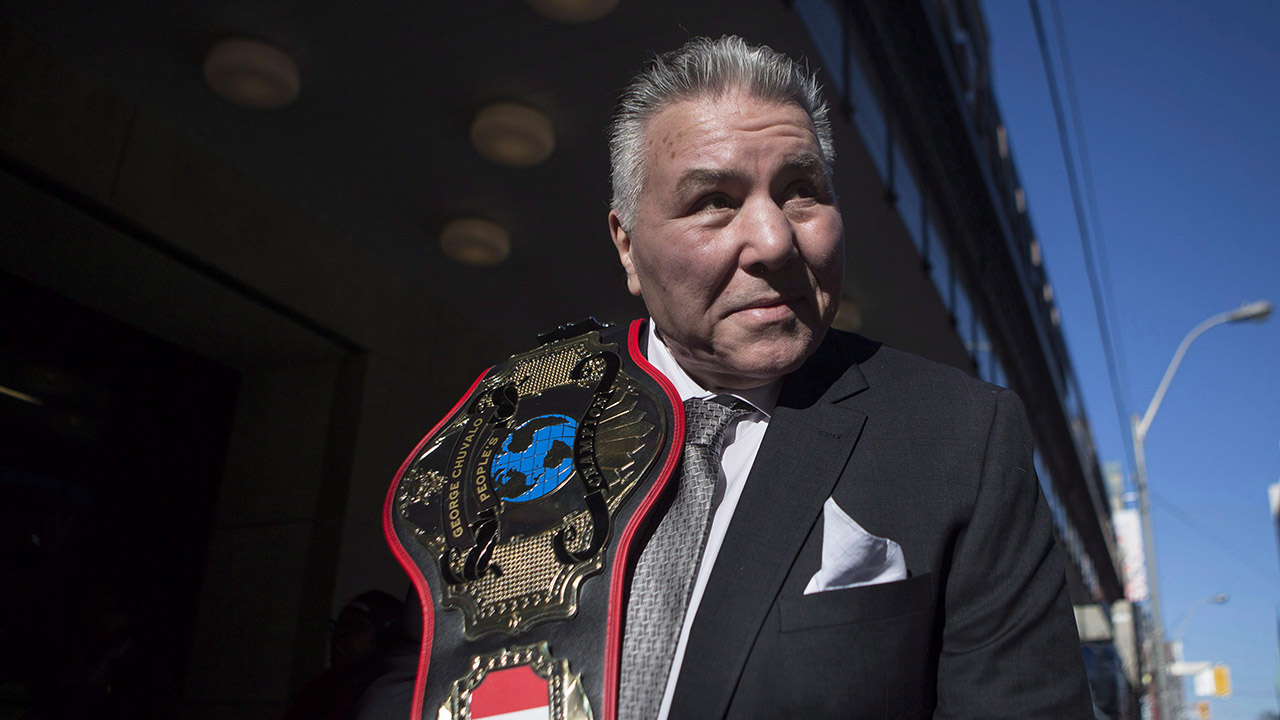
For a fan, it was easy to imagine what might have been for Chuvalo. If he had come up in the Bronx or Staten Island, they would have named a street after him in New York or at least a bar. If he had come along in the ’30s, he would have inspired a fictional character for Damon Runyon. It was Chuvalo’s grave misfortune to come along where he did and when he did.
Even graver misfortunes were found at home. Those scenes from Sports Illustrated back in ’65 captured the Chuvalo family in good times, but they did not last. He had two sons die from heroin overdoses and one from suicide, and his wife, lost in her grief, also took her own life. Much later in life he would make the rounds of schools and speak to kids about mental illness and the mortal cost of substance abuse.
I last talked to Chuvalo at the International Boxing Hall of Fame in 2008. He was not an inductee — sadly, there’s no committee recognizing the greatest chins in boxing history. He was, however, in his element at events, floating about the banquet room like a social butterfly and sticking one-liners like a bee. He was happy and — given his age and former occupation — remarkably cogent. He remembered everything. I reminded him of a few stories that he had written for a magazine I edited back in the ’90s — they were among the funniest I’ve ever read, but none ended up running because soon after they landed on my desk the magazine folded, as magazines do. “I think I could have been a writer,” he told me.
Could have been a writer — could have been, and was, a contender. To truly honour George Chuvalo on the event of his death, they shouldn’t lay his casket in the ground. They should stand it up, so he departs this mortal coil on his feet.
 1:54
1:54 1:09
1:09