
This story was originally a Digital Bonus for Sportsnet Magazine.
From the nosebleeds at the University of Michigan’s Crisler Center, the sound is an undulating hum that rises and falls with the constant overlapping addition and subtraction of dozens of voices at a time. Kicking up whenever the visiting team –Purdue in this case — has possession, it spreads from the lower bowl out over the court and into the stands, running over the arena’s spotless seats, prodding alumni and fans, flowing over the scoreboard and crashing against the rafters. It’s the sound of the Michigan Wolverines’ student section, the “Maize Rage”–2,700 college kids dressed in yellow, jumping up and down and screaming their lungs out any time the opposition touches the ball.
On the court it must be deafening, but Purdue keeps it together through the first 20 minutes and leads by one at the half. Things fall apart five minutes into the second, when Michigan strings together a 10-0 run. With the Wolverines up 46-40, Purdue guard Anthony Johnson brings the ball across half and nearly loses it when Michigan’s Trey Burke lunges for a steal. Johnson has nothing but open floor in front of him, but somehow Burke recovers, diving at him from behind. The ball is knocked loose and corralled by freshman centre Mitch McGary, who tosses it ahead to the streaking Burke, now leading the charge into Purdue territory followed by Wolverines forward Glenn Robinson III. With the Boilermakers watching from halfcourt, Burke drops a pass back to Robinson, who jumps, spins 180 degrees, double clutches and tosses up a lefty reverse layup that clanks off the side of the rim. McGary, trailing the play, tips home the rebound.
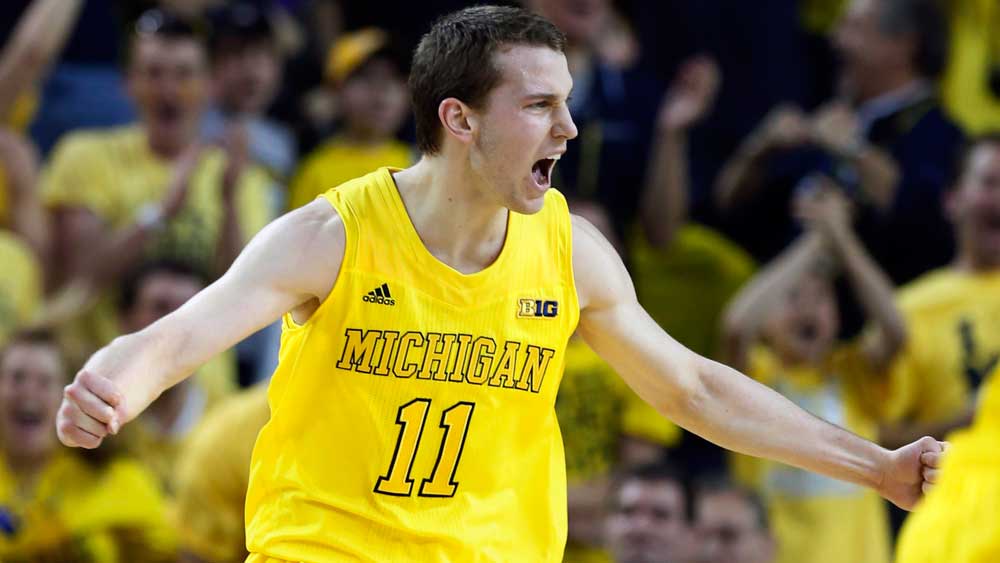
The basket doesn’t count, called back for a foul on Johnson in the open court, but the finish, sloppy as it is, captures something important about this year’s Michigan basketball team. Shut down star point guard and Big Ten Player of the Year Burke, Canadian sharpshooter Nik Stauskas and future first-round picks Robinson and Tim Hardaway Jr., and you can still get burned by a tip-in from a first-year forward, stretched to centre and averaging less than 20 minutes of floor time a game. The Wolverines are a fluid, run-and-gun offensive juggernaut — one of the most entertaining and dangerous teams in college basketball. They move the ball well, shoot the lights out and boast four players with double-digit scoring averages. They are the best Wolverines basketball team in 20 years, and earlier this season they earned Michigan its first No. 1 ranking since Nov. 30, 1992, when the Fab Five were still wearing the maize and blue.
That success would’ve seemed inconceivable in 2007, when head coach John Beilein left West Virginia University to take over a Michigan program still reeling from the aftershocks of the Ed Martin scandal. In Beilein’s first season, the team went 10-22 and finished second-last in the Big Ten, but he’s since led the Wolverines to four NCAA tournament appearances (in 2009, 2011, 2012 and 2013) and, last season, their first regular-season conference championship in 26 years.
The turnaround is all the more impressive when you consider the old-fashioned stateliness of Michigan’s recruiting tactics.
“A lot of programs at our level will offer (scholarships to) eighth or ninth graders,” assistant coach Jeff Meyer explains. “We go through a process that’s a little bit slower.”
The Michigan policy of waiting for players to finish their sophomore year of high school before offering scholarships means missing out on a lot of top talent. But unlike with the Fab Five, where the coup was netting a handful of the nation’s top-50 recruits, today’s Wolverines are dedicated to spotting the talent, and potential, that others miss.
“Our guys, quite frankly, weren’t McDonald’s All-Americans,” Meyer says. “We’ve got kids here who kind of have chips on their shoulders. They weren’t the guys coming out of high school everybody wanted, but they’ve grown into really good players.”
In Burke’s case, “really good” is an understatement. The Big Ten freshman of the year last season, he led the Wolverines in minutes played, points, assists and steals, and still managed to see room for improvement.
“I think sometimes I was out there on the court just playing off of my natural speed and abilities,” Burke says. “This past summer I was able to watch film of myself and learn the game more — different reads, pick-and-roll action, how to get certain people involved.”
Burke also attended a series of invitation-only skills camps run by the NBA’s elite, including Chris Paul, Deron Williams and LeBron James. Sacrificing his summer vacation has paid off. Burke’s stats are up across the board and he’s shooting significantly better percentages from every spot on the floor. He’s a stronger defender, takes better care of the ball and has made huge strides in his on- and off-court leadership. Burke spent most of the regular season on pace to become the first Big Ten player since Magic Johnson to average at least 17 points and seven assists over the course of a season. Though he came up short in the assists column, he still finished the season averaging 19.2 points and 6.7 dimes-and he did it in a year in which five of the Associated Press’s top 25 teams played in the Big Ten and the conference sent seven teams to the NCAA tournament.
Burke isn’t the only weapon Beilein’s staff has found to stock the Wolverines’ arsenal. Freshman forward and Mississauga, Ont.-native Stauskas has quickly developed into one of college basketball’s premier deep threats, while third-year shooting guard Hardaway and freshman forward Robinson–whose fathers notched seven NBA all-star appearances between them–are both dynamic scorers capable of slashing to the basket and racking up buckets from the perimeter (Hardaway averaged 14.8 points and Robinson shot 55.7 percent from the floor during the regular season).
As Stauskas explains, the wealth of talent leaves opponents saddled with a difficult choice: “Teams have to decide whether they’re going to play one-on-one coverage and deny me, Glenn and Tim the ball, or give a lot of help on Trey’s pick-and-roll, stop him from getting to the basket and leave us open on the wings.”
Neither option is particularly pleasant. Send a help defender to shut down Burke and get burned by the open man. Camp on the perimeter and watch Burke glide to the front of the rim. It’s a rock and a hard place, a frying pan and a fire. Either way, someone’s going to beat you.
It hasn’t all been smooth sailing, though. After dropping a string of important road games at Indiana, Wisconsin and Michigan State, the Wolverines fell from first to seventh in the country and disappeared almost entirely from the conversation concerning national title favourites.
“A lot of people saw that hit we took and didn’t want to still put us up there in that top 10,” Burke says. “But going into it in this conference, everyone pretty much knew nobody would come out undefeated.”
Those losses effectively ended Michigan’s chances of defending their regular-season Big Ten championship (a title that eventually went to the one-seeded Hoosiers), but they also provided a valuable learning opportunity for a young team hoping to play deep into March, and maybe even April.
“These aren’t like high school environments. These crowds affect the way you play on the court just by how loud it is and what people are saying to you,” Burke explains. “I think as a freshman you need to get those types of games out of your system.”
Robinson failed to score more than four points in all three losses. Stauskas fared a bit better, averaging 8.3 points, but shot just four of 14 from behind the arc-more than 16 percentage points worse than his overall three-point percentage.
Michigan got some revenge in the final days of the regular season, edging the Spartans 58-57 at Crisler Center, but a home loss to Indiana and a second-round exit from the Big Ten tournament have earmarked them for an early exit from most NCAA tournament brackets.
“I think we’ve been a little soft,” Stauskas says. “Being physical and talking, that’s what’s going to get us back on track.”
Playing on neutral sites-and kicking off the tourney in the Michigan-friendly Palace of Auburn Hills-won’t hurt either, especially for a team as entertaining as the Wolverines. But the real key will be whether Michigan can rediscover the dominant four-headed offensive attack that saw them start the season 20-1.
“I feel like we have the pieces and the right coaching staff to get to Atlanta and the Final Four,” Burke says.
Overlooked in high school and underestimated heading into March Madness, don’t be surprised if these Wolverines end up busting your bracket to the deafening roar of the Maize Rage.
Evan Rosser is Sportsnet Magazine’s associate editor.