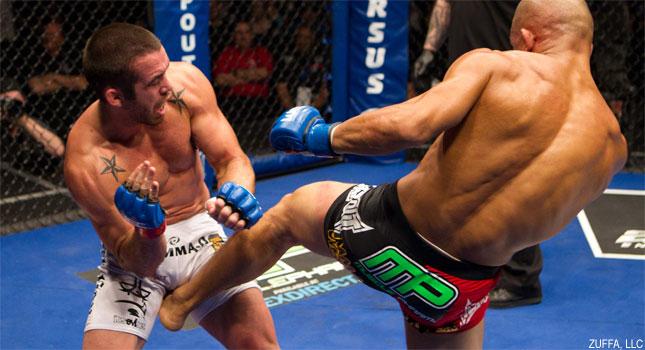

It was a tough way for a great night of fights to end Sunday as the WEC made its first foray into Canada and the great fight town of Edmonton got its first taste of the world-class Octagon.
The crowd had already been treated to three Canadians putting on fantastic showings — two of them emerging victorious — and hopes were high for the main event between two top lightweight contenders in former champ Jamie Varner and unbeaten Kamal Shalorus. To witness three hard-fought rounds marred by low blows, numerous stoppages and a draw as a result felt a bit like a kick to the groin. (Or in Varner’s case, three.)
I like the way MMA Award-winning journalist John Morgan described it in his proposed headline: “Judges deliver nutty decision at WEC 49.”
However, while the initial reaction to the reading of the scores (29-27, 27-29, 28-28) was that of disbelief, upon reflection one should not be that surprised. It’s the exact kind of thing that happens when you fail to heed the old adage: “Don’t leave it in the judges’ hands!”
Let’s break down each round, using FightMetric as a reference. (The complete analysis report of the fight can be found here.)
The first round was actually pretty even in terms of damage (on paper) with each landing 20 total strikes. Shalorus was more accurate (20 of 50 strikes thrown vs. 20 of 72 for Varner) but Varner was more effective (15 of 47 in power shots to the head vs. 7 of 29 for Shalorus) and Varner had the best punch of the round, wobbling Shalorus midway through with a strong right.
Watching it live, I gave the first round to Shalorus for his accuracy, busyness, aggression and Octagon control. Others (including FightMetric) gave it to Varner. I don’t think you’re very wrong to argue either way.
The second round was interesting. Each threw exactly 55 strikes, but Shalorus connected on nearly twice as many (27 vs. 14). Yet just like in the first frame, you can argue Varner landed the stronger shots. I gave Round 2 to Varner, scoring it 10-8 because of the point deduction for the low blow by Shalorus, making it 19-18 Varner after two (same as judge Cecil Peoples). If you gave both rounds to Varner (as Nelson Hamilton did) it’s 20-17 Varner, but if you give both rounds to Shalorus (like Cameron Quewek), it’s 19-18 Shalorus.
Finally, Shalorus easily earned the third round, in most people’s minds, with the takedown and advantage in strikes, which explains the judges scores of 28-28, 29-27 Varner and 29-27 Shalorus.
Varner of course feels adamant he won at least two of the rounds, arguing he landed “the better strikes.” He may be right, but a veteran like him should know better by now that that isn’t good enough if you want to ensure a victory. One of those “better strikes” better put your opponent to sleep.
Having said all that, I still think Varner was robbed. Because after Shalorus was penalized a point for a second groin shot in the second round, there should have been another point deduction when he did it again in the third. This was no glance of a shot. It was a direct north-south kick to the cup that in my opinion required more than a warning.
I have a feeling I know why referee Josh Rosenthal was hesitant to take away that second point. In a fight so significant and so closely contested, he was loathe to do something that would more or less hand the result right over to Varner.
But here is another example of fighters’ fortunes being partly decided by an official’s decision. The night before at The Ultimate Fighter 11 finale, referee Herb Dean penalized Keith Jardine a point for an accidental eye poke. No warning was given for this first foul of the fight and Jardine was incredulous. So was I, especially considering Dean might not have even seen the foul as he was reaching to the mat to retrieve Jardine’s mouthpiece at the time.
I’m not saying Rosenthal or Dean are bad referees (they’re certainly two of the best) or even that they made bad calls. But MMA needs rules to be standardized for these types of things, so that a referee can’t be second guessed. For example: first accidental offence equals warning, each subsequent one equals point deduction. (If it’s deemed intentional, that’s another matter.)
Dean said the eye poke was “accidental but damaging so I have to take away a point.” But why does he have to? Having a standard rule would make answers to those types of questions clear.
And we wouldn’t be wondering why Rosenthal didn’t feel the same way about the third low blow foul.
NOTES:
— Unfortunately, because of the draw and the murky sense of who really won the fight between Varner and Shalorus, a title shot is still up for grabs. And it could go instead now to the winner of a matchup between Shane Roller and Anthony Pettis at WEC 50 in August.
— At the previous weekend’s UFC event in Vancouver, Yves Lavigne was slammed for intervening on a choke attempt too early, as Mac Danzig didn’t tap and never lost consciousness from a rear naked choke by Matt Wiman. Well Sunday in Edmonton, he was too late to stop L.C. Davis from going to sleep from a guillotine choke by Josh Grispi. Not to criticize the veteran ref; in both cases, he checked the fighter’s arm, found it wasn’t moving and thus called the fight, for the safety of the fighter. It just so happens in the first case, he was fooled. One wonders if this is a case where the commissions can use instant replay; ie, after determining Danzig was never choked out, they allow the fight to resume and the ref puts the fighters back in the same position they were when it was mistakenly stopped.
— Speaking of replay, James McSweeney hopes it can work in his favour, it just won’t be “instant.” The TUF 11 castmember, who lost to Travis Browne on the undercard of Saturday’s finale, believes he was ultimately subdued because of multiple illegal elbows and wants the decision overturned by the Nevada State Athletic Commission.
— As you may or may not already know, sportsnet.ca has new fighter pages, schedules, results and fight stats, powered by FightMetric. One thing to note is a distinction between total strikes and “significant strikes.” The latter excludes jabs from the clinch and on the ground since the stats provider’s research has shown those are not as significant in helping a fighter win a fight. Comparing sportsnet.ca’s “boxscore” of the Varner-Shalorus fight to FightMetric’s full analysis you’ll see the difference in the number of total strikes in the third round, which is due to this distinction.
Also note that the schedules and fighters’ records do not include all promotions. It is limited to the four major promotions; namely, UFC, WEC, Strikeforce and Dream. (Past results from the now-defunct EliteXC, Affliction, BodogFight and Pride, are included however, among others.)