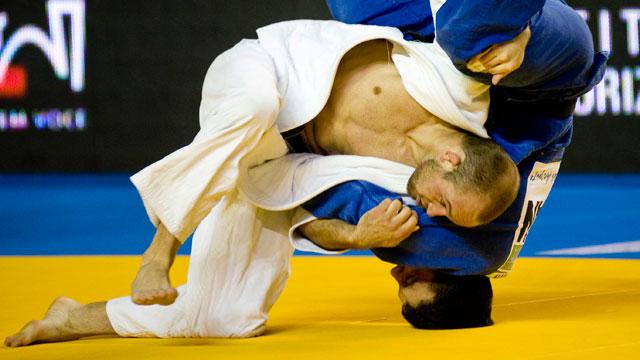

The sport of judo has been gaining a lot more traction in MMA lately, most notably with the ridiculously quick rise of Ronda Rousey, who has been tearing through her opponents (figuratively speaking; their limbs, literally speaking) en route to capturing the Strikeforce women’s bantamweight championship last month.
It got another big boost this week, as former Bellator middleweight champion Hector Lombard made his move to the UFC.
Lombard, a three-time International Judo Federation champion and nine-time medalist, had been plying his craft to tremendous success in the growing Bellator promotion, but the spotlight on him will obviously increase dramatically now that he’s in the big show.
It’s already being noticed. I recently had a chance to speak with a couple of Canadian judokas who are headed to this summer’s Olympic Games in London, and they shared some of their thoughts on the rise of judo in MMA.
Sergio Pessoa Jr., who is competing this weekend at the Pan American Judo Championships in his home town of Montreal, says judo is perfectly suited for mixed martial arts.
“In judo, we don’t punch or anything like that, but if you have close contact to your opponent then you can throw him on his back and do transitions to the ground work,” Pessoa said. “In MMA when you see guy coming after you punching, you can do a counter attack and throw him on his back and do a transition because we do a lot of that in judo as well. We do the throw, then we transition into a newaza which is the groundwork (that’s how we call it). So yeah it’s very effective.”
Pessoa, who has been doing judo since he was four, has never done MMA himself but has a connection to the sport’s biggest Canadian star — he shares the same sports psychologist as UFC welterweight champion Georges St-Pierre. And he believes that those who excel at judo have a good chance to succeed in MMA because of the mental fortitude required for both two disciplines.
“You have your gameplan and everything, your strategies, so those are things you have to think about and preparation is very similar in an MMA fight or a judo fight,” Pessoa said.
He said most people familiar with MMA think of all the grappling to be a form of jiu-jitsu, but that’s not necessarily the case. Not to mention they have similar origins anyway.
“A lot of the chokes you see in MMA, you can also do in judo. They’re not jiu-jitsu, but judo and jiu-jitsu are very related,” Pessoa said. “They started in Japan, and they’re very similar sports.”
Pessoa said the popularity of his discipline, which he took up while following in the footsteps of his father Sergio Pessoa Sr., a former Olympian himself, is because of more high-profile fighters with a judo background utilizing the moves effectively in their bouts. He also points to American Rick Hawn, who has won medals at the U.S. Nationals, Pan American Games and participated in the 2004 Olympics, placing ninth.
Hawn, who made the move to MMA in 2009, made a splash when he joined Bellator in October 2010, winning his first three fights in the promotion to earn a spot in the final of its Season 4 welterweight tournament. There, he lost a split decision to veteran (and former UFC fighter) Jay Hieron, his first pro defeat in MMA.
Since then, the 35-year-old Hawn has won two straight fights by knockout, including a win last week over Lloyd Woodard at Bellator 66.
Here’s a video of Hawn’s TKO in his Bellator debut, which came right after a beautiful judo throw:
One of Pessoa’s teammates, Nicholas Tritton, who bears a striking resemblance to GSP, actually trained with Rousey when he was younger and she lived in Montreal.
(She called him Trittoni Macaroni, saying he was small but admitting he “beat her up” plenty of times. That’s one thing you can do with judo — overcome size disadvantages with execution.)
Tritton is not competing at this weekend’s Pan Ams because of an injury, but he has already qualified for London 2012 and he’s expected to be ready to go by then. He believes that judo could become quite prevalent in MMA, it just needs the recognition.
“Obviously MMA is a whole different sport, but the background is there,” Tritton said. “(Many people) don’t realize we do groundwork, (submissions), we have chokes; it’s not the same scoring system as jiu-jitsu, but it’s very similar.”
Tritton is happy to see fighters like Rousey who were very good at judo — she won bronze at the 2008 Olympics in Beijing — having success in MMA, because there have been UFC fighters in the past who have claimed to be strong in judo but never really had much success as judo players.
“If you actually look at the good people that go over to judo, they’re very good in the MMA,” Tritton said.
In Rousey’s high-profile Strikeforce title fight against Miesha Tate, one of the storylines going into it was the debate over which fight base is better: judo (Rousey) or wrestling (Tate).
Judo won out on that night, as Rousey won by armbar (again). Still, people often look to wrestling as being the stronger base discipline.
But there’s no question that when throws come into play, judo often leads to more exciting moments. Wrestling, while also having throws of its own, is getting a quite a knock lately for leading to boring, ground-dominated fights, to the point where many fans are coming just short of screaming for wrestling to be banned from MMA. (Just ask Bellator welterweight champion Ben Askren.)
Perhaps the opportunity is there for judo to become the new wrestling — only more exciting.
“Ronda and Rick are showing their judo skills, and I think people like to see their throws,” Pessoa said. “Not everyone can apply those throws in MMA fights, so when they see something new like the throw Ronda has been doing, they get excited. It’s new for them.
“And that’s what Judo is about. People think it’s not a spectacular sport, but it is. The throws we do, they’re very different, and we can impress people with them.”