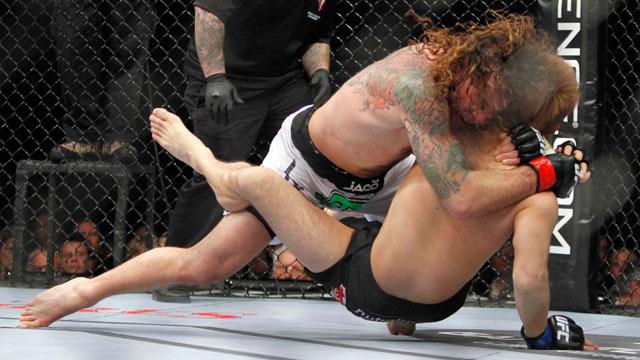

The Association of Boxing Commissions, which governs the Unified Rules of MMA employed by professional mixed martial arts promotions in North America including the UFC, are holding their annual meetings in Clearwater, Fla.
On Monday night they addressed a number of rules and items related to MMA scoring and judging and instituted some changes in an effort to reduce the number of controversies that have been plaguing the fight game lately (well, actually for years).
Here’s a list of the said items. (Below, I give my thoughts on each.)
1. “Effective defence” has been removed as a judging criterion.
2. Striking and grappling are of equal weight.
3. The term “damage” as a criterion has been replaced by the term “effective damage.”
4. Heavier strikes with impact get more weight than the number of strikes landed.
5. Grappling moves scored are takedowns, reversals and submission attempts, passing to dominant positions, and the use of active and threatening moves from the bottom. Also, close submission attempts count more than just attempted submissions, and submission attempts that lead to fighters being tired are also weighed significantly.
6. “Effective aggression” has been formally defined: It is judged as a fighter moving forward and using legal techniques, as well as attacking with strikes or submissions on the ground from either the top or bottom position.
7. “Cage/ring control” has been formally defined: It is judged as a fighter dictating the pace, place and position of a fight.
8. One potential change that was being considered, the “10-point must” scoring system, remained unchanged.
Here are my thoughts:
1. “Effective defence” has been removed as a judging criterion.
This rule should end the debate as to whether a fighter who simply stuffs an opponent’s takedown attempt should get credit for it. The answer is no, unless of course he defends by punching/kicking the attacker, in which case, he is actually applying offence.
This does NOT mean that fighters like Georges St-Pierre, Jon Jones or Junior dos Santos do not benefit as fighters with good takedown defence. They simply can’t get credit for it in a fight by just defending; they must also be offensive (which they very much are). Of course, fighters still benefit immensely by having good defence by virtue of avoiding being in positions where they can be scored upon.
Same thing goes with defending strikes. While doing so will reduce the number of strikes absorbed and thus increase the chances of having the striking edge in terms of scoring, a judge must never say something like, “Fighter A was the more effective striker because he defended better.” Fighter A must also have attacked better. (You hear that, Clay Guida?)
2. Striking and grappling are of equal weight.
This should have already been implied, and likely most judges already scored under this assumption, but now it has been formalized. Previously, striking was listed higher and thus could have appeared to have had higher value.
This is very important, because it is “mixed” martial arts. While effective strikes can tend to lead to more “damage” in terms of putting a fighter away, the opportunity to finish a fighter with grappling is just as dangerous — and just as valued — as it is with striking (regardless of what fans may yell from the stands.)
3. The term “damage” as a criterion has been replaced by the term “effective damage.”
4. Heavier strikes with impact get more weight than the number of strikes landed.
No. 3 and 4 together provide a qualitative way of defining what has already been quantitatively measured by “significant strikes.” For example, FightMetric, the MMA stats provider that sportsnet.ca has used for years and was recently adopted by the UFC, defines “significant strikes” as the ones that help a fighter to potentially finish a fight. Jabs to the body from the guard or the clinch are excluded, because those do very little but pad a fighter’s total striking stats.
This doesn’t mean that landing a high output of strikes isn’t important, just that the strikes that are heavier (ie, do more effective damage) should be given much more consideration when scoring.
5. Grappling moves scored are takedowns, reversals and submission attempts, passing to dominant positions, and the use of active and threatening moves from the bottom.
A perfect example of where this definition could have helped would be the Clay Guida-Anthony Pettis fight, where Guida spent most of the fight on top but mounted very little offence, compared to Pettis, who was the only one trying for submissions and using “active and threatening moves from the bottom.” Perhaps he wouldn’t have won the fight, but he certainly should have won the second round, despite being taken down twice. Of course, Guida also gets credit for five total takedowns and his three failed takedown attempts shouldn’t hurt him since defence is no longer scored.
Also, close submission attempts count more than just attempted submissions, and submission attempts that lead to fighters being tired are also weighed significantly.
This is also important and should remind judges again that fighters shouldn’t be rewarded for doing well defending submission attempts. Even if they weren’t in trouble from being finished, the attempt takes a toll on a fighter and thus should be scored in favour of the attacker (even if it also takes a toll on said attempter.)
6. “Effective aggression” has been formally defined: It is judged as a fighter moving forward and using legal techniques, as well as attacking with strikes or submissions on the ground from either the top or bottom position.
This rule, combined with No. 1 above, should answer the question, “When a fighter stuffs a takedown, should the defender get credit for it?”
He should not, and in fact, the fighter who attempts the takedown should get points, even if he goes 0-for-5. Being the aggressor counts, and even if the technique is weak, it’s up to the defender to turn the fight around and become the aggressor, not simply shrug off poor offence. Same goes for striking. (You hear that, Gray Maynard?)
7. “Cage/ring control” has been formally defined: It is judged as a fighter dictating the pace, place and position of a fight.
I would still like to see this better explained in terms of how to score. It remains very subjective, and unclear how to weigh each of the three aspects listed.
If one fighter is the one moving forward for most of the fight, but then gets taken down in the latter part of the round and ends up on the bottom for a good portion of the round, who had the better cage control? Ultimately, this is where educating judges is of utmost importance.
8. One potential change that was being considered, the “10-point must” scoring system, remained unchanged.
I know some people were hoping to see a change here, perhaps even a move to the half-point scoring system, which had been employed in a pilot program for the past year, in which judges could score rounds, say, 10-9.5 or 10-8.5, instead of having to score them 10-10, 10-9 or 10-8 (for example). In the test program, judges scored fights using both systems for side-by-side comparison.
Unfortunately, findings from the four commissions which used it did not support such a change. Three, including the Edmonton Combative Sports Commission, said less than five per cent of fights would have resulted in a different outcome with the half-point system, and one suggested employing it could lead to more draws.
I personally tend to agree and think the half-point system would only lead to more subjective scoring and debate. As has been argued many times, clearer judging criteria (of which Monday’s rule changes are a good start) and better judges (resulting from better qualifications) is the way to go.
Interestingly, the Edmonton-based Maximum Fighting Championship was actually one of the first to use the half-point system used in a professional event for its official scores. At MFC 31 in October, light-heavyweight champion Ryan Jimmo defeated Rameau Thierry Sokoudjou by the scores of 49-48.5, 49-48.5, 49-48, about as close as you can possibly get, and that decision was just as controversial as any in recent memory.
Jimmo, who has a reputation for going to close decisions that are not easy to score, is set to make his UFC debut this Saturday at another city in Alberta, where MMA sanctioning is handled at the municipal level, at the organization’s first event in Calgary. Had there been another outcome to the test run on the half-point scoring system, you never know, we might well have seen it in place for the first time at UFC 149.
For now, we’ll settle for a little bit of progress at a time.