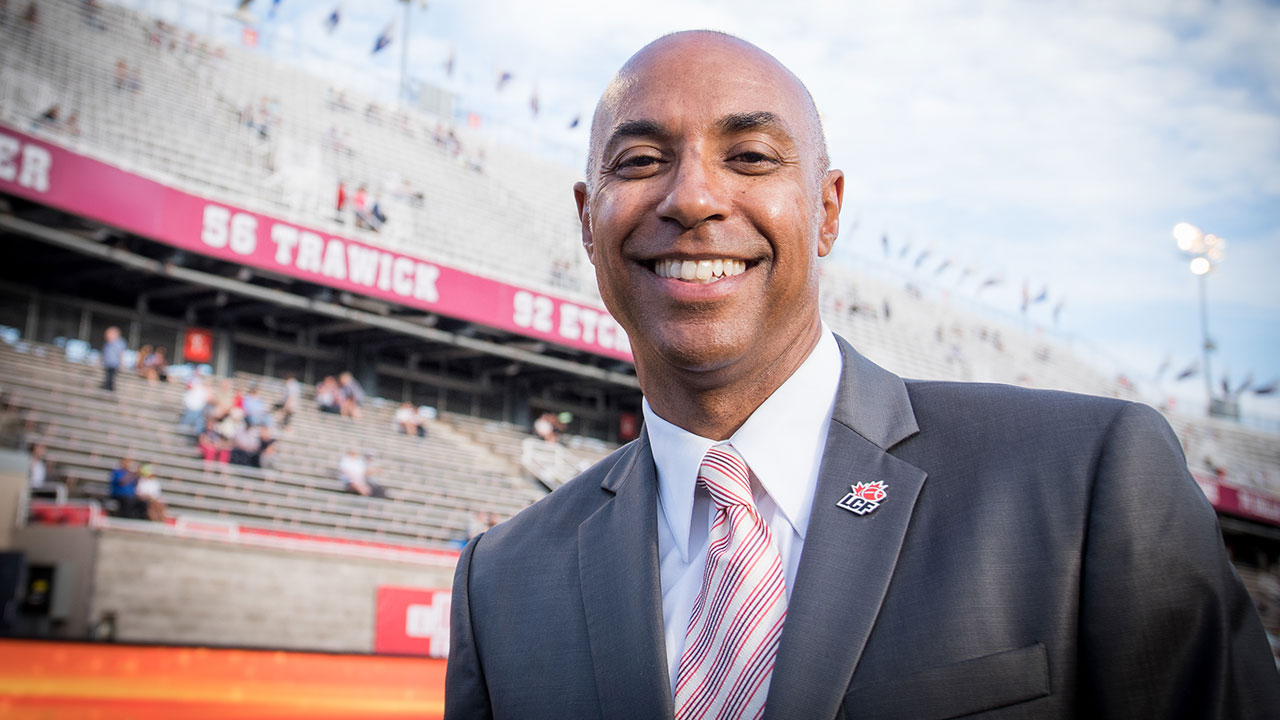

Last week, Canadian esports outfit Tiidal announced that former CFL commissioner Jeffrey Orridge was joining the company as its chairman of the board.
First established in 2010, Tiidal owns and operates the esports team Lazarus, which was first called “SetToDestroyX.” Lazarus has seen most of its success come from sports games like Madden and shooters such as Counter-Strike: Global Offensive and Fortnite.
Most recently, Lazarus made headlines in the video game press when they announced a partnership with the SheIs Collective, an initiative that aims to elevates women in both the traditional sports and esports worlds.
Sportsnet caught up with Orridge after the announcement of his new move was made and asked him why he decided to take the plunge into esports and why Tiidal, specifically.
(Note: This interview has been edited for clarity.)
Sportsnet: You’ve enjoyed a long career as a sports executive and have worked for some of the biggest names in sports such as USA Basketball, Reebok, CBC Sports and, of course, the CFL. Why did you decide to make esports your next venture?
Jeffrey Orridge: I’ve been involved in organized sports since I was eight years old and professionally I’ve been involved for the last 25 years.
It’s the perfect segway for me. Esports, even though it’s a nascent industry, it’s a burgeoning industry, and to me it’s just a natural extension and evolution of traditional sports. So what’s exciting is it’s got almost unlimited reach, it’s extraordinarily relevant to this next generation of consumers, sports enthusiasts and fans and it’s built on communities and relationships.
So it’s got all the things that are exciting about the sports industry: Reach, relevance, relationships, community-building and, because it’s digital first, it’s got an almost unlimited platform and it’s boundary-less.
So it’s a great opportunity for so many people on so many different levels to get involved.
SN: How familiar were you with the esports space before you decided to take the plunge yourself?
JO: Because I’ve been involved in traditional sports you always have to be attuned to and aware of what the next big thing that’s coming — what’s the future of sport? Esports has always been on my radar for the last several years looking at the growth of the industry and looking at what’s emerging.
Figuring out what kind of sponsorship and commercial activity is being generated, how esports plays into traditional sports, being aware of people in my traditional sports industry — everyone from Michael Jordan to Rick Fox, to Mark Cuban and Robert Kraft. All of these people have invested in esports, so you’re always aware of what’s happening in the industry.
SN: What about Tiidal convinced you that they were the right spot for you to enter esports industry?
JO: I think I’ve really got to give a nod here to Charlie Watson, the co-founder and CEO of Tiidal Gaming. Since moving to Canada over a dozen years ago, I’ve been involved with some of the most iconic Canadian brands. Whether it be CBC, the CFL, Canadian Tire, they are iconic, and they’ve been pioneers in their space and Tiidal and Charlie are no different.
I wanted to get involved with them because they were the first esports organization in Canada starting in 2010. Charlie has been a pioneer, an icon, a visionary in this space and so associating myself with this type of organization and this type of management, with Charlie at the helm, made me very interested in not only what I can bring to the organization in terms of my traditional skill sets in marketing and licensing and deal-making and media and entertainment, but also the learning curve that everybody in this industry needs experience in right now in terms of its growth and its trajectory.
So it’s a two-way street for me. I get to help set strategic direction and apply the 25 years-plus of expertise to sports to a new industry that is clearly going to change the shape of how we look at sports and, certainly, how the next generation and generations after that are consuming sport.
SN: How do you plan to use that 25 years-plus of experience and apply it to your new role at Tiidal?
JO: I think my understanding of whatever the traditional sports market space is, and business in general, it’s the same business principle that I think you need to apply to any industry in any area.
So that’s what’s really exciting to me, that I can bring all of this vast experience and apply it in different ways, but also, at the same time, be open to new and different innovations, because one side doesn’t fit all and this is a burgeoning industry and things are not set in stone and it’s not concrete and there is no one roadmap. So it also allows for innovation of thought. It’s great.
And let me get back to one other thing that you mentioned, ‘Why would I be attracted to this space?’ I’ve always thought about sport as a great equalizer. And I think that within sport you don’t have to have been born with hitting the genetic lottery — you don’t need to be the biggest or the fastest or the strongest, physically — to be competitive in this space, and what I really like about this space is it’s got a really diverse geographic and a really diverse gender base to it and it’s borderless. It is truly global.
[relatedlinks]
The Weeknd joins Toronto Defiant ownership group OverActive Media

OverActive Media wants to make Abel Tesfaye make you fall in love with esports.
Tesfaye, better known by his stage name “The Weeknd,” like Drake with the Toronto Raptors, has been named the global ambassador of the Toronto Defiant’s ownership group and is considered to be an “important part of OAM’s brand and content building efforts across Canada and around the world.”
“As a big esports fan, I am really excited to be involved in this project,” said The Weeknd in a press release. “I am looking forward to collaborating with OverActive Media in unique and innovative ways.”
It’s unclear at the moment what The Weeknd’s role will be, exactly, but given the three-time Grammy winner’s résumé, it’s probably safe to assume his musical expertise will play a factor into things.