THE CANADIAN PRESS
LAS VEGAS — Chuck (The Iceman) Liddell helped build the UFC. Now he’s going to help run it.
The UFC Hall of Famer and former light-heavyweight champion announced his retirement Wednesday to become the mixed martial arts organization’s executive vice-president for business development.
The 41-year-old Liddell, better known for beatdowns than business, acknowledged it was a title he never expected to precede his name.
"Definitely not, but if I’m going to be a vice-president of something, have a real job, this is the one I want," Liddell said.
Liddell (21-8) talked of retirement in April 2009 after a string of poor performances culminated in a TKO loss to Mauricio (Shogun) Rua at UFC 97 in Montreal. UFC president Dana White, who once managed Liddell, was more definitive before and after the Rua fight, saying it was time for his friend to quit before he got hurt.
But Liddell missed the sport and — after rededicating himself to training — returned to the cage in June at UFC 115 in Vancouver, where he was knocked out by Rich Franklin.
That loss was his third straight and fifth in his last six outings.
"Listen, I can’t even imagine what it’s like to walk out into an arena with 20,000 people screaming your name and all the things that go along with it — and the money and the fun and the fame," said White.
"The reality is he was the king, man. And it’s tough to walk away from that."
Liddell acknowledged that.
"I would have liked to gone out on a win streak but I don’t think I would have left if I was on a win streak," he said.
"If I got a win, then I would just want to fight again."
White made a point of stressing the job was no PR stunt, pointing to Liddell’s accounting degree from Cal-Poly State.
Liddell, said White, is joining the UFC’s inner circle of top executives.
"He’s a smart guy. This is a guy that graduated from Cal-Poly with honours. He’s a guy who’s really been in business with me since Day 1. This is a guy who has been in the trenches with me. We were on planes, trains and automobiles for five years driving around the country telling people about the sport.
"And to be honest with you, he can take as big a role as he wants in this thing."
White said he expects Liddell to eventually move to Las Vegas, where the UFC is headquartered, from his home in San Luis Obispo in California.
Liddell, who made his pro debut at UFC 17 in May 1998, was emotional in a short visit to the podium at the pre-fight news conference for UFC 125.
The event was in the lobby of the MGM Grand, where he and Tito (The Huntington Beach Bad Boy) Ortiz helped set the UFC gate record of more than US$5 million when they fought at UFC 66 in December 2006.
Liddell’s retirement was not unexpected, but there was no clue that it might be announced at a news conference publicizing this week’s fight.
Liddell said afterwards he was happy at the new direction, saying he had taken time in making the decision and then asked the UFC to delay making the announcement so he had time to come to grips with it.
"It’s hard," he said. "It’s all I’ve done for ever. Shoot, between kickboxing and MMA, I’ve been fighting for almost 20 years."
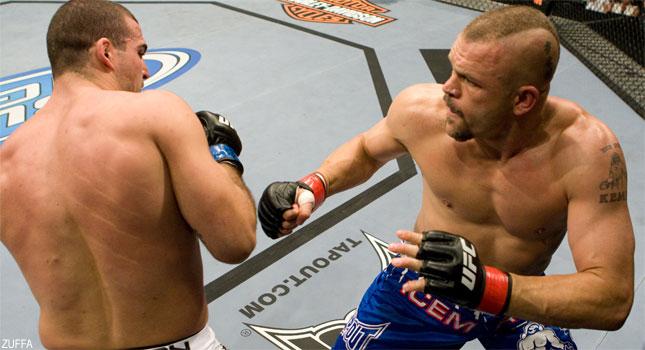
Liddell exits as an icon in the sport — the man with the mohawk and a tattoo on the side of his head. The Iceman’s reputation extended well beyond the borders of MMA, earning him a stint on "Dancing With the Stars" that was memorable more for his enthusiasm and frilly sleeves than his fancy footwork.
Fight fans will remember Liddell’s loping style of movement in the cage, drawing opponents towards him like a giant spider beckoning a fly. When the time was right, Liddell would strike with a devastating punch or kick.
"If I put my hands on people enough, sooner or later one of them’s going to knock them out," Liddell warned before knocking out Renato (Babalu) Sobral in the first round for the second time.
His rivalry with Ortiz and Randy (The Natural) Couture helped put MMA on the map.
And with his Ferrari and Hummer, he was a symbol of the success of the sport.
Prior to losing his title to Quinton (Rampage) Jackson at UFC 71 in May 2007, Liddell had been on a roll. He had won 15 of his 17 UFC fights, with the last loss to Couture at UFC 43 in June 2003.
But the years caught up with him. While Liddell rejected the suggestion, other fighters figured him out. And they made him pay.
Despite recent poor results, Liddell remained a massive draw for the UFC.
And he was compensated accordingly, with recent purses listed at US$500,000 which did not include a cut of the lucrative pay-per-view revenue.
"When I first started in the sport, the end of the rainbow was probably a $50,000 cheque for the fight," he recalled. "I’ve had sponsors pay me more than that to wear a shirt now. It’s grown so much."
Liddell, along with Couture, also served as a coach on Season 1 of "The Ultimate Fighter" reality TV show, whose finale between Forrest Griffin and Stephan Bonnar proved to be a watershed moment for the organization.
"I always thought the sport would get here some day," Liddell said. "I’d be lying if I said I thought it would get here this fast."
As an executive, will he grow out his mohawk?
"You know, I haven’t decided that yet," he said with a smile. "I’ve been growing it out on and off lately. But I still like it. I don’t know. I don’t have to."