
Over the holidays we’ll be re-visiting Sportsnet staff writers’ favourite pieces from 2015. Today: Shannon Proudfoot explains why her feature on the Bluewater Tug-of-War Club.
If I could design my perfect beat, I would write nothing but stories about people who are obsessed with something no one on the outside appreciates.
I love delving into hidden little subcultures to try to understand and explain them on their own terms, and there’s something so beautiful about people who are passionate about something that might inspire sidelong glances from those who don’t get it.
I indirectly stumbled upon the Bluewater Tug-of-War Club by literally Googling “weird sports.” I started with a phone interview with Cathal McKeever, president of the Tug-of-War International Federation (he appears briefly in the story), and he told me about a Canadian team in southwestern Ontario who have been punching way above their weight on the international scene.
I often have to do some wheedling to sell my editors on the idea when I pitch a fringe sports story (which is more or less all I ever pitch), but with this story, they were pretty much sold right away. I made plans to go to Dashwood to watch Bluewater’s evening practice the night before nationals, then to Fergus the next day for the competition before heading home to Ottawa again.
For the record, I cannot recommend strongly enough that no one ever, ever drive 1,300 kilometres over two days alone in a rental car; I was so fried when I got home, I yelled at my husband about a pint of blueberries.
There are often things that come up in interviews that really grab you, but they end up hitting the cutting room floor by the final draft because you have to make tough choices given finite space for a story (I have a weakness for side plots, which is why 5,000 words and up is my favourite neighbourhood).
The Bluewater team couldn’t have been more welcoming, but at first, it was clear they were a little nervous about what I was there to write. It emerged that they’ve been subjected to coverage in the past that amounted to mockery—the coach mentioned one article that said something like, “What’s next? Egg-and-spoon races?” But the really nasty conundrum is that they’ve learned their choice is often between no coverage at all—and therefore no potential to grow their sport—or being the object of stupid one-liners. I think they realized pretty quickly that I wasn’t there for a cheap drive-by, and several of the team members told me I asked great questions. That’s one of the nicest things you can hear as a reporter.
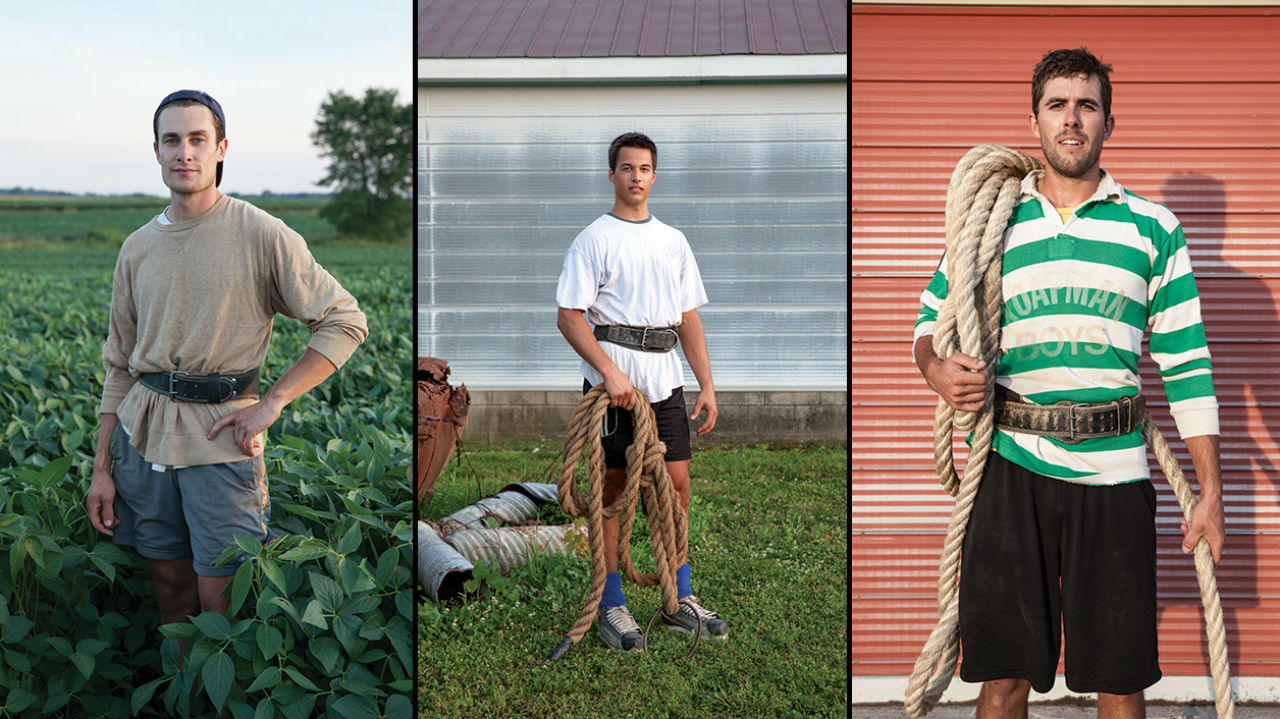
I think the story we ended up with—together with the gritty, gorgeously lit images by our photo director Myles McCutcheon, who was so excited about this story, he insisted on shooting it himself—portray Bluewater exactly as they are: a crew of hardcore amateur athletes toiling away in the ultimate grassroots sport, simply because it grabbed hold of them and won’t let go.
——
Excerpt: Hand-to-hand combat
In the yard outside, a dozen or so men—they range from late teens to mid-40s, most of them the kind of tanned and toned that comes from working on farms or in trades, not from the gym—are readying themselves for battle.
They yank on and lace up the specialized footwear their sport demands: hockey skates, figure skates or in-line skates with the blades hacked off, the soles made of thick plastic kitchen cutting boards trimmed into shape, with a steel plate screwed onto the heel.
“Let’s go,” someone barks. They stand tallest to shortest in a military-precise line, with an inch-and-a-half-thick hemp rope draped over each man’s right boot. “Pick up the rope,” their coach commands, and they flick up their feet to grab it. “Take the strain,” he calls, and they kick out their left feet simultaneously, the jaunty angle at odds with the savagery with which they drive their heels into the earth. Then the coach sweeps his arms down and yells, “Pull!” The team members haul on the rope and lean back into identical 45-degree angles, their boots marking a staccato rhythm as they step in unison, eating up hard-fought territory an inch at a time.
Their training partner tonight, as usual, is a giant plastic drum filled with cement and rigged into a pulley system—1,200 lb. of implacable enemy hovering in the air.
This is the Bluewater Tug-of-War Club. It is not a pack of refrigerator-sized men yanking on a rope with their ham-hock arms or some whimsical schoolyard contest where the winners get an extra scoop of ice cream. Competitive tug-of-war is a haiku of a sport: just a length of rope, a patch of turf and the matching of raw strength and endurance. To be among the best in the world—and Bluewater is edging toward that, despite hailing from a country where their sport is all but orphaned—tug-of-war requires total-body fitness and teamwork so intense its practitioners lapse into mystical language to explain it.
“It’s heavy-duty,” says Rob Hoffman, a founding member of Bluewater and the current “point,” or position closest to the centre of the rope. “I’ve seen some of those teams and had goosebumps because of the power. It’s almost artistic—just to see those eight work together, it’s like music.”
Full story: Hand-to-hand combat
More of Shannon’s favourites from 2015:
Lunch and lots of opinions with PK Subban
Sports call-in radio: the world’s cheapest therapy
Relationship status for A-Rod and Yankee fans: it’s complicated
From almost-kindling to museum treasure: the world’s oldest hockey stick