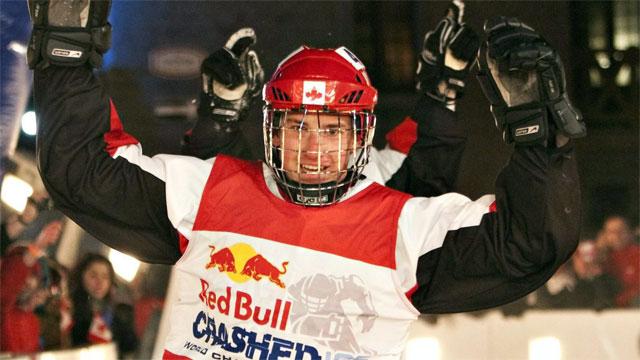

See you at the finish.
Those were the words silk-screened onto the back of Kyle Croxall’s jersey.
Red Bull Crashed Ice’s version of a smart-ass bumper sticker? Perhaps. But Croxall’s message was more of a promise than a boast, as the defending 2012 overall champ began the 2013 Crashed Ice world championships where he left them last winter – with the competition in his rearview.
“There was a lot of pressure on me coming into this race,” Croxall said afterward. “Feels amazing.”
The final heat was a doozy, as Croxall needed to move from third to first as he navigated one of the most technical courses in tour history, the highlight being a piggyback leap over a fallen Kilian Braun from Switzerland.
In an all-Canadian ladies’ final, Ottawa’s Fannie Desforges claimed top spot in a race in which all four racers crashed at one point.
The setting for the launch of the 2013 Red Bull Crashed Ice world championships smacked of symbolism. Hard, like a missed landing on frozen water.
It’s the obvious metaphor, but it’s also the most gorgeous, most dangerous one: the larger-than-life symmetry between the natural wonder of Southern Ontario’s 53-metre unfrozen Niagara Falls themselves and the man-made marvel that is the 460-metre-long ice floe constructed adjacent to the postcard spectacle.
Location, location, location – it’s not only the golden rule of home-buying, it’s Red Bull’s mandate when selecting spots to host the beautiful, burly ordeal that is the ice cross downhill race events.
So Niagara Falls, which made its Crashed Ice circuit debut Saturday night, seems a natural choice to go along with icy wonders in Landegraaf, Netherlands; Lausanne, Switzerland; and Old Quebec City, where the series-expanded to five stops for the first time in its 13-year history-will once again culminate this March.
“Red Bull picks the nicest spots in the world to do all their events, so we’ve gotten to see some awesome places,” says Mississauga, Ont. native Scott Croxall, who was eliminated early in Saturday’s finale. After taking a face-first spill off a jump while in his first heat, he surrendered his lead and would never recover.
Scott’s older brother, Kyle, professionally a firefighter in Calgary, made good as Canada’s best hope for victory into Niagara this weekend, his jersey’s message serving as both foreshadowing and exclamation point.
But another Canadian, 26-year-old Adam Horst, made the final four and, were it not for a fall after his fabulous start, could’ve tested Croxall.
Minnesota’s Cameron Naasz, a sophomore on the tour who qualified with the fastest time, dominated his semifinal heat and finished runner-up to Croxall after being passed in the latter third of the final.
Despite weak starts in almost all of his heats – his pattern for the evening and perhaps a strategic move – Croxall quickly made up ground for come-from-behind victories in both his semifinal heat and the final showdown.
Croxall also got a bit of luck as one of his toughest foes did not race.
Arttu Pihlainen of Finland, a skilled downhill veteran with six titles under to his name, pulled out of Saturday’s final due to injury, despite qualifying with the eighth-fastest time.
Croxall will try to keep his good fortune rolling into the series’ next race, scheduled for Jan. 26 in St. Paul, Minnesota.
The estimated 60,000-plus rosy-cheeked spectators who lined the Niagara course, wowing at the racers’ speed and wincing at the competitors’ 50 km/h tumbles, seemed to love every minute of it.
How could they not?
Look left and see highly trained and slightly crazy daredevils speeding now a twisting illuminated path of kickers, rollers, step-ups, banked turns and drops as steep as 30-degrees and as high as 75 feet, striving to be the first of four to cross the finish line.
Look right and see one of Earth’s seven natural wonders, equally illuminated, only slightly more scary-looking.
If Croxall feels like King of the World* for a night, one would be a fool to blame him.
*Leonardo DiCaprio style.