THE CANADIAN PRESS
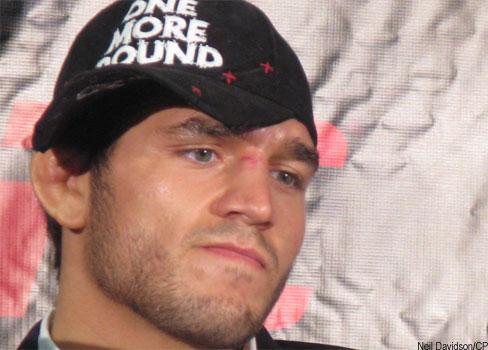
The comeback continues for Patrick (The Predator) Cote.
After being out for 18 months due to two knee surgeries, the Montreal middleweight was beaten by Alan (The Talent) Belcher at UFC 113 in May. Belcher took advantage of a prolonged Cote takedown attempt and dropped him face first on the canvas, locking in a rear naked choke to force a submission.
It was back to the drawing board for the groggy Canadian.
Time, injuries and the Belcher loss have knocked Cote (14-6) down the middleweight ladder. Two fights and two years ago, at UFC 90, Cote was riding a five-bout win streak when he took on Anderson Silva for the 185-pound title. What should have been Cote’s finest moment proved to be his most painful as his right knee gave out in the third round.
The 30-year-old Cote returns to the cage Saturday at UFC 121, saying injuries and the ring rust he showed against Belcher are finally behind him.
“It’s a new beginning for me,” he said. “I’m going back to the prelim card and it’s good. . . . You start the fight, no entrance (music), that’s it. It’s going to put my feet down to earth and I think it’s going to be good for me.
“I’ll win this fight and I’m going to start another streak after that.”
Cote’s bout against (Filthy) Tom Lawlor (6-3 with one no contest) will be televised prior to the main card in Anaheim, Calif. Because of TV timing, the two fighters won’t get the traditional walkout to the cage to music, which is a shame given Lawlor specializes in over-the-top entrances.
Cote’s journey back into the cage for the Belcher fight was a long one. His knee right basically blew apart in the Silva fight
“ACL, MCL, both meniscus, everything just broke at the same time,” he said later.
He had surgery but there were complications when he resumed training. A piece of ligament came loose and snapped. That required more surgery, with two cadaver ligaments inserted to strengthen the knee.
Cote is no stranger to hardship, however.
He spent five years in the military as a member of the Royal 22nd Regiment known as the Van Doos, serving in Bosnia.
He lost his first four fights in the UFC, including a debut at UFC 50 that saw him vaulted from the undercard to the main event at the last minute to fight veteran Tito Ortiz in a different weight class.
At the time, Cote had a picture of Ortiz on his screensaver.
Fast forward some six years and nine UFC fights and Cote said he was confident going into the Belcher bout. He felt good and his sparring had been sharp.
But in a sport built on timing, being out 18 months is a long time.
“I wanted a big fight right away and that’s exactly what we had,” Cote said of Belcher. “But when the fight started, it just hit me in my face — ring rust does exist and it took me a minute, minute and a half to be very comfortable in the Octagon and start doing my thing.”
Belcher opened the fight by lashing Cote’s body with kicks. Cote started slowly but began to find the range with his right hand — his primary weapon.
Midway through the first round, Cote caught Belcher’s leg after absorbing another kick and dumped him to the ground. Working out of half-guard, Cote had a good shot at a kimura but tried to get too fancy and lost position on the submission hold.
Early in the second round, Cote broke his right hand. He kept swinging but, looking for other ways to do damage, then tried to take Belcher down.
When his attempt at a double-leg takedown stalled at the fence, he kept his head between Belcher’s legs too long. Belcher reached under Cote’s stomach and lifted his jackknifed opponent in the air before dropping him.
Cote landed face first and Belcher quickly finished him off.
MMA’s unified rules prohibit spiking an opponent to the canvas on his or her head or neck. A faceplant is permissible, it seems.
Months after the bout, Cote wonders whether the regulation need to be clarified.
“You know I don’t make rules, I fight and this is not my decision. But I think this rule is not very clear.”
Added Cote: “I think the forehead … it’s part of the head.”
The Nevada State Athletic Commission, which leads the way in combat sports regulation, has a longer explanation of the rule.
“Any throw that has an arc is a legal throw. A fighter may not pick up their opponent, invert them placing the fighter’s feet straight up in the air and their head straight down and pile drive their opponent into the canvas. When a fighter is using a takedown or a throw against their opponent, they are allowed to throw their opponent to the ground without worry as to whether their opponents head makes contact with the canvas before another part of their body as long as they have not placed their opponent into the above stated pile driver position.”
Cote hopes to use his head a different way against Lawlor, who has lost two straight, including a submission defeat at the hands of Canadian Joe Doerksen at UFC 113.
Lawlor started well but faded in the second round against Doerksen.
Cote says he likes the Lawlor matchup and relishes a shot at a southpaw, whose stance is tailor-made for his right hand.
“He’s a gamer. He’s not a very technical striker but he likes to stay on his feet and stay in the pocket and exchange,” said Cote. “I always say I’m not scared of anyone in my weight class on my feet and I think I’ll be more powerful, more technical. . . . I’m pretty sure he’s going to try to put pressure on me and push me against the fence and try to wrestle me against the fence.
“If not, we’re going to stay in the middle of the Octagon and exchange and somebody’s going to sleep for sure.”
Cote points to his recent work with Muay Thai coach Achraf Alaabouch at Montreal’s TKO Fight Club Fitness gym.
“You’re going to see some new stuff from me,” he promised.
Lawlor, however, comes into the fight well aware of Cote’s power.
“A lot of people know him for his right hand and look out for that,” said Lawlor. “It seems like the game plan’s pretty cut and dried — just stay away from that right hand.”