THE CANADIAN PRESS
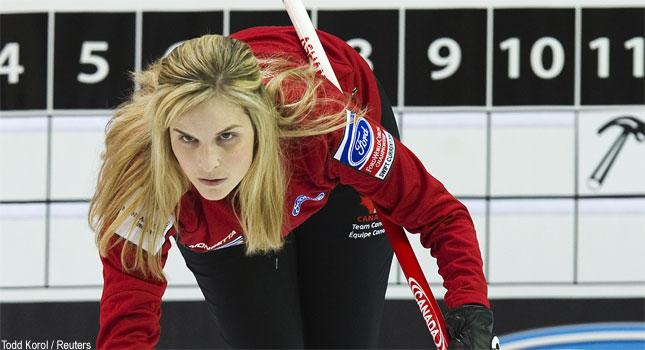
SWIFT CURRENT, Sask. — Canada’s Jennifer Jones will take the win and try to forget her first few ends of the women’s world curling championship.
Jones, third Cathy Overton-Clapham, second Jill Officer and lead Dawn Askin recovered from a shaky start and beat Sweden’s Cecilia Ostlund 9-6 on Saturday.
"Our philosophy is, if you lose a game, you might as well lose it trying hard and get something out of it, so that’s what we did and we ended up winning it," Jones said.
The St. Vital Curling Club team from Winnipeg faces Latvia’s Iveta Stasa-Sarsune (0-2) and Norway’s Linn Githmark (1-0) on Sunday. The Canadians won a world title together two years ago in Vernon, B.C., and look for a repeat on home ice in Swift Current.
Canada started horribly Saturday, wrecking on guards and missing takeouts. They fell behind 5-1 in the fourth end and their body language during the break said it all. While the foursome stood together at the side of the ice, there was little discussion and no eye contact between them.
"It was just "OK guys, let’s just make eight good (shots) and we hadn’t put eight good shots together,"’ Jones said.
A key double takeout by Officer and Ostlund’s first miss of the game with her final shot in the fifth end gave Jones a break with an open draw to score two.
The young Swedish team — with an average age of 22 — had executed flawlessly in the opening ends, but their inexperience surfaced in the back half of the game.
Ostlund’s misses allowed Jones a pivotal steal of three in the sixth end for a 6-5 lead. The Canadians began to smile and their shoulders dropped away from their ears.
Jones, Overton-Clapham and Officer are playing in their fourth world championship together and they know how to defend a lead. They stole another point in the seventh.
"I don’t think experience is necessary, but I don’t think it hurts and obviously our team knows that we can come back," Jones said. "We’ve done it a few times, maybe just a couple."
After taking her single point in the eighth, Ostlund was light on a draw and gave Jones another easy two in the ninth.
Jones curled 47 per cent to Ostlund’s 97 in the first four ends, but those numbers were an even 67 per cent by the 10th.
"We had to make some good shots when we had our backs against the wall, so that’s good for us and hopefully we’ll come out a little bit sharper tomorrow," Jones said.
The game was played in front of a full house of 2,567 at the Credit Union i-Plex. The size of the arena makes for an intimate atmosphere as all spectators in the building are close to the action on the ice.
Ostlund, a world junior silver medallist two years ago, is the heir apparent in Swedish women’s curling to Anette Norberg, whose team defended their Olympic gold last month. Norberg beat Canada’s Cheryl Bernard 7-6 for the gold medal in Vancouver.
Ostlund’s team may be young, but it has benefited from playing Norberg several times domestically. Ostlund defeated Norberg twice in the preliminary round of Swedish nationals in January, but Norberg countered with a victory in the final.
"We played really well in the first half and then I think we got quite nervous," Ostlund said. "It was our first game in a world championship, so I think we were nervous."
Canada had the afternoon draw off and played its first game in the evening. Erika Brown of the United States opened 2-0 on Saturday. Russia and Japan were 1-1.
Germany, Norway and Scotland opened 1-0, while Denmark, defending champion China, Switzerland and Sweden were 0-1.
Germany’s Andrea Schopp upset Olympic bronze medallist Bingyu Wang of China 8-6. Schopp, a mathematics and statistics professor, is making a record 17th appearance at the world championship as a skip.
"I don’t care if they are the defending champions," Schopp said. "The teams are really close together, so you can win 50-50."
The Germans haven’t thrown a rock since finishing sixth at the Olympics in February. The ice was removed from their home rink in Garmisch-Partenkirchen on March 1 "because it is too expensive, they said," Schopp explained. "They only took the curling ice away because they are still playing hockey."
China’s slow start may be due to fatigue. They went home to China for 10 days of Olympic celebrations with sports officials and returned to Canada for a warmup tournament.
"Our players did not feel so good for this first game," Wang said. "Our sweep communication was not so good. We’re tired, but that’s not an excuse for us. We come here, we should be playing well."