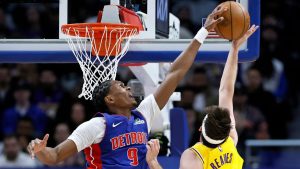
This is Part 1 of a two-part series on the 10 trends worth noting from the Toronto Raptors' 2022-23 season. For thoughts 6 through 10, click here.
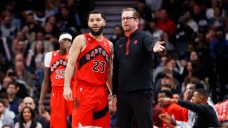
1. What do the Raptors do with Fred VanVleet?
As far as contract years go, this wasn’t ideal. Fred VanVleet shot a career-worst 34 percent from deep, and while it’s too simplistic to pin narrow losses solely on just him, VanVleet's shotmaking was missing in important moments.
There’s the Hawks game lost in overtime where VanVleet shot 4-for-18. There is a loss to Boston by one possession where VanVleet was 3-of-14. In a loss to Philadelphia, he shot 3-for-15 including whiffing on two wide-open threes in overtime. There was another 3-for-15 as the Raptors collapsed in the fourth against the Pacers. VanVleet went 3-for-9 in an embarrassing meltdown to the Lakers, after shooting just 4-for-12 in a narrow loss to the Clippers two nights prior.
Down the stretch, there was the 7-for-22 performance in a must-win game against the Pacers at home, a 5-for-17 showing in Philadelphia, and a combined 5-for-25 in the two-game spanking in Boston which effectively sealed their fate in the play-in, where VanVleet started strong but shot 1-for-6 in the fourth quarter as Toronto collapsed for the final time in fitting fashion.
To be fair, there were also stretches of positive play. VanVleet posted career highs in two-point percentages and assists, with the latter bumping to 8.6 dimes with Jakob Poeltl’s introduction to the starting lineup.
Having a genuine pick-and-roll partner to pair with helped VanVleet’s game more than anyone else in the group, and it gave the Raptors a secondary option to play through on offence besides clearing out for Pascal Siakam. It also eliminated the games where VanVleet was relegated to catching and shooting, which on paper seemed like a strength for him, but in actuality, it led to some alarmingly empty stat lines (2-for-9, 0-for-11, 1-for-8, 1-for-9).
VanVleet’s impact metrics also remained strong despite the missed shots, and the Raptors were plus-195 with VanVleet on the floor to lead all players. That outlines the team’s need for VanVleet’s position – a lead playmaking guard who can run pick-and-roll, collapse the paint for kick-outs, limit turnovers, and launch threes at a high volume.
But this also meant that the Raptors were living and dying with VanVleet’s success in this role, and more often than not he came up short.
Ideally, the Raptors would upgrade, but it’s not even easy to find a replacement. There are no in-house solutions if VanVleet were to move on in free agency, as he hasn’t had a viable backup in two seasons, nor would it seem wise to lean further into the “Vision 6-9” strategy of playing without guards.
A sign-and-trade is possible, but if any other market is looking to bring in VanVleet, it would be to upgrade their own shortcomings at point guard, therefore the Raptors would only be offered discards in return. That’s why re-signing VanVleet has always been the most likely outcome, although agreeing to the right number would be difficult.
VanVleet stated on the record in December that he did not decline a four-year extension worth $114 million, as it was agreed from both sides to circle back after the season, but there is a real danger in going much beyond that figure. It might be a fair figure considering that the Raptors have no other options, but the real question is whether any other team values him at that figure because otherwise it becomes a bad contract.
If there’s any possibility of keeping the term shorter to mitigate risk, it would be for the best. The alternative to retaining the asset would be to just let him walk, but that is the main reason why the Raptors are in this predicament of being short on talent in the first place.
2. Scottie Barnes didn’t break out, so now what?
The team’s plan coming into the season was for Scottie Barnes to take the next step after winning Rookie of the Year, but it was quickly apparent that he wasn’t ready. Siakam suffered an injury nine games in, while VanVleet was noticeably taking a step back to allow the offence to flow through the wings, and so it fell to Barnes to step up.
But in those eight games where the number one role opened up, Barnes shot 39 percent from the field and averaged 14 points. More importantly, the numbers don't capture the lack of intent from Barnes, who remained as a passenger while others (VanVleet, O.G. Anunoby, and even Dalano Banton) took the reins.
Barnes settled in more comfortably in a tertiary role once Siakam returned, but his aggression became the focal point once again in December when teams started ignoring him on offence by having their centres drop deep into the paint.
Barnes eventually solved that coverage and it actually coincided with the stretch of the season where he was most involved offensively, but the arrival of Poeltl bumped Barnes back to the wing where he was in and out to finish the year. Similar to his rookie year, he would show stardom but only in flashes, leaving us wanting more.
Barnes ended up with strikingly similar numbers to his standout rookie campaign, but celebration gave way to criticism. Before the season even began, Nick Nurse begged Barnes to show the same enthusiasm as he did as a rookie, and repeated it a month later during his slow start, urging him to not treat it like a job.
Nurse also strangely benched Barnes for a game in favour of Juancho Hernangomez, and Barnes struggled to hide his displeasure afterwards. That same week, Masai Ujiri flew out on the road specifically to meet Barnes 1-on-1 to deliver “hard truths,” as reported by Michael Grange.
Thad Young speculated about the sophomore slump, then had an altercation with Barnes after halftime warm-ups in January. Barnes settled in from that point onward and found ways to contribute positively in a variety of different roles, but rarely as the leading man.
And while Barnes is quick to point out that he contributes in other ways besides scoring, that is the area of growth that is most commonly stressed by both the organization and the fans. The Raptors were crying out for another scorer all year and Barnes always has the green light. Until he makes that jump, the franchise will be stuck in the same spot.
From the moment he was drafted fourth overall in 2021, there have been hints of subsequent moves to free up Barnes.
The two most commonly discussed options remain cutting bait with VanVleet who currently plays point guard, or trading Siakam to free up space in the frontcourt.
Restructuring may happen down the line, but Barnes needs to find his aggression first and foremost. Currently, Barnes’ usage and efficiency drop with either VanVleet or Siakam off the floor, so it’s not a case of him being held back, rather he is being helped by the current structure.
Barnes has all the tools to be a great player, and has shown higher highs than any other player on the roster. But the hope from everyone involved is that his game evolves above the level of the team’s current leaders to force the hands of management to restructure as needed.
Right now, subtracting talent just to elevate him won’t accelerate the process, it will only make the task of improvement even more difficult.
3. Pascal Siakam can’t be the only star on this team
The standout performer on the Raptors was clearly Siakam. Even though he didn’t reach his starry standards of becoming a top-five player, Siakam did the best he could throughout the season to prop up the roster both on and off the floor.
He was mostly consistent outside of going limp in the Raptors’ final western conference road trip, and was excellent in the play-in game with 32 points, nine rebounds, and six assists to lead the team. The highs of the season were Siakam’s career-high 52 points at Madison Square Garden, and when he made the All-Star team as an injury reserve.
On a team bereft of scoring, Siakam was the one player who could generate advantages for himself and others. After another dedicated offseason regiment, Siakam found more ways to get to his spots on the floor, and while his momentum faded a few months in, he was still clearly a cut above his teammates.
Siakam is the only player who consistently creates downhill pressure, making 14 drives per game ranking behind only Giannis Antetokoumpo and Jimmy Butler for tops among forwards, and he also took almost twice as many free throws as the next closest Raptor.
The limiting factor with Siakam, however, is the lack of three-point shooting. With such high usage in the midrange, there becomes an artificial cap in efficiency which was a similar problem that DeMar DeRozan ran into.
For all his efforts to improve, Siakam has been a 32 per cent three-point shooter on low volume for three seasons running after topping out at 36 per cent on six tries per game in 2020. That needs to be the focus of his efforts moving forwards since he’s mastered most of the space inside the arc.
The other growing concern is that Siakam has a track record of tailing off in fourth quarters. In crunch time scenarios dating back three seasons, Siakam is shooting less than 40 per cent and particularly struggles with three-point shooting and free throws.
That might be a function of him leading the league in minutes during that time, but it is an important missing piece that ultimately limits the Raptors who suffered enough fourth-quarter collapses to fall into the play-in. Siakam isn’t a singular figure who can carry the team night in and night out, but there are at most a dozen players who fall into that category.
The verdict this summer is simple: Barring an unforeseen blockbuster trade offer, extend Siakam with a full term especially since it’s very unlikely that he will qualify for the supermax. The harder part is finding another player of his calibre to split the load with.
4. O.G. Anunoby is pretty good, but what more is there?
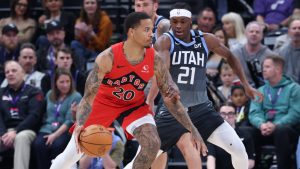
The pattern with Anunoby has become routine. It’s plain to see that he is one of the best individual defenders in the league – deserving of All-Defensive honours even though he isn’t able to carry an elite defence by himself – and he is efficient on offence when he is being set up to score.
The overused 3-and-D label is too reductive to account for the full scope of Anunoby’s contributions, but it does highlight the most important aspects of his game. He is a seamless fit and vital for any playoff team, and at least for one more season, his contract is easy to trade for which is why his name will keep coming up in trade talks.
Much of this was already known before the season started, but the question remains if he can and if he wants to do more. He shows flashes of being able to create his own offence, but the overall metrics remain poor.
In isolations, Anunoby shoots 32 percent. As the ball handler in pick-and-roll, he is at 37 percent. On drives, he improved as the year went on but settled in at 41 percent with twice as many turnovers as assists. And when he pulled up for jumpers, his effective field goal percentage was a paltry 41 percent.
On paper, there aren’t the makings of a star player who can initiate and create for others effectively, and the limitations remain the same.
His loose handle and lumbering movement don’t allow him to create separation on the perimeter, nor can he burst through gaps and explode at the basket, although there is still room to improve in reading when and how to attack. There’s no reason for a player of his size and athleticism to be blocked as often as he does.
Every team in the league would be thrilled to have Anunoby as a supporting player, but is he content with that?
Anunoby is careful in interviews to speak around the subject, but rumours last summer suggested that he wants a bigger role and Nurse confirmed as much.
Even though the star leap didn’t come, he did quietly make improvements throughout the year. In the second half of the season, Anunoby played more as a shooting guard by taking Gary Trent Jr.’s spot in the starting lineup, was featured in a handful of games in leading the second unit, and showed more patience in his overall approach which led to more efficient metrics, most notably by reducing turnovers.
More importantly, Anunoby was much healthier than last season and only missed time after a hard landing which left him with a wrist injury. The Raptors might cash out this summer and still get three late firsts from a contender, or prepare to extend him next year and ride out his development.
Odds are, they’ll do the latter.
5. Jakob Poeltl fixed a problem, he didn’t fix all the problems
It seems almost absurd that the Raptors spent the better part of the last three seasons compromising every night.
Without a playable center in the middle, the Raptors had to constantly invent fluky schemes to cover for one of their wings checking a bigger player, while rim protection and defensive rebounding were obvious areas of weakness.
It was exhausting and nobody wanted the role full time. Bringing in Poeltl was welcomed by everyone, even though the timing and direction of the move was too little too late.
Poeltl excelled at fitting in. It took just three games for him to break out with a 30-point effort on 15-of-17 shooting, and while he was never a volume scorer, he was reliable, efficient, and disciplined in the paint. Poeltl also found the nuances of setting screens which made life easier for VanVleet, Barnes, and Siakam, and was a nifty playmaker in the high post even though the Raptors didn’t feature him unless it was a necessity.
Defensively, Poeltl spoke repeatedly about the contrast of shifting between San Antonio’s conservative scheme of dropping back and limiting fouls, to the polar opposite in Toronto where pressure on the ball and double teams were encouraged.
For the most part, he found the right balance, although in key matchups the Raptors still opted for Anunoby against star centers (Anunoby took the assignments on Nikola Jokic, Joel Embiid, and Anthony Davis), and Poeltl was lacking in the play-in game.
Having invested a top-six protected pick in Poeltl, it’s imperative that the Raptors retain him in free agency. The market for centres is fairly weak, so anything over $20 million per year would be a surprise.
And while it was also surprising that the front office invested a first-round pick instead of tanking while sitting at four games under .500 at the deadline, Poeltl on a fair deal should be able to bring back a first if the Raptors were to pivot in that direction down the line.
It would be nothing short of a disaster and complete mismanagement of assets if Poeltl were allowed to walk.