Here are 10 takeaways on the Toronto Raptors' seven-game road trip ahead of the trade deadline.
1. Toronto went 4-3 on their longest road trip in 15 seasons, and return home five games under .500 ahead of the trade deadline. Their best performance came against the Sacramento Kings, where they showed their potential as a disruptive defensive force, coaxing All-Star center Domantas Sabonis into a career-high nine turnovers.
But that togetherness dissipated by the very next game in Golden State, who scored 10 open layups in the first quarter alone. Toronto managed to stay within striking distance against the Warriors, but their defense was never set and so the chase was futile.
The same pattern played out in a loss to Utah, where they gave up 131 points. Phoenix didn't have the same firepower as Utah and Golden State with Devin Booker missing, but they still managed to edge ahead by one possession in the end thanks in large part to Deandre Ayton and Mikal Bridges, who the Raptors had no answers for.
Wins over Memphis, Portland, and Houston were notable, but hardly impressive. Memphis is in the midst of a 1-8 collapse and were without three starters, Houston is tanking to a degree that renders them unwatchable and they were also without their backcourt, while Portland is very much a one-man team.
Toronto sits 2.5 games back of the fifth-best lottery odds, and 2.5 games back of the eighth seed in the East. The front office was on hand for the trip, along with scouts from various teams, as is standard ahead of the trade deadline.
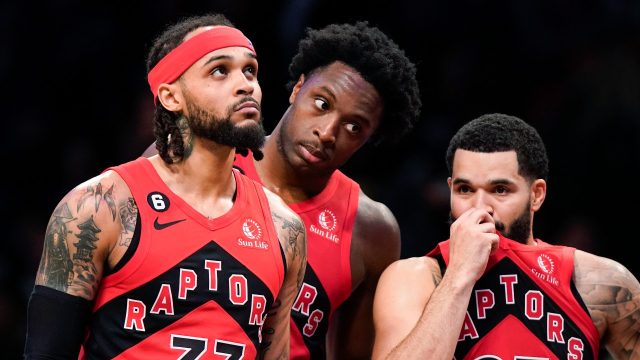
The prognosis for this season is simple: Even if the Raptors come together and pull off a run, their ceiling is a first-round exit. The harder question is on the viability of this core in future seasons. Pascal Siakam is the present, and Scottie Barnes is the future; are OG Anunoby, Fred VanVleet, and Gary Trent Jr. the right pieces to bridge that gap?
2. One trend that eludes stats is very obvious when you see them up close: The Raptors have a bad habit of not playing together. Some players are more guilty of it than others, but the problem is endemic. Trent Jr. stands out on the offensive end, where he refuses to make the extra pass.
It was trivial in the win over Houston when Trent Jr. didn't feed Malachi Flynn for a wide-open layup and instead held onto the ball for the intentional foul, but it was costly against Phoenix where twice he failed to find Siakam running the break in a game that came down to one possession. VanVleet and Siakam routinely stop the offense, and while they create the best advantages, they are also the leaders who need to instill trust in the team.
Chris Boucher was literally hopping mad that he didn't receive a pass against Memphis, and Barnes is especially expressive when the pass doesn't get to him, or if others don't make the play he wants off his passes.
Defensively, the issues are harder to spot but there are subtle breakdowns everywhere. VanVleet reamed out rookie Christian Koloko for not helping on a driver that sped right by him at the point of attack. Siakam gave up three and-ones in being late on rotations against Memphis in a game where he battled foul trouble, while Lauri Markannen beat him three straight trips when he fouled out in Utah. Boucher is routinely lost on rotations, Thad Young is too slow for the wing and too undersized in the paint, which left Barnes and Achiuwa doing most of the heavy lifting.
3. Siakam is clearly exhausted after practically leading the league in minutes in two straight seasons. There was an ebullience about his game to start the year, where he consistently beat his man either with the midrange jumper or with incisive drives to the basket that produced baskets, fouls or assists.
At that point, he was a shoe-in for All-Star and there was still optimism in the season. But of late the signs of fatigue are everywhere. His free throw percentages are down and his three-point shot has abandoned him, the midrange jumpers aren't falling with the same regularity, and his drives are being rounded out by even mediocre defenders.
Defensively, he was stellar in the Kings game as with everyone else, but a minus in the remaining six games. Even his body language is slumping, both during games and in media sessions. The silver lining to missing All-Star is that he can relax and get away for a week to rest, but the bigger concern for both coaching and management is to find a consistent second option to split the load, otherwise, the best of Siakam won't last through an entire season, especially when he is being asked to play both ends of the floor.
Other one-man acts like Luka Doncic, Trae Young, Damian Lillard -- they at least take possessions off on defense. Any notion of trading Siakam, however, would be choosing to return to the dark ages.
4. VanVleet was the Raptors' best player on the trip, averaging 23 points, six rebounds, eight assists, two steals and a block. Since his slow start (which VanVleet attributed to injuries, role changes, and open shots not dropping), he is averaging 22 points, five rebounds, seven assists and shooting 43/36/94 in his last 25 games which rivals his numbers from when he made All-Star last season.
To the point of role changes, the Raptors are clearly restored VanVleet's license to run pick-and-roll instead of waiting off-ball, and entrusting him to create rather than just finish. As such, when the Raptors are down which happened against Utah, Houston and Memphis, VanVleet clearly feels a responsibility to jumpstart the team.
That drive comes from the right place, but it does lead to stretches of ball dominance which leaves the team living and dying on VanVleet's playmaking which can come and go. The right balance would be for VanVleet to only take over as needed, which he clearly can do at times but it isn't a reliable strategy to depend on.
In any case, his return to form is a win for everyone. For VanVleet, he distances himself from the premature rumors of his decline and has restored his averages heading into the most important free agency summer of his career. For the Raptors, they can either choose to bet once again on VanVleet, or move him for value at the deadline. If they decide to move on, the Raptors absolutely need to bring back a playmaking guard in return because they are already in short supply on this roster.
5. OG Anunoby's absence was untimely. Anunoby landed hard on his wrist after an ambitious drive to the basket against Golden State, and while the fall was violent and Anunoby is sporting a brace, Nick Nurse expressed surprise at the decision to sit him for the remainder of the trip.
He would have likely made the difference against Phoenix, where Bridges was allowed to run free shooting over a much shorter defender in VanVleet, and Anunoby would have been the primary assignment on Markannen in Utah. There’s never any question of Anunoby’s contributions towards winning, as his three-point shooting and diligence on defense fit anywhere which is why half of the playoff picture is sniffing around on his availability in a trade.
But the questions are if Anunoby is happy to buy into a role, and what the best offer is on Thursday. The Raptors should settle for anything less than one young starter and two picks. In 18 months, Anunoby will be slated for a raise of double on his current rate of $18 million, which can only be justified on a playoff contender, or if he finally makes a leap to being able to create offense for himself and others which he currently does at one of the least efficient rates in the league.
6. Achiuwa is ready for a bigger role, but what will that role be? His rebounding, defense, and athleticism in the open floor is the best on the team, and he’s made his case once again for a starting position that currently isn’t open. Dealing one of Anunoby, Trent Jr., or VanVleet likely changes that, but the Raptors will need to be decisive on Achiuwa’s future. Is he a forward or an undersized centre?
That’s been the conundrum with Achiuwa ever since college where he was shifted from the wing to the paint in James Wiseman’s absence, and that compromise continues in Toronto where there wasn't a 7-footer to begin with.
Achiuwa has done well in that role because he buys in, but his time as a five feels like a compromise, just like when Barnes plays there, even if it is where he is most effective. Achiuwa's move to the wing, however, would need to coincide with a return of his three-point shot.
The spacing with him at centre is already woeful since Achiuwa refuses to take the open look, and it's actually leading to more spot-ups for Siakam and Barnes who themselves are not reliable from deep. Adding a center into that mix just makes it even more cramped for everyone. This is a consequence of Toronto's team-building strategy of stacking athletic forwards with the idea of teaching them perimeter skills.
7. The same questions can be asked of Barnes, who is very much a player that appears in flashes. His fourth-quarter takeovers are encouraging, but he clearly isn't that player on a consistent basis, and the challenge of development will be to help him find consistency. His role on offense changes regularly, but the invitation to be aggressive is always the same. Barnes averages 5.8 drives per game, which ranks fourth behind Siakam (15.2), VanVleet (14.0), and Anunoby (7.4) on the team, and 113th overall in the league.
When he makes his mind up and determines that he will get to his spots, Barnes looks almost impervious to defenders as in the case where he made two shots over Defensive Player of the Year frontrunner Jaren Jackson Jr. to complete the comeback. His overall team play is good, where his passing, screening, rebounding, and defense are already clear positives but the team needs him to do more, and to be aggressive consistently.
8. The problem with the bench remains the same. The individual pieces are fine, but they don't work without a bench guard who can run the offense. Young is useful so long as is involved in the play, whether that's in pick-and-roll or in the post. Boucher is a sparkplug who erased slow starts by the starters in all three games, and he contributes too much to be yanked after one or two mistakes.
The second unit has looked fine when someone takes the initiative to carry them forward, like when Barnes seized the reigns in the fourth quarter against Memphis. But what the Raptors truly need is a playmaking guard who can carry that duty for the second unit, rather than having to rely on a starter to extend himself.
Malachi Flynn struggles to generate advantages with the ball, and while he can knock in a catch-and-shoot three, he is a net negative overall. Dalano Banton is still more theoretical than he is an actual contributor, and while he has the excuse of sitting out with injuries and spending time in the 905, the bottom line is that he saw two minutes on the trip and in those two minutes he made five mistakes to spark a run for Houston.
Christian Koloko has a case for more minutes, but he is very much a prospect who needs to bulk up to do the bare basics like holding his position. Juancho Hernangomez means well and plays unselfishly, but is it really sacrificing if there's nothing to give in the first place? Khem Birch never sees the court and is strictly there as a salary.
9. Nick Nurse hasn't been perfect, but the shortcomings of the team cannot be solely pinned on him. This roster has two playable guards, two and a half creators with the half being when Barnes is in the mood, three shooters, no seven-footer and no bench. In the bigger picture, his options are to ride the starters and risk burnout (which has happened in both seasons; last year with VanVleet and this time with Siakam) or to risk the bottom falling out when he extends the rotation.
Zooming into the details, and there are clearly some mistakes like the timeout fiasco against Boston, subbing in an all-bench group in Phoenix, or just generally poor preparation to start games with the team trailing early, but you can find examples with every team. His creativity in changing defensive schemes also seems to be dulled, not only because the league has also adopted many of the same moves, but because so often the Raptors don't play hard for the strategy to even matter.
The biggest takeaway for Nurse is to give more defined roles before the season, and to hold players accountable to those expectations. Barnes and VanVleet never looked comfortable to start the year which were the first dominoes to fall this season.
10. The Kyrie Irving trade likely has little direct impact on Toronto's business. It was perhaps the quickest trade saga involving a superstar, as Irving demanded a trade on Friday, and was shipped to Dallas by Sunday. The return on Irving speaks more to his inability to avoid controversy than anything else, and Dallas was always unlikely to strike a trade involving the Raptors' players. Toronto should once again hold the most appealing trade targets ahead of the deadline, and there is clearly a robust market for point guards with both LA teams and Phoenix being desperate.