The 2026 NBA trade deadline has officially come and gone.
With the dust finally settling after a turbulent couple of days, we've reached the part when goodbyes can begin, bags can be packed and deep dives can get underway.
It was an interesting spree of wheeling and dealing around the league to say the least, with the prevailing theme being that of "pre-agency."
Players on expiring deals were swapped en masse, with teams either hoping to negotiate new contracts before the off-season or simply looking to clear their books for bigger moves in the summer. And speaking of money, we saw the number of franchises operating above the luxury tax line drop from 14 to eight, with only three teams remaining above the first or second apron (CLE, NYK, GSW) compared to the six that entered the deadline frenzy.
Shedding salary and maintaining financial flexibility appears to be the name of the game under the league's current CBA.
In any case, when there are deals, financially motivated or otherwise, there are naturally winners and losers. So here are some of the teams that stood out.
Winner: Cleveland Cavaliers
It's not often that a win for a billionaire owner's cheque book is also positive for a team's on-court potential.
But the Cavs' front office threaded the needle well this deadline by adding impact pieces like James Harden (who presumably gets to keep his 16-year playoff streak alive), Keon Ellis and Dennis Schroder, while shedding long-term contracts in Darius Garland, De'Andre Hunter and Lonzo Ball — all of whom had been under-performing relative to their price tags on a very expensive roster.
Cleveland now gets a trio of players who help plug some holes while shedding nearly $20 million in actual salary, amounting to approximately $100 million saved in luxury tax payments.
All of which came on the heels of the Cavaliers' best stretch of play this season, entering Thursday 10 games above .500 after going 8-2 in their last 10 games and 12-5 since the start of 2026. Vibes could not be higher in The Land right now.
Loser: Golden State Warriors
After weeks (months?) of being a constant presence in the rumour mill, the Dubs got their championship-winning European power forward, but much to the chagrin of fans in the Bay Area, it was Kristaps Porzingis and not Giannis Antetokounmpo (more on him later).
The Latvian centre has looked good when on the court this season, averaging 17.1 points, 5.1 rebounds, 2.7 assists and 1.3 blocks, and would offer the Warriors a great blend of spacing and rim-protection they've wanted next to Draymond Green for some time. But there's no guarantee we see that pairing anytime soon or all that often as Porzingis continues to navigate his POTS, an autoimmune disorder that's kept him out for all but 17 games this season and 13 straight.
All the while, he's owed $30 million this season before unrestricted free agency in the summer.
Even if the Warriors retained Porzingis on a more cost-effective deal, acquiring an oft-injured 30-year-old as the centre-piece return for Jonathan Kuminga, who's seven years younger and under team control next season, feels like a less-than-stellar return for the team's lone trade chip (that they held onto far too long).
Winner: Washington Wizards
The NBA is always full of surprises, but the DMV ball club being buyers at the deadline was still out of left field even by usual standards.
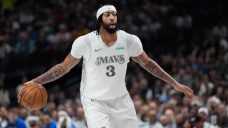
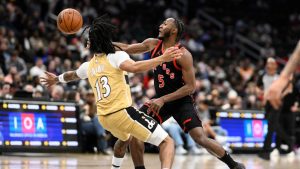
Still, seeing how little it cost the Wizards to add a pair of multiple-time all-stars in Anthony Davis and Trae Young, it's hard to see much downside, even though Washington will need to sort out long-term deals with both.
The Wizards gave up none of their meaningful young players and minimal draft compensation, considering the 2026 first via OKC will likely be low, the Warriors' 2030 first is top-20 protected and three second-rounders don't have much chance of amounting to anything worth losing sleep over.
While there are risks in trying to blend a roster of aging vets and ascending youngsters, not to mention Davis' availability concerns, the Wizards have reached such a point of mediocrity that even the chance of inching toward competitive relevancy is worth commending. Washington hasn't won 40-plus games in seven consecutive seasons and is on pace to make it an eighth.
Fans can only stomach so much losing, and with the additions of Young, Davis and one more lottery pick (should they keep their top-eight protected first this summer), a new era in D.C. might be on the horizon.
Loser and winner: Dallas Mavericks
While there's no need to dunk on ex-general manager Nico Harrison any further since he's no longer in charge, Wednesday's shipping away of Davis — the centre-piece return for Luka Doncic — allowed us to put a bow on the most bizarre trade in NBA history.
Dallas ultimately gave away a perennial MVP candidate in his prime for 29 games of Davis, Max Christie, salary filler, three presumably non-lottery firsts and three seconds.
Thankfully for Mavs fans, Rookie of the Year front-runner and No. 1 pick Cooper Flagg did fall into their laps along the way, so if there's a glass-half-full point of view to consider, it's that all of Dallas' attention will be on him now — with a couple more picks and a lot more cap space to flesh out the roster.
Winner: Utah Jazz
Similar to Washington, fans in Salt Lake City have been subject to copious amounts of losing in recent years and building through the draft hasn't amounted to much.
With the addition of Jaren Jackson Jr., who's under contract for at least three more seasons after 2025-26, the Jazz have secured a well-established frontcourt rotation — bolstered by a former DPOY, who'll surely help the NBA's worst defence — for the present and future without emptying the war chest.
Although Utah gave up three first-round picks, only one of those was their own to begin with, and two of them are for 2027, which is projected to be a weaker class. Meanwhile, adding Jackson likely won't stop the Jazz from pursuing their top-8 protected first this season (a much stronger class), and adding another top prospect to the mix.
Loser: Anyone hoping for a Giannis Antetokounmpo trade
It turns out the big fish is staying put in his pond.
And while that's disappointing for folks who would've liked to see the saga finally come to an end, it was probably the right choice by the Milwaukee Bucks.
By all accounts, the packages being offered for the Greek Freak were somewhat underwhelming, considering we're talking about a two-time MVP, averaging 28.0 points, 10.0 rebounds and 5.6 assists, albeit while navigating injuries.
And with Antetokounmpo under contract till at least the end of next season, there was no reason for Milwaukee to settle for anything less than a top-end prospect and a haul of picks. So, by waiting until the summer, the Bucks can see how situations shake out for teams around the league and wait for sweeter offers to arrive — after teams unlock more pick equity in the off-season.
And who knows, maybe Antetokounmpo really is as loyal as he says, and Milwaukee remains his NBA home for the rest of his decorated career (he says with a shudder).
Co-winners: Indiana Pacers and Los Angeles Clippers
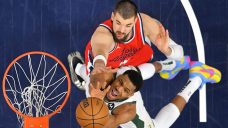
It's no secret Indy has been after a centre ever since Myles Turner left in free agency last summer, and now they've got Ivica Zubac, who's arguably on one of the best value contracts in the NBA with an AAV of $19.6 million through the next three seasons.
As for the acquisition cost, it's undoubtedly a high-risk, high-reward gamble. Giving up an unprotected first in 2029 is fine and dandy, but the 2026 pick is the key in all this. The first-rounder is protected 1-4 and 10-30, so if it lands in the 5-9 range, the Clippers end up with a potential franchise cornerstone from a strong class.
Right now, the Pacers own the third-worst record, which means they could drop as low as seventh in the lottery, which there's a 47.9 per cent chance of happening. But if Indiana keeps the pick, they'll immediately re-enter contender status next year with a healthy Tyrese Haliburton back in the fold as well.
As for the Clippers, along with the pick equity, they also netted Bennedict Mathurin — who's only 23 and in the midst of a bounce-back season — and can start negotiating a new deal with the Montreal native before his restricted free agency this summer.
Honourable mentions
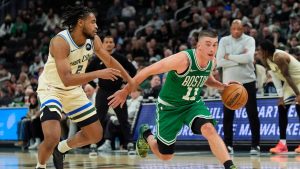
Nikola Vucevic (winner): The 35-year-old is finally free from the shackles of the Windy City and is now in line to make the playoffs for just the fifth time through 15 seasons. The Boston Celtics did well to turn Anfernee Simons, who wasn't part of their future plans, into a starting-calibre centre to bolster a thin big-man rotation. And while he's no defensive stopper, Vucevic can score at multiple levels, rebounds well and is now coached by one of the league's best in Joe Mazzulla, who'll be well equipped to hide some of the two-time all-star's warts.
Sacramento Kings (loser): With a roster that had floundered to 12-40 entering Thursday and an average age of 32.5, first-year GM Scott Perry wound up with nothing more than acquiring De'Andre Hunter in the midst of a career-worst season. And while the likes of DeMar DeRozan, Zach LaVine and Russell Westbrook appear past their primes and hold little value on the trade block, having all of them on the roster past the deadline to cannibalize minutes from Sacramento's youngsters was certainly a choice. Not to mention Malik Monk and Domantas Sabonis, who presumably could've fetched something in return for the NBA's last-place team.
Jared McCain (winner): The second-year guard was a Rookie of the Year front-runner before getting hurt last year, and had fallen further down the pecking order with the Philadelphia 76ers when they drafted VJ Edgecombe. Now, McCain gets a fresh start with the defending champs and will join a bench rotation that can use his particular strengths. While OKC's second unit has the league's best net rating, it's middle-of-the-pack offensively and below average when it comes to three-point percentage. The 21-year-old McCain is a career 38 per cent marksman and joins the Thunder on the heels of shooting 57.7 per cent from deep over his last six games.
The 2018 draft (loser): Even with the best of scouts, picking through a pool of prospects has always been a crapshoot. But even by those standards, the 2018 class will go down as one of the most bizarre examples. With Jackson being traded to the Jazz, the only player drafted in the first round of the 2018 draft that's still with the team they debuted with is Miles Bridges. And even he was dealt on draft night by the Clippers to the Charlotte Hornets in exchange for Shai Gilgeous-Alexander (who was later traded as a sophomore). Mitchell Robinson with the New York Knicks is the only player of the 60 drafted in 2018 that remains with his original team (h/t Keith Smith).