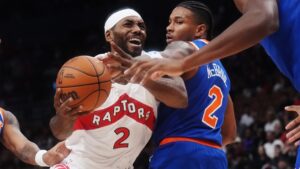
Ja'Kobe Walter was taking driving lessons.
Sabrina Walter, his mother, was his driving instructor.
Not: She took her son driving so he could get some practice in.
But actually: She was a driving instructor, at Prosper Driving school in McKinney, Texas, and her then 16-year-old son was her student, practising for his license.
It was the ultimate test of coachability and the willingness to accept your role.
How did it go? Not bad, not bad at all. There were moments when Walter didn't want to hear exactly what his instructor wanted to say. And moments when the instructor wished the student would nod more and talk less. But they got through it — no small thing as anyone who has experienced the new driver-parent dynamic from either perspective.
Even as a 16-year-old Walter recognized the situation, and made the right read:
“I did what I had to do because I didn’t want to be there any longer than I had to be. I felt like I could drive perfectly fine,” Walter said. “(But) I listened. I kept it simple; I did what I had to do to get out of there. She wasn’t going to let me go otherwise. Two hands on the wheel, speed limit, all that.”
His instructor’s version: “He was teachable. But he would listen sometimes, and then sometimes it was like he already knew everything,” said Sabrina Walter, who did a long list of jobs when her kids were growing up — driving instructor just one of them. “We would be on Lesson 3 out of 7 and it wasn’t going fast enough for him.”
But everyone persevered. Walter took his test with the owner of the school and his mom insisted that he not show any leniency.
And?
“I got 100 per cent on my driving test,” said Walter. “When your mom is your driving instructor, you can't mess that up.”

The Raptors Show
Sportsnet's Blake Murphy and two-time NBA champion Matt Bonner cover all things Raptors and the NBA. Airing every weekday live on Sportsnet 590 The FAN from 11 a.m.-noon ET.
Latest episode
As the Toronto Raptors get ready to take on the Cleveland Cavaliers in their first playoff action since 2022, there is good reason the Cavaliers are heavy favourites.
They have the highest payroll in the NBA; Donovan Mitchell is one of the most lethal scorers in all of basketball, with multiple 50-point playoff explosions to his name; James Harden remains as skilled a half-court operator as ever; Evan Mobley is one of the league’s best defenders; and on and on.
But in addition to having a 3-0 regular-season record against Cleveland to bolster their belief, the Raptors can gain confidence from the way their roster has developed over the course of the season. Sure, the Raptors' fortunes will likely rise or fall on the performances of all-stars Scottie Barnes and Brandon Ingram, but the season-long progression of youngsters such as rookie Collin Murray-Boyles and Walter, the second-year wing from just outside of Dallas, has the Raptors entering the playoffs as the deepest and most versatile version of themselves seen this season.
It’s a welcome development, if a tad unexpected. Murray-Boyles was an unproven commodity out of training camp without a defined position as the No. 9 pick in the draft. And Walter? He was third — if not fourth — among a crowded collection of wings the Raptors had set up to compete for minutes off the bench. He didn’t even start in the Raptors' intrasquad scrimmage at the end of training camp in Calgary, and was DNP-CD (did not play, coach’s decision) in the second and third games of the season.
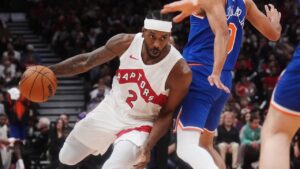
But coming into his first playoff series, Walter has very definitively figured it out. The 21-year-old who shot 34.1 per cent from the college three-point line during his one season at Baylor and 34.9 per cent from the three in his first NBA season has turned himself into a lethal threat from distance. He led all Raptors regulars in three-point percentage on the season at 40.9 per cent, and from the all-star break on, he shot a blistering 47.6 per cent from three, second in the NBA among all players with at least 100 makes.
He’s done it while establishing himself as a legitimately pesky on-ball defender, and a dangerous off-ball bandit. His 73 steals were fourth overall in the Raptors ball-hawking lineup, but when playing time is factored in, Walter led Raptors regulars in thefts with 1.8 per 36 minutes, well ahead of Barnes’ 1.5.
It’s all translated into Walter fulfilling a role the Raptors were desperately in need of filling going as the season got underway: A floor-stretching wing who could make threes and be a plus defensively. Every team needs them — the Raptors more than most, given they ranked 29th in three-pointers made a year ago. If form holds, the Raptors will count themselves lucky to find just such a contributor in Walter, who they took with the 19th pick in the 2024 draft, and the Cavaliers will be lucky when he’s not on the floor.
“We all know he’s been great defensively for us,” Barnes said, as the regular season was winding down and more of his assists were coming off Walter's hand for three. “Being able to put pressure on the ball, turning guys, trapping guys, helping us get out and run, but his shooting is just something that we need on our team, and he’s been on fire. Each shot he takes, it feels like it’s going in and he’s been super important for our team. Sometimes, we get in these ruts where we’re not making shots. But we can count on him to play defence and make shots.”
The irony is that an off-ball, ‘3-and-D’ wing was never a role Walter had played before in his career. He led Baylor in scoring as a freshman, was a McDonald’s all-American coming out of high school and was the best player on his AAU team before that. Even last season with the Raptors very much rebuilding, Walter was getting more opportunities with the ball (his usage rate fell from 18.4 per cent to 14.0 this year) and taking more shots when he had it (from 7.6 per game compared to five) than he has in his second season.
But with the addition of Ingram and pushing for the playoffs an organizational goal, roles shifted this year. Walter adapted seamlessly. It’s a quality his teammates have noticed.
“He’s got this ability to just be a gamer, to have a certain level of competitiveness,” said Garrett Temple, the Raptors 17-year veteran and in-house mentor-at-large. “His ability to take coaching is very old school, and he's very low maintenance. It’s, ‘Yes, sir.' Whatever you tell him to do, it’s, ‘I’m on it.’”
Said Raptors head coach Darko Rajakovic: “He’s a such a great kid and such a competitor, he’s very, very easy to coach, you know? You tell him something one time, he takes that very seriously and he’s trying to apply it right away.”
It’s no small thing. One of the challenges for young players coming into the NBA is recognizing that the game they played with a full heart for all their years has instantly become a job. Which doesn’t mean that the love of the game automatically wanes, or the passion for personal development or goal chasing should stop. Quite the opposite: Standing still in the NBA is an invitation to get churned out of the league as fast as you arrived.
But the job part — which is probably the most relatable element of life in the most gilded league in sports — is that very few players get to play in the NBA the same way they did when they were striving to earn one of the 450 regular roster spots league-wide, or exactly how they want to play. That’s some of what is bundled into ‘figuring it out’ — the catch-all phrase that so often summarizes young players adapting, or not, to NBA requirements.
For Walter, it was baked in.
“It’s the way my parents raised me,” he said. “I’ve always respected people that have authority over you, and was kind of listening all the time, and I think that's kind of made me the player I am now.”
Of all the skills that can get a player into the NBA, the one that can be make-or-break as far as them cracking a roster or staying on the floor, being coachable is near the top of the list. Walter has never not been an elite basketball prospect. He was AAU teammates with Bronny James of the Los Angeles Lakers and Ron Holland of the Detroit Pistons, among other big names. And like any teenager, he remembers the thrill of seeing his highlights coursing out across social media. But somehow as he made his way through the ego-driven gauntlet of elite youth basketball, Walter was able to recognize that a team game didn’t automatically revolve around him.
George Clay thought he was done with coaching summer basketball until he saw a pick-up run where a skinny Grade 9 kid was, in his words, "doing special things." He introduced himself to Walter's mom, Sabrina, and his father, Eddie Walter. They hit it off, and Clay ended up coaching Walter for three summers.
"Ja'Kobe was always a kid that could impact the game without having to score," said Clay. "Now, he was a heck of a scorer, don't get me wrong. But he knew he could do other things, whether it was shutting down the other team's best player, and even as your best player, he's the one diving on the floor for a loose ball, getting a steal or an extra possession. He took a lot of pride in all the areas of his game, versus feeling like — even though he was our best player — feeling like he had to act like that. He did all the little things that kind of mattered and helped us win.
"It's very, very refreshing to have a guy that knows that there's more to basketball than scoring a bucket, right?”
For Walter, there was never much of an option. His father, Eddie, played NAIA basketball at Birmingham-Southern, in his hometown of Birmingham, Ala., though judging by his shoulders, you might have guessed Division 1 football. Shake his hand and you’re thinking if rock-crushing was a sport, he’d be good at that.
“He a definitely no-nonsense guy, you know,” said Clay, who remains close with the Walter family. “Great guy, one of my close friends, but definitely no-nonsense.”
He was Walter’s first coach, and his first lessons weren’t that complicated: “I’m all about defence, that’s just me,” said Eddie, who set the school record for steals at Birmingham Southern, and works as a utility repairman since he moved to the Dallas area after university. “And be the best teammate you can be and always try to make the right passes. That was me growing up, and I wanted to instill that in Ja’Kobe."
The other? “Don’t be complacent. Don’t just go the gym, stay in the gym and work on your craft.”
Message(s) received. One of Clay’s preferred memories of Walter came at the end of their AAU run together at the Adidas circuit championships. They were playing in a closed gym with no college coaches on hand and, in any case, Walter had long ago signed with Baylor. There was nothing at stake other than bragging rights. And yet Walter was throwing himself around, diving on the floor, drawing charges and imploring Clay to press to make up a 15-point deficit before he hit the game-winner.
“I mean, he's just a competitor,” said Clay. “And I think that's the one thing that everybody started seeing about him.”
Walter remembers the game, but to him it’s not that noteworthy. Why wouldn’t he play that way? It’s his way. It’s only now that he’s been able to see it how others do.
“You know, I’ve never understood until, probably — truly — this year,” he told me. “But I’ve always been a player that played hard no matter what the situation was, and I really don’t know how to play a different way. I feel like I play the game to win, regardless, so I don’t ever have to put myself in that mindset of playing hard. When there’s a loose ball, obviously you’re supposed to go get the ball. For me, there’s never been anything else. You put your body on the line, you take the charge, dive on the ball and play defence. So that has pretty much helped me to where I am right now. I feel like that mindset alone got me very far in my career.”
The beginning of this season was the first time Walter’s approach didn’t seem to be delivering the results he’d come to expect for himself. Even when he started getting some playing time, it was coming in dribs and drabs, fits and starts. Over a two-month stretch early in the season that included seven games starting in place of a then-injured RJ Barrett, Walter struggled to find a rhythm. He had company in that respect — Gradey Dick or Ochai Agbaji hadn’t exactly taken the job by storm either. Through Jan. 1, the trio was collectively shooting 30 per cent in 53 shared minutes per game.
It wasn’t exactly how Walter envisioned his second season unfolding. But he didn’t overreact. He stayed steadfast in his habits — Walter looks for opportunities for extra work in every crevice of the schedule, routinely staying late after practice or shootarounds on the road, or coming back later in the day or evenings when the Raptors are at home. He aims for 1,500 made threes per week. And his pre-game routine doesn’t vary: Sixty made threes off the catch and 90 off movement, with special attention paid to his balance and footwork. And he also took a step back to consider the context.
“I was talking with coach Jimbo (long-time Raptors assistant Jim Saan, who oversees the Raptors development program) and he was telling me about working with dudes like (former Raptor and now Miami Heat all-star) Norman Powell, and how (Powell) didn’t have everything given to him and he wasn’t the player then he is right now,” said Walter. “But that he would always stay consistent and keep working. And after hearing that, I did a little bit of research, looking at different players and how their careers went, and they weren’t always the players they are now, you feel me? And when you understand the league, you know it made sense in my head.
“When you come in as a young guy, you’re not always going to have that role (that you want), so you have to do the little things. And when I changed that mindset, I never really had that bad feeling about going to the games, or I never really got down on myself, because I just understood that this is part of it and it’s all going to come around.”
But Walter hedged his bets. A 21-year-old millionaire has a lot of options to consider with a week of vacation staring him in the face, but Walter wasn’t tempted by any of them. During the all-star break, he headed home to McKinney and put himself through full days of workouts at his old high school with Clay. Shooting, conditioning, weightlifting — no steps were skipped.
His efforts didn't go in vain. Just before the all-star break, the Raptors had traded Agbaji and shortly after that, Dick fell out of what was becoming a tighter rotation after the all-star break.
Walter's climb up the depth chart was complete.
Over the last 15 games of the season, Walter averaged 26.6 minutes per game of almost exclusively positive basketball. He shot 53.8 per cent on more than five threes a game, but just as important made only eight turnovers while accumulating 16 steals, and did it against the best competition.
The Raptors lost on the road against the surging Boston Celtics on April 5, but Walter — starting with Immanuel Quickley sidelined at the time with a foot injury — finished with 16 points, was 4-of-5 from three and had two steals, one each from Celtics stars Jaylen Brown and Jason Tatum. Those who know him best suggest that Walter eventually emerging from the pack and earning his way into a crucial role for the Raptors wasn't a matter of if, but when.
"Anytime there's a competition, I'm putting my money on Ja'Kobe for those minutes," said Clay. "So it doesn't surprise me at all because I feel like if there's fair competition, he'll win."
It's all made for an exciting spring for the Walter family. Walter's older sister, Nikira, will graduate from her Master's program in statistics from Columbia on Sunday, May 17, so if the Raptors happen to have a playoff game that day, his mom and dad will have to miss it. A good problem to have. But they'll be there this Saturday as their son makes his NBA playoff debut, eager as everyone else to see how the Raptors match-up against Cleveland.
It's a special feeling seeing your child succeed in any context, carrying the values you tried to infuse them with on the brightest stages. The Walters are doubly blessed in that respect, and although they'll acknowledge that while they can trace where their son's basketball acumen comes from, having a daughter poised to pursue a PhD in math is something that falls more into the 'your kids can surprise you' category.
But having seen enough of both of their kids' progress over the years, that their son has arrived in this place — succeeding in his role, even if it's not the role he was accustomed to before stepping into the NBA — isn't something he could have envisioned.
"That's what he does, this is him," said Sabrina of her son's ability to adapt and thrive. "At some point or another, he's going to excel like he wants to, and we want him to. But I don't worry about it. For sure I don't, because that's just how he is."
Take it from Mom, take it from his former driving instructor: the Raptors' young wing is licensed to drive, and driven to succeed.


 1:09
1:09